Some deliveries may take a little longer than usual due to regional shipping conditions.

DOWNLOAD THE APP


Customer Services
Copyright © 2025 Desertcart Holdings Limited
DOWNLOAD THE APP

🎞️ Digitize your past, shine in the present!
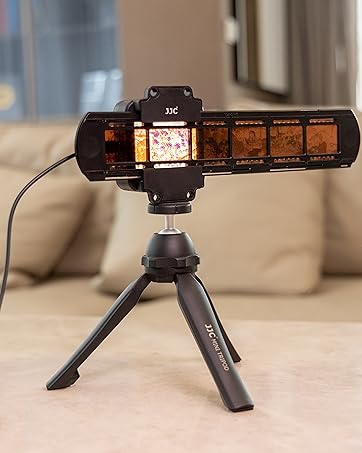
The JJC 35mm Negative Film Scanning LED Light Set is a professional-grade tool designed to convert old 35mm film negatives and slides into high-quality digital images. Featuring 42 ultra-bright LEDs with a 95+ color rendering index and 6500K color temperature, it ensures accurate color reproduction. The set includes slide and strip film holders, a 10-level brightness remote control, and versatile mounting options for tripod or flat surface use, making it an affordable, easy-to-use solution for preserving vintage photos.














| ASIN | B09NKVJ7Y5 |
| Best Sellers Rank | #178,046 in Office Products ( See Top 100 in Office Products ) #85 in Slide & Negative Scanners |
| Customer Reviews | 4.1 4.1 out of 5 stars (186) |
| Date First Available | December 13, 2021 |
| Item Weight | 9.6 ounces |
| Manufacturer | Jinjiacheng Photography Equipment Co.,Ltd. |
| Product Dimensions | 6.1 x 2.8 x 3.57 inches |
P**B
Good value
I've looked at other solutions from Canon & Nikon and had sticker shock. While I'm sure they are very well made, I just could not justify the cost. Yes, this is mostly made of plastic but it's a far cry form the $300-$800 setups I found people using on the internet. The light source works well and is very convenient by comparison to the other kluged-together setups I tried first. I will say you will be well served by rigging some sort of support system as this does extend out quite far from the camera and has the tendency to sag. This can be done at the hardware store or at the camera store. Luckily for me I had some old DSLR video rig hardware laying around and was able to put together a very stable rig. By no means do I think you need to buy all this stuff. I just happened to have it so I used what I had. You could probably put something together with some scraps of wood. It might not be as cool looking as my rig but you just need a way of supporting the setup. The other thing I discovered that will be true of any hardware you use is that processing the resultant files is not a one click endeavor. I won't delve too deep into the details but the reality is that different films will need different processing. Slides will clearly be much easier than negatives. I found a piece of software called Negative Lab Pro that seems promising. I have not used it yet but there is a free trial you can download to make sure it's worth the extra money. I've heard that Nikon has a software solution for some of their higher end cameras but I shoot Canon so… Good luck everyone
J**N
Excellent accessory to scan films, affordable and dead simple
The device is simple as pie. Instructions are clear and simple with a large leaflet with detailed drawings. You choose the correct ring for your lens, attach the hood and then take the film holder and put the film inside. Then you slide the holder into the dedicated wood which is itself attached to your lens and there it is. I just had to put a flash light in front of the lens (the hood) to lit the film. I could scan hundred of my old films from 30 years ago. I used a free desktop app called Grain2pixel to convert the negative to a positive colour corrected image. On some damaged filmed, I had to perform additional editing to clean and repair photos. But the device is simple and great and very affordable. There are more practical options which are much more expensive. But if you are already into photography, it's a great item.
G**N
Works OK for the price
Equipment: Nikon D7200 AF-S Micro NIKKOR 40mm f2.8G JJC ES-2 (this kit) JJC Photo Slide and Film Light (companion kit purchased previously, https://www.amazon.com/JJC-Digitizing-10-Levels-Brightness-Backlight/dp/B09PMFPDHQ) Likes: The system is easy to use by itself. Pairing with the JJC backlight kit works OK. Slide holder is easy to use. Dislikes: The slide holder indexing isn't quite scaled correctly (see example photo 1) requiring adjustment of the strip in the rail. It's not a deal breaker but it is obnoxious. I'd rather be able to scan move scan. The spring tension is loose so the strip rail doesn't stay square with the rest of the frame, requires frequent adjustment. (If you take it apart, which I suggest anyway (see below), you can bend the springs a bit to get more tension). The gap between the film rail on the light and the rail on the ES-2 is huge, requiring a large sheet of fabric to prevent light leak which WILL ruin exposures unless shooting in pitch black. The included pin spacers to attach the light to the ES-2 put the backlight too far away, allowing for even more light leak. The rails, in addition to the miss-timing of the bridges, have rounded corners and aren't quite square. Add to that the thickness and the angles when using a macro lens at such close distance and you're going to have to crop down pretty far. If you think ahead and leave a fair border around your shots you should be fine but it's not ideal. I would have preferred metal with sharp corners honestly but we can't trust people to not run with scissors so... Suggested improvements (DIY) If you're combining the ES-2 with the light kit bust out the screw drivers. You'll need a Philips #4 as all the screws are the same small size. On the ES-2 remove the flat field plate and replace the screws without it. The second flat field plate cuts too much light to be useful and introduces some weird vignetting. You'll also need to remove the rail springs as they require the plate to function and we're going to use the ones on the light instead. Wrap in cloth and store the flat field plate somewhere safe. Keep the springs in the same box but don't wrap them up with the plate to prevent scratching. That plate is still useful. Now ignore the plastic pin spacers they send with the kit. They're bulky, unreliable and place things too far away to be useful. Instead grab some M3 bolts, nuts and washers and "permanently" fix the two together. This is a much stronger union and puts the light at a pretty much perfect distance for imaging, at least with my setup (see gear above). With the #1 adapter tube ("permanently" installed in the ES-2 unless you want to make some more severe changes to the rig) I can push it all the way in and just get one edge of the film in the shot to see the negative number in the scan (example photo 4). Once you've got everything bolted together get some double sided Scotch tape and attach some 2mm craft foam baffles. This blocks 95% of the light leaks out. The example images were shot in a room with a large north facing window in the middle of the day with no appreciable light leak. The more careful you are with the placement of the foam the better your results will be. It's not the prettiest thing but it's a HUGE improvement. Overall the kit gets a 4 but I'm pretty tolerant and a dab hand at DIY. If you aren't as picky as I am the kit works great as packaged and intended to be used. If you're willing to put a bit more work in you can get even better results. All that said I'll probably gift this kit away with my mods and pick up something more hobby the hobby now that I've got some experience with the results. I'm willing to spend more to get them but you can't really beat the price here.
D**Z
It gets the job done.
Not a substitute for scanning, but it does get the job done.
R**N
i brought this, well packaged, metal extension tubes, plastic film holder
some of the reviews mentioned all plastic,that is incorrect. the extension tubes are made of solid metal, it's not flimsy, but nice, solid, and expertly milled, i can see why this product is priced above $50. there are multiple tubes and variations to fit the most popular macro lenses that's used for slide reproduction. the film holder is plastic, and functional. what surprised me was the packaging it was well put together, every part was individually packaged, there's foam, and there's no rattling when you shake the box. instructions are clear and written in multiple languages. the only fault was the film and slide holders being made of plastic, but i can live with that.
N**L
Amazing product
Just what I needed. Instructions on the adapters were a little off but was way cheaper than alternative options. All parts are high quality likely metal or very hard plastic. Felt like real professional equipment and came packaged very nice everything had its own individual box and it is a very study setup.
U**S
The product is an excellent and cost-effective alternative to the Nikon ES 2- Film Digitizing Adapter. Looks quite well made and is supplied plenty of stepping rings to fit a host of lenses, across various Camera systems. It’s an ideal product for those who wish to scan their Films using DSLR/Mirrorless Cameras.
M**R
As a professional photographer utilizing a Sony full-frame camera, I am thoroughly impressed with the Film Digitizing Adapter Set with LED Light. This adapter has become an indispensable tool in my workflow, significantly enhancing the efficiency and quality of my film digitization process. Seamless Integration and Build Quality The adapter integrates effortlessly with my Sony full-frame camera, providing a secure and stable connection that instills confidence during use. Its robust construction ensures durability, making it a reliable companion for both studio and on-location shoots. Exceptional Performance The LED light source included in the set delivers consistent and even illumination, crucial for capturing the fine details and accurate colors of my negatives and slides. This feature has notably improved the sharpness and clarity of my digitized images, meeting the high standards required for professional work. User-Friendly Design The adapter's intuitive design allows for quick setup and easy operation, streamlining my workflow. Its compatibility with various lenses adds to its versatility, accommodating different project requirements without the need for additional equipment. Versatility Across Formats Designed to convert 35mm negatives and slides into digital photos, this adapter set has proven to be a versatile tool in preserving and enhancing my film archives. Its performance has consistently met my expectations, delivering high-quality digital reproductions of my analog work. Conclusion Incorporating the Film Digitizing Adapter Set with LED Light into my photography toolkit has been a game-changer. Its superior build quality, exceptional performance, and user-friendly design make it an invaluable asset for any professional photographer looking to digitize film with precision and ease. I highly recommend this adapter set to fellow photographers seeking to elevate their film digitization process.
J**N
Muy bien y si funciona
A**R
Good quality, easy to use, satisfied with this product.
A**R
A very clever idea with a couple of minor flaws that hold it back from being great... biggest problem is the spacer tubes appear to be designed for crop sensor cameras - on my full frame sony there is a bunch of wasted room not being utilized around the frame. It needs a half-length tube to get back to 1:1 (or at least close to it). 2nd issue is the slide holder is a very simple slot with fairly loose spacing that allows for a lot of slop in the film placement - it really needs a spring or something to hold the film flat. The holder itself does seat positively in the lens tube, but the film does not sit nicely in the holder. I would rate this 3-stars, except for the price - considering the cost I'm very pleased & assuming your camera/lens is up to the task the results are excellent - my a7r4 + 90 macro is producing outstanding results - far better than my plustek film scanner.
Trustpilot
1 day ago
1 month ago