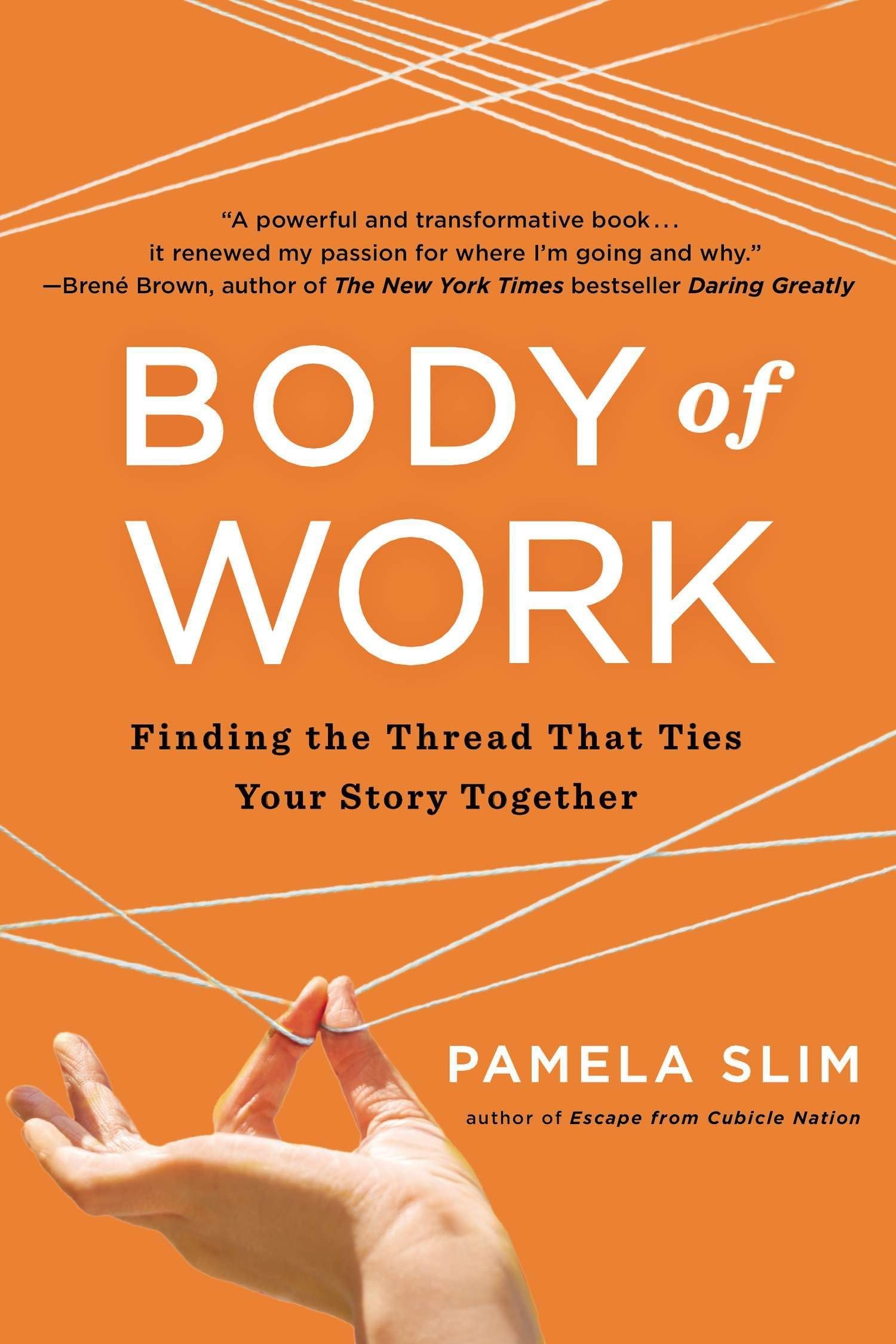

Buy Body Of Work by Slim, Pamela online on desertcart.ae at best prices. ✓ Fast and free shipping ✓ free returns ✓ cash on delivery available on eligible purchase. Review: When trying to explain what this book is all about to a colleague, I noticed that we don't seem to have a good expression for "body of work" in German. "Lebenswerk", your life's work, comes close but is too depressingly retrospective. Actually, there is a bit of retrospective involved here. Pam Slim encourages you to take a look at what you've accomplished in your life so far, but to also imagine where you want to go. The motivation being that some day, when you've reached that point where you look back at your life's work, you'd be able to say "Yes, this is what I wanted to do." But you're not there yet - it's still time to steer things in the right direction. This book promises to help you with this goal. Now, I'm usually a bit reluctant about all these self-help books of pretty much any kind. They're often very hype-y, postulate "new and better" methods, try to cheer you on but often fall short in terms of applicable, practical advice. I've taken one of Pam Slim's online courses in the past (Power Teaching, which helped me immensely when creating my own workshop), so I know her style and that it works for me. After defining what that "body of work" is all about, the book takes you through the steps of looking where you're coming from, what you have to offer and how you work. Once you have a clearer picture of yourself and your actual goals, the book explores ways to get you to where you want to be - overcoming the inevitable fear that's involved with this undertaking, collaborating with others (like-minded people as well as mentors and influencers), and finding a definition of what success would actually mean for you. I realise that when listing it like that, it may all sound a bit esoteric; much like the "other" books that I criticised above. But what Pam Slim is actually doing is more concrete than it may sound at first. She starts each section with a motivational, personal, real-life example and then uses that to analyse and explain how and why it worked; and, most importantly, what you can learn from it for your situation. Also, each chapter is rounded off with a worksheet that will help you find the answers for your specific case. "Body of Work" is one of the calmer, subtler self-help books; which comes with the topic, I guess. It's also full of sound advice which is not just thrown at you but comes with a bit of background and fits into an overall concept. Even if you do not plan to change your direction or follow all the advice, reading "Body of Work" will make you think about what you have accomplished in your life so far and will help you realise that if you wanted to, you could change where things are heading. If you are happy with how things are, then the book doesn't scream at you to change your life nonetheless (like some of the others in this genre do). Instead, it will help you reassure you of your decision. Review: The title of this review was suggested by Dan Pink's observation, in DRiVE, about the secret to high performance and satisfaction in all dimensions of our lives. Clayton Christensen also has much of value to say about this in How Will You Measure Your Life? as does Ken Robinson in two books, The Element and Finding Your Element. With regard to the title of this book, Pamela Slim recalls, "After decades of watching my dad work, I realized that he was not just building a career (although he was a very successful professional photographer), he was not just being a volunteer (although he spend hundreds of hours of unpaid time on community projects), but he was creating a deep and rich body of work that not only had great meaning and significance to him but also created considerable change and value in his community." She makes skillful use of several reader-friendly devices in Chapters 1-7. They include various exercises to complete, examples anchored in real-world experience, and boxed vignettes and FYIs to illustrate key points. These devices achieve two separate but related and critically important objectives: They enable her reader to interact with the material provided in her narrative, and, they facilitate, indeed expedite frequent review of key material later. These are among the dozens of subjects and issues of special interest and value to me, also listed to indicate the scope of Slim's coverage. o How do you build a body of work? (Pages 12-13) o The ingredients to make effort effective, and, Identifying one's ingredients (37-42) o Work modes in the new world of work (55-59) o How to expand your comfort zone (61-64) o There Are Four Parts to Your Creative Process (81-89) o The 20X Rule (97-99) o Four skills needed to cope with fear and uncertainty (106-125) o Avatars, ecosystems, and watering holes (134-139) o Five ways to ask for help with marketing your business (151-152) o Success in the new world of work, and, Body of Work Success Framework (162-169) o Your definition of success (173-175) o The two critical stories for career success, and The Persuasive Story Pattern (187-194) o How to communicate clearly (199-206) o The skills Pamela Slim's father used to create his body of work (218-220) I agree with the concluding remarks that Pamela Slim shares with her reader: "Viewing your career as a body if work will give you more choice, financial security, and creative freedom. The world is not going to serve up neat career tracks anymore. You cannot guarantee that your business or nonprofit will survive in a constantly changing economic landscape. But you can choose the kinds of projects that are worth completing and the type of life that is worth living." Presumably she agrees with me that choosing the kinds of relationships that are worth having is at least as important as choosing the kinds of projects that are worth completing. All of "creative and brave people" she discusses in this book, and especially her father, built a body of work that was primarily the result of service to others, of on-going efforts "to learn and create new things, and to do better by ourselves and our world."
| Best Sellers Rank | #438,337 in Books ( See Top 100 in Books ) #4,426 in Job Hunting & Careers #4,509 in Business Motivation & Self-Improvement #5,784 in Business Development & Entrepreneurship |
| Customer reviews | 4.5 4.5 out of 5 stars (94) |
| Dimensions | 13.77 x 1.68 x 20.88 cm |
| Edition | Standard Edition |
| ISBN-10 | 1591846196 |
| ISBN-13 | 978-1591846192 |
| Item weight | 221 g |
| Language | English |
| Print length | 256 pages |
| Publication date | 31 December 2013 |
| Publisher | Portfolio |
D**N
When trying to explain what this book is all about to a colleague, I noticed that we don't seem to have a good expression for "body of work" in German. "Lebenswerk", your life's work, comes close but is too depressingly retrospective. Actually, there is a bit of retrospective involved here. Pam Slim encourages you to take a look at what you've accomplished in your life so far, but to also imagine where you want to go. The motivation being that some day, when you've reached that point where you look back at your life's work, you'd be able to say "Yes, this is what I wanted to do." But you're not there yet - it's still time to steer things in the right direction. This book promises to help you with this goal. Now, I'm usually a bit reluctant about all these self-help books of pretty much any kind. They're often very hype-y, postulate "new and better" methods, try to cheer you on but often fall short in terms of applicable, practical advice. I've taken one of Pam Slim's online courses in the past (Power Teaching, which helped me immensely when creating my own workshop), so I know her style and that it works for me. After defining what that "body of work" is all about, the book takes you through the steps of looking where you're coming from, what you have to offer and how you work. Once you have a clearer picture of yourself and your actual goals, the book explores ways to get you to where you want to be - overcoming the inevitable fear that's involved with this undertaking, collaborating with others (like-minded people as well as mentors and influencers), and finding a definition of what success would actually mean for you. I realise that when listing it like that, it may all sound a bit esoteric; much like the "other" books that I criticised above. But what Pam Slim is actually doing is more concrete than it may sound at first. She starts each section with a motivational, personal, real-life example and then uses that to analyse and explain how and why it worked; and, most importantly, what you can learn from it for your situation. Also, each chapter is rounded off with a worksheet that will help you find the answers for your specific case. "Body of Work" is one of the calmer, subtler self-help books; which comes with the topic, I guess. It's also full of sound advice which is not just thrown at you but comes with a bit of background and fits into an overall concept. Even if you do not plan to change your direction or follow all the advice, reading "Body of Work" will make you think about what you have accomplished in your life so far and will help you realise that if you wanted to, you could change where things are heading. If you are happy with how things are, then the book doesn't scream at you to change your life nonetheless (like some of the others in this genre do). Instead, it will help you reassure you of your decision.
R**S
The title of this review was suggested by Dan Pink's observation, in DRiVE, about the secret to high performance and satisfaction in all dimensions of our lives. Clayton Christensen also has much of value to say about this in How Will You Measure Your Life? as does Ken Robinson in two books, The Element and Finding Your Element. With regard to the title of this book, Pamela Slim recalls, "After decades of watching my dad work, I realized that he was not just building a career (although he was a very successful professional photographer), he was not just being a volunteer (although he spend hundreds of hours of unpaid time on community projects), but he was creating a deep and rich body of work that not only had great meaning and significance to him but also created considerable change and value in his community." She makes skillful use of several reader-friendly devices in Chapters 1-7. They include various exercises to complete, examples anchored in real-world experience, and boxed vignettes and FYIs to illustrate key points. These devices achieve two separate but related and critically important objectives: They enable her reader to interact with the material provided in her narrative, and, they facilitate, indeed expedite frequent review of key material later. These are among the dozens of subjects and issues of special interest and value to me, also listed to indicate the scope of Slim's coverage. o How do you build a body of work? (Pages 12-13) o The ingredients to make effort effective, and, Identifying one's ingredients (37-42) o Work modes in the new world of work (55-59) o How to expand your comfort zone (61-64) o There Are Four Parts to Your Creative Process (81-89) o The 20X Rule (97-99) o Four skills needed to cope with fear and uncertainty (106-125) o Avatars, ecosystems, and watering holes (134-139) o Five ways to ask for help with marketing your business (151-152) o Success in the new world of work, and, Body of Work Success Framework (162-169) o Your definition of success (173-175) o The two critical stories for career success, and The Persuasive Story Pattern (187-194) o How to communicate clearly (199-206) o The skills Pamela Slim's father used to create his body of work (218-220) I agree with the concluding remarks that Pamela Slim shares with her reader: "Viewing your career as a body if work will give you more choice, financial security, and creative freedom. The world is not going to serve up neat career tracks anymore. You cannot guarantee that your business or nonprofit will survive in a constantly changing economic landscape. But you can choose the kinds of projects that are worth completing and the type of life that is worth living." Presumably she agrees with me that choosing the kinds of relationships that are worth having is at least as important as choosing the kinds of projects that are worth completing. All of "creative and brave people" she discusses in this book, and especially her father, built a body of work that was primarily the result of service to others, of on-going efforts "to learn and create new things, and to do better by ourselves and our world."
S**S
Me parece un libro vigente y recomendable especialmente para aquellos que quieran emprender en el mundo del freelancing, pues enseñar a identificar y utilizar las habilidades, experiencias y herramientas que se han adquirido a lo largo de nuestro trayecto laboral. En general, no busco libros sobre coaching; sin embargo, éste captó mi atención debido a los grandes, rápidos y a veces impredecibles cambios sociológicos que se están desarrollando en la sociedad occidental actual. Es un libro de fácil lectura. Requiere apertura ppr parte del lector para aprovecharlo al máximo.
N**K
The idea of this book deserves five star rating. But the entire idea can be conveyed as a blog instead of a longwinded book which dilutes the idea.
T**T
In this inspiring book Pamela Slim explores how we can connect the dots in our life - how do we find the connections between our diverse accomplishments and, as we navigate and survive the world of work, how do we tell the story about our journey? Slim argues that the ability to look at things from new and critical perspectives is a fundamental skill in creating our careers. Being wedded to a career path that follows a linear trajectory, in a world where we must “plan for failure, calamity and unexpected disasters”, is not the secret to a satisfying career or life. Rather, we must consider our careers as a “body of work” - everything we create, contribute, affect and impact is a body of work. Viewing our careers in this way, means we are not restricted to a job title, or constrained to one business. It is more complex, yes, but thinking about the overarching themes in our life and how the experiences we’ve had contribute to these themes, gives our lives meaning and purpose. In her book, Slim takes us through exercises structured to understand how to build a body of work and how to sell the story of the journey that underpins it. Understanding the ideas that drive us emotionally and the change we want to create in the world provides the foundation. Defining our roots – our purpose, belief and convictions, motivates us to keep going through adversity and keep us strong and stable when we face challenges in our careers. Completing the exercises is not easy. “Surfing the fear” asks us to consider what we are afraid of and accept that pain is an inevitable part of life (but suffering is not). Truly defining what success means for us, and not falling into the trap of “success dysmorphia” (viewing your success through somebody else’s results) requires us to question conventional career advice, which Slim argues can keep us feeling trapped, defensive or guilty about our choices. Despite the discomfort that looking in the mirror in this way creates, science shows, that this is the secret to a satisfying career and life. In another brilliant book Drive: The Surprising Truth About What Motivates Us, Daniel Pink – one of the world’s top business thinkers states: The science shows that the secret to high performance isn't our biological drive or our reward-punishment drive but our third drive - our deep seated desire to direct our own lives, to extend and expand our abilities, and to live a life of purpose. Individuals who structure their careers around autonomy, mastery and purpose will have a powerful body of work, providing them with more choice, financial security and creative freedom. They will feel more alive, engaged, connected and excited by their work. I've ordered a copy of the this for the Head of 6th Form at my children's school - why wait until you're my age to consider your career in such an integrated and enriching way?! On a similar topic of finding purpose and meaning in your life also read Stephen Cope's The Great Work of Your Life and Zander & Zander's The Art of Possibility. Both are brilliant. As Pamela Slim says, let the creating begin.
Trustpilot
2 months ago
2 weeks ago