
DOWNLOAD THE APP


Customer Support

Desert Online General Trading LLC
Warehouse # 7, 4th Street, Umm Ramool, Dubai, 30183, Dubai
DOWNLOAD THE APP
Customer Support
Desert Online General Trading LLC
Warehouse # 7, 4th Street, Umm Ramool, Dubai, 30183, Dubai

🚀 Elevate your smart home game with unbeatable Zigbee power and flexibility!
The SONOFF Universal Zigbee 3.0 USB Dongle Plus is a compact, high-performance Zigbee coordinator featuring a TI CC2652P chip, 20dBm output gain, and an SMA antenna interface housed in aluminum for interference reduction. Pre-flashed with Z-Stack 3.x.0 firmware, it offers plug-and-play compatibility with Home Assistant, IoBroker, and Zigbee2MQTT. Advanced users can reflash it as a Zigbee router/repeater to extend network range, making it ideal for complex smart home setups requiring reliable, local device control without cloud reliance.


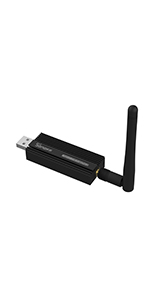


| ASIN | B09KXTCMSC |
| Best Sellers Rank | 2,644 in DIY & Tools ( See Top 100 in DIY & Tools ) 2 in Home Automation Hubs & Controllers |
| Guaranteed software updates until | unknown |
| Item model number | ZBdongle-P |
| Manufacturer | SONOFF |
| Product Dimensions | 11.1 x 4.09 x 1.91 cm; 36.85 g |
R**S
excellent device for Home Assistant - Re-flashable as a Router & works well (not for novices)
Be warned that Geeky products attract geeky reviews - like this one ! :-) I wanted to automate my Garden workshop lights, as its a steep uphill jog from there to the house in the hissing rain only to discover that, in your haste to get out of the rain, you left the bleeping lights on! Having researched various methods to achieve this, ZigBee seemed to be the easiest to setup even if the range was constrained when compared to similar wireless connections like Wi-Fi. So I bought my first Zigbee light switch and Sonoff dongle to try and make it happen. The dongle plugged straight into my home assistant server (running as a VMWare based virtual machine situated in my attic some 200 feet away and 70-100 ft uphill from my workshop) and was immediately recognised by Home assistant as a Zigbee Co-ordinator. Unfortunately for me though, when I fitted the ZigBee light switch, the attic dongle couldn't see it as there were thick roof slates and two VERY thick breeze block walls in our terraced hillside garden separating them. The light switch was tucked away beneath the final wall. I feared with all the Wi-Fi and bluetooth traffic on the same radio channels (curse of living on a hilltop) that my proposed solution was a non-starter. But being a hobby / professional Linux geek, I had a google and a poke around on the GitHub website to discover that the same Sonoff dongles could be re-flashed with third party firmware that turns them into stand alone ZigBee Repeaters / Routers. Once flashed, all they required was a 5V USB power source (I used an old Samsung phone charger) and they work as a ZigBee range extender. **Fair warning** - building and setting up the software packages to reflash these devices is not for novices. But once built, you have a tool that can flash as many of these dongles as you need (be careful as there are 2 hardware dongle variants too) . So I bought a second dongle , and flashed it. Having flashed it, I took it down the workshop and plugged it into the phone charger into a mains socket on the the "downhill" wall so that it had a better view of the attic about 150 feet away and 75 feet higher in elevation above it. Within seconds home assistant recognised the existence of the shed router dongle and began talking to it. A minute or so later Home assistant reported the light switch as available so I completed the integration. I could now not only turn my workshop lights on and off from anywhere in the world (!), but use the shed lights as "soft" lighting for our deck above it. and all was well. That was... until our neighbours Wi-Fi decided to move channel autonomously (it does that a LOT) ! :-( The HAN (Home Area Network) tried to reconfigure itself , but at this point the distances involved with the roof slates and the level of Wi-Fi interference made the light on/off function a 1 in 3-4 chance of getting through. I purchased a 3rd ZigBee dongle, flashed it as a router, and installed it under my eaves using another old mobile phone power supply and a USB extension cable. I pushed the antenna out through one of the attic vents built into the eaves, and wrapped the antenna joints in self-amalgam tape for waterproofing. Instantly all devices linked up together solidly! and there has not been a single issue since (no matter what neighbour's Wi-Fi tries) . The attached pic shows the topography of the network auto generated in Home Assistant. I now have saturation coverage of my home and gardens so VERY pleased with the setup. Since that snapshot was taken I have added many other ZigBee devices without a hitch. So to my scoring: VALUE FOR MONEY As a plug and play ZigBee co-ordinator - 5 stars - no quibbles. plugged it in and boom! it integrated100% As a ZigBee Router once flashed , again 5 stars - zero failures , no wobbles , nothing - just works! EASE OF INSTALLATION: It would be nice if Sonoff had made it easier to reflash the device without extensive Linux knowledge. Perhaps a windows app for the not-so-geeky everyman? Hmm...I think one point off for relying on third party software when it has potential to double sales of your product! EASE OF USE: In both co-ordinator mode and router mode (once flashed) you plug it in and it works thus far error free therefore I have to give it 5 stars. I hope you found this interesting if a bit geeky - but thats ZigBee for you. Thanks for reading!
K**N
Value for money zigbee dongle
🧩 Overview: Sonoff Zigbee Dongle + Home Assistant The Sonoff Zigbee 3.0 USB Dongle Plus is a popular and affordable Zigbee coordinator for smart home enthusiasts using Home Assistant. It enables local control of Zigbee devices without relying on cloud services. --- ⚙️ Setup & Integration You can integrate the dongle with Home Assistant using two main methods: 1. ZHA (Zigbee Home Automation) - Native integration in Home Assistant. - Simple setup: plug in the dongle, go to Settings → Devices & Services, and add the ZHA integration. - Ideal for users who want a straightforward experience with basic automation. 2. Zigbee2MQTT (Z2M) - Requires installing the Mosquitto MQTT broker and Zigbee2MQTT add-on. - Offers deeper customization and broader device compatibility. - Recommended for advanced users or those with complex device setups. Both methods support pairing devices like switches, sensors, and bulbs with ease. --- 📶 Performance & Reliability 🔹 ZBDongle-P (CC2652P chip) - Widely praised for stability and strong signal range. - Works well with both ZHA and Zigbee2MQTT. - Recommended firmware: 20220922 or 220221226 for best results. 🔹 ZBDongle-E (EFR32MG21 chip) - Mixed reviews: some users report connectivity issues and quirks under both ZHA and Z2M. - May require firmware updates and careful configuration to perform reliably. > 💡 Tip: If you're starting out, the ZBDongle-P is generally considered more "plug-and-play" and robust. --- 🧪 Real-World Experience - Users running both dongles simultaneously (ZBDongle-E for ZHA, ZBDongle-P for Z2M) report solid performance with over 70 devices across both networks. - Z2M is preferred for exposing full device entities (e.g., thermostats, multi-function bulbs), while ZHA is great for simple sensors and switches. - Some Reddit users found the ZBDongle-E disappointing due to pairing issues and inconsistent range, though others had smoother experiences after firmware tweaks. --- ✅ Pros - Affordable and widely available. - Compatible with a large ecosystem of Zigbee devices. - Supports both ZHA and Zigbee2MQTT. - Strong community support and documentation. ❌ Cons - ZBDongle-E may require troubleshooting and firmware updates. - Zigbee2MQTT setup is more complex for beginners. - USB extension cable recommended to avoid interference. --- 🏁 Final Verdict If you're building a local, privacy-focused smart home with Home Assistant, the Sonoff Zigbee Dongle Plus is a solid choice—especially the ZBDongle-P variant. It balances cost, performance, and flexibility, and integrates smoothly with both ZHA and Zigbee2MQTT. Just be mindful of firmware versions and setup nuances to get the best experience.
E**Y
Easy and (so far) reliable
While I've slated the Sonoff temperature sensors, this one is completely different. Very easy to use - plugged it into a Raspberry Pi running a Docker instance of HA and to was recognised immediately. Seems to be compatible with every Zigbee device I've paired it with and recognises & connects to them quickly. Nice compact unit that plugs into a USB port, feels like a relatively rugged aluminium case; however, be aware it's a bit bulky and obstructs adjacent ports, so a short extension lead is sensible (even more so if it's connected to a USB3 port as there are claims of interference). Really good for the price.
L**O
Technical abilities required
It works well but requires a lot of technical jiggery-pokery to get fully operational and up to date. It helps a great deal with Home Assistant and other zigbee communications.
G**D
Great value for money. Easy to setup and supports a lot of devices.
Easy to install on Home Assistant with Raspberry Pi. A lot of people have said to use a USB extension cable to keep RFI away from the Pi, but I can’t say I’ve noticed any issues even after a year and a bit of operation. Good value for money and it has no issues working with Sonoff, Moes, Phillips and Candeo and I can’t remember the make of my light.
G**N
I got this to create a Zigbee network in Home Assistant after finding that many of the devices and sensors that I wanted to use made use of this protocol. So far, I have only positive things to say. It was detected right away after rebooting my Home Assistant host, and configuring the first few Zigbee devices was a painless experience, including Ikea globes and remotes too. It is a bulky case, so if you are plugging it directly into your machine, you might find some clearance issues, but a small extension can fix that easily. I would definitely recommend this device based on my own experiences so far.
R**S
Werkt uitstekend plug & play op Home assistant. Goed bereik
J**Z
Hub Zigbee para Home Assistant , conectar , configurar y listo. Para los amantes de la domotica sabemos que Sonoff no defrauda, y a buen precio.
N**I
Ho collegato questo SONOFF ZigBee 3.0 USB Dongle Plus al mio Raspberry Pi 5 per Home Assistant, e nel giro di pochi minuti avevo tutta la casa sotto controllo. Configurazione semplicissima: riconosciuto subito, funziona sia con ZHA che con Zigbee2MQTT. Io ho optato per Zigbee2MQTT e devo dire che l’accoppiamento dei dispositivi è stato rapidissimo. Al momento ci ho collegato: 4 sensori di presenza 1 sensore di vibrazione 3 sensori di movimento 3 prese smart Risultato? Tutto perfetto, stabile e reattivo. Nessuna disconnessione, nessun lag: le automazioni scattano in tempo reale. L’antenna esterna fa la differenza: il segnale copre tranquillamente più stanze, senza impazzire con repeater o altri trucchetti. Il case in alluminio poi aiuta a ridurre le interferenze: zero problemi anche con altri dispositivi vicini. Il bello è che è già pre-flashato con firmware coordinatore Z-Stack 3.x.0, quindi non serve smanettare per ore prima di usarlo. Lo attacchi e sei operativo. In conclusione: ✅ Facilissimo da configurare ✅ Compatibile con ZHA e Zigbee2MQTT ✅ Segnale stabile e potente (+20 dBm) ✅ Gestisce più dispositivi senza colpo ferire ✅ Perfetto con Home Assistant su Raspberry Pi Per quello che costa, è probabilmente il miglior investimento che si possa fare per dare stabilità e libertà al proprio ecosistema ZigBee. Da quando l’ho messo, la casa smart è diventata davvero… smart. 5 stelle meritatissime! 🚀
S**N
Works!
Trustpilot
4 days ago
5 days ago