
DOWNLOAD THE APP


Customer Services
Copyright © 2025 Desertcart Holdings Limited
DOWNLOAD THE APP
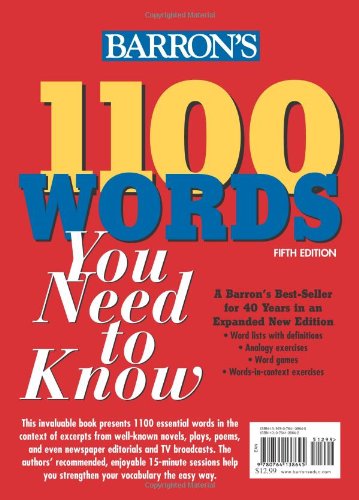


Buy Barrons Educational Series 1100 Words You Need to Know by Bromberg, Murray, Gordon, Melvin online on desertcart.ae at best prices. ✓ Fast and free shipping ✓ free returns ✓ cash on delivery available on eligible purchase. Review: I am a tutor. Until very recently, the majority of my income came from tutoring students for various exams, mostly SAT and ACT. This is the one book that I recommend to all parents and students who contact me, whether they decide to employ me or not. Here is an excerpt of a recent email to a parent searching for a tutor for her daughter who is a sophomore in high school: "Unfortunately, vocabulary cannot be thoroughly taught in a single year or even two; it is the culmination of a lifetime of learning. Whether you employ anyone to help with the college entrance exams or not, you should purchase "1100 Words" by Barron's, and have your daughter do at least one lesson per day. It is a fairly painless way to increase vocabulary without having to resort to flashcards, which are really not very helpful for most students in the long run. "Also, turn on the closed-captioning on your television (closed-captioning has been required to be available on all modern televisions for over a decade), and leave it on all the time. It might drive people crazy for a week or two, but you will get used to it, and the vocabulary of everyone in the house will start increasing. It would be helpful to your daughter for her to keep a steno pad or other medium-size notebook next to where she usually watches television and have her write down all words that she sees and hears that are unfamiliar to her; then she can look them up later, write down a one or two-word definition, and use the word in a sentence. Even if she does not bother doing this, it is still well worth keeping the closed-captioning turned on because she is both hearing and seeing the word in an actual context, which will go a long way in understanding and retaining the meaning. If there are other children in the household of ANY age, closed-captioning will benefit them as well and it will probably benefit the adults. "I turned on closed-captioning initially because my oldest son would not allow me to read to him (we discovered later that he has Asperger's form of autism, ADD/ADHD, and a severe visual processing disorder-far worse than the usual dyslexia). One teacher told us that he would never learn to read, much less write. I noticed that the only thing he could pay attention to was the television, so I turned on the closed-captioning in hopes that he could learn to read by the television's reading to him. It worked out so much better than my wildest dreams! Not only did the television teach him to read, his vocabulary began to soar far above that of his classmates. I also had him go through Barron's 1100 Words during his 8th-grade year (I had to home school him from 4th through 8th grade due to teachers' refusing to believe that he was capable of learning). This child is now an honor student at an excellent private university where he received a full scholarship after making a perfect 800 on his SAT Reading, a near perfect 790 on SAT Writing and a very respectable 700 in SAT Math. His brother is now an outstanding reader as well because I left the closed-captioning on even after the older one went away to college. My own vocabulary was substandard for a person with a Master's degree, and now it is far better thanks to closed-captioning, using Barron's 1100 Words, and studying Spanish and Latin. Closed-captioning really aided me in becoming fairly fluent in Spanish after the age of 40. I also recommend closed-captioning for English Language Learners (people who are learning English but whose first language is not English)." If you didn't notice what I thought the absolutely least painful way to increase vocabulary, it is to turn on closed-captioning in every television in your home. Don't forget to turn on closed-captioning or English subtitles for all of your movie services and DVD players as well. Besides being so effective, it is FREE. Getting back to "Barron's 1100 Words", it is the one book that EVERY student should review in its entirety prior to taking the college entrance exams, it is great for high school and college students who need to increase their vocabularies to do better in class, and it is in a one-lesson-per-day format that even busy adults can take time to do. Some people have complained in their reviews on this book that "1100 Words" does not contain dictionary definitions. That is true, but after you have done the lesson, you end up discovering the meaning of the word, which you can retain far longer than if you had tried to learn the word from its dictionary definition. If you really insist on having the dictionary definition, the Kindle version will accomplish that for you since ALL Kindle books allow you to click on any word to look up the dictionary definition. Review: こんな本を探していました。本を読むとき辞書を引くと読むリズムが崩れるので、前後関係から語の意味を推測しつつ原書を読んできました。このテキストは同じような感覚で、文脈から言葉の意味を覚えていくことができます。そして馴染みの単語も、うろ覚えにしか覚えていなかったのだと、思い知らされました。毎日、重要語が5個入った短い例文、語を使った文章問題、語の定義のクイズ、用句を一つ15分で終わります。出てくる単語も私のレベルにぴったりで、毎日の学習を楽しんでいます。
| Customer reviews | 4.4 4.4 out of 5 stars (103) |
| Dimensions | 20.32 x 2.54 x 27.94 cm |
| Edition | 6th |
| ISBN-10 | 0764138642 |
| ISBN-13 | 978-0764138645 |
| Item weight | 853 g |
| Language | English |
| Print length | 384 pages |
| Publication date | 1 August 2008 |
| Publisher | Barron's Educational Series Inc.,U.S. |
S**R
I am a tutor. Until very recently, the majority of my income came from tutoring students for various exams, mostly SAT and ACT. This is the one book that I recommend to all parents and students who contact me, whether they decide to employ me or not. Here is an excerpt of a recent email to a parent searching for a tutor for her daughter who is a sophomore in high school: "Unfortunately, vocabulary cannot be thoroughly taught in a single year or even two; it is the culmination of a lifetime of learning. Whether you employ anyone to help with the college entrance exams or not, you should purchase "1100 Words" by Barron's, and have your daughter do at least one lesson per day. It is a fairly painless way to increase vocabulary without having to resort to flashcards, which are really not very helpful for most students in the long run. "Also, turn on the closed-captioning on your television (closed-captioning has been required to be available on all modern televisions for over a decade), and leave it on all the time. It might drive people crazy for a week or two, but you will get used to it, and the vocabulary of everyone in the house will start increasing. It would be helpful to your daughter for her to keep a steno pad or other medium-size notebook next to where she usually watches television and have her write down all words that she sees and hears that are unfamiliar to her; then she can look them up later, write down a one or two-word definition, and use the word in a sentence. Even if she does not bother doing this, it is still well worth keeping the closed-captioning turned on because she is both hearing and seeing the word in an actual context, which will go a long way in understanding and retaining the meaning. If there are other children in the household of ANY age, closed-captioning will benefit them as well and it will probably benefit the adults. "I turned on closed-captioning initially because my oldest son would not allow me to read to him (we discovered later that he has Asperger's form of autism, ADD/ADHD, and a severe visual processing disorder-far worse than the usual dyslexia). One teacher told us that he would never learn to read, much less write. I noticed that the only thing he could pay attention to was the television, so I turned on the closed-captioning in hopes that he could learn to read by the television's reading to him. It worked out so much better than my wildest dreams! Not only did the television teach him to read, his vocabulary began to soar far above that of his classmates. I also had him go through Barron's 1100 Words during his 8th-grade year (I had to home school him from 4th through 8th grade due to teachers' refusing to believe that he was capable of learning). This child is now an honor student at an excellent private university where he received a full scholarship after making a perfect 800 on his SAT Reading, a near perfect 790 on SAT Writing and a very respectable 700 in SAT Math. His brother is now an outstanding reader as well because I left the closed-captioning on even after the older one went away to college. My own vocabulary was substandard for a person with a Master's degree, and now it is far better thanks to closed-captioning, using Barron's 1100 Words, and studying Spanish and Latin. Closed-captioning really aided me in becoming fairly fluent in Spanish after the age of 40. I also recommend closed-captioning for English Language Learners (people who are learning English but whose first language is not English)." If you didn't notice what I thought the absolutely least painful way to increase vocabulary, it is to turn on closed-captioning in every television in your home. Don't forget to turn on closed-captioning or English subtitles for all of your movie services and DVD players as well. Besides being so effective, it is FREE. Getting back to "Barron's 1100 Words", it is the one book that EVERY student should review in its entirety prior to taking the college entrance exams, it is great for high school and college students who need to increase their vocabularies to do better in class, and it is in a one-lesson-per-day format that even busy adults can take time to do. Some people have complained in their reviews on this book that "1100 Words" does not contain dictionary definitions. That is true, but after you have done the lesson, you end up discovering the meaning of the word, which you can retain far longer than if you had tried to learn the word from its dictionary definition. If you really insist on having the dictionary definition, the Kindle version will accomplish that for you since ALL Kindle books allow you to click on any word to look up the dictionary definition.
ふ**び
こんな本を探していました。本を読むとき辞書を引くと読むリズムが崩れるので、前後関係から語の意味を推測しつつ原書を読んできました。このテキストは同じような感覚で、文脈から言葉の意味を覚えていくことができます。そして馴染みの単語も、うろ覚えにしか覚えていなかったのだと、思い知らされました。毎日、重要語が5個入った短い例文、語を使った文章問題、語の定義のクイズ、用句を一つ15分で終わります。出てくる単語も私のレベルにぴったりで、毎日の学習を楽しんでいます。
P**R
I read regarding this book in a Blog. First I borrowed this book from a Library and found it very useful, especially for a non-native English speaker like me. Pros: - Each word is mentioned in an example story/paragraph, so the reader will get some idea where the word can be used. - At the end of the book, several references of Magazine/newspaper articles are available. - One can improve his/her vocabulary dramatically. Cons: - Didn’t find any so far.
H**G
This is really a good read.. start building your vocab with this before trying any other options.. the paras given are fun and the practice questions help you guess/apply words learnt and hence remember them
M**O
全部で46週間分+ボーナス2週間分の内容ですが、 一日に費やす時間は15分程度なので、少しずつでも 毎日勉強するような方には、取り組みやすい形だと 思います。 指示通りのペースで行った場合、終わるまで長い期間が 必要となってしまいますが、本書は短期間で飛躍的に 語彙を身につけるというよりも、学習者に地力をつけさせる というコンセプトの方がしっくりします。 (ただ定義を丸暗記するのではなく、未知単語について 文章の中で語意を類推したり、単語を文章の中で使う 練習などをするので) 語彙のレベルについては、私は本書より先に同程度の 難易度の『Word Power Made Easy』をやっていたので、 特別難しいとは思いませんでしたが、過去『〜Made Easy』に 初めて取り組んだときは、かなり難しいと思ったので、本書で 学習するにはある程度の語彙力が必要とされると思います。 しかし普段洋書を読んでいると、本書に掲載されている 単語が普通に出てくるので、洋書を読めるようになりたい、 そして更に楽しんで読めるようになりたいと思っている 方には、お薦めできる学習書です。
Trustpilot
2 days ago
1 month ago