
DOWNLOAD THE APP


Customer Services
Copyright © 2025 Desertcart Holdings Limited
DOWNLOAD THE APP
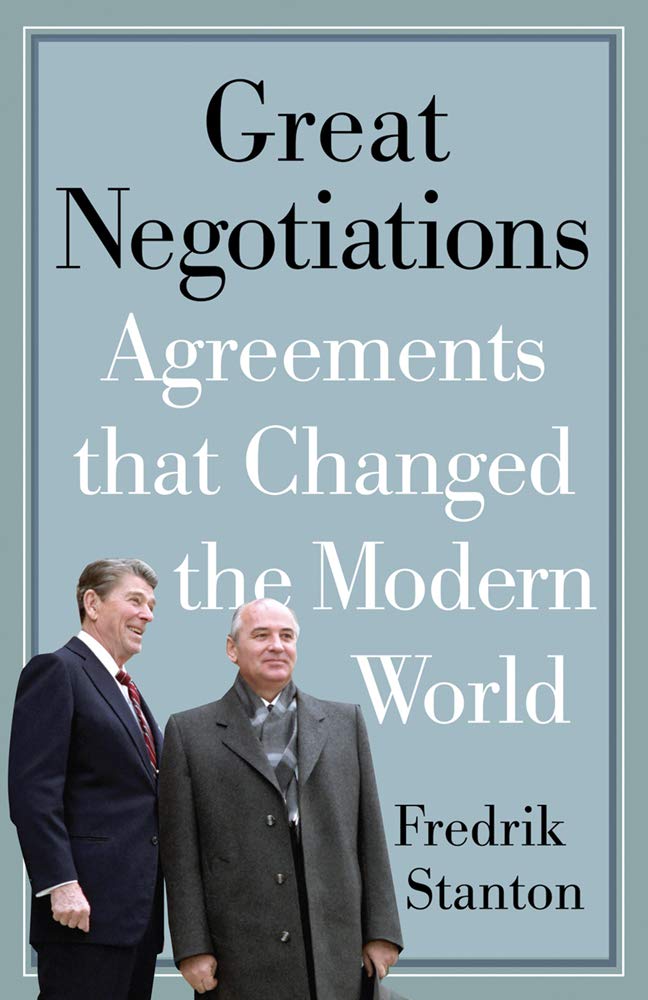
Great Negotiations: Agreements that Changed the Modern World [Stanton, Fredrik] on desertcart.com. *FREE* shipping on qualifying offers. Great Negotiations: Agreements that Changed the Modern World Review: An Excellent Study in the Art of Negotiation - Fredrik Stanton's excellent, "Great Negotiations: Agreements that Changed the Modern World" focuses in on eight great negotiations beginning with Benjamin Franklin's securing of French assistance in America's war of independence against the British, to the Reykjavik Summit of 1986, in which Mikhail Gorbachev and Ronald Reagan sought to negotiate sizable reductions in their countries' nuclear arsenals. While the Summit was initially judged a failure, it ultimately laid the groundwork for the Strategic Arms Limitation Treaty (START) signed just four years later by Gorbachev and President George H.W. Bush. Great Negotiations is an eminently readable work of scholarship that should appeal to not only the professional diplomat, but also to students of history and conflict resolution. General readers interested in the art of negotiation will also find this work a delightful read. As Mr. Stanton himself notes, for all of its military might, the United States gained more from negotiations than from all of its wars combined. This is history well worth studying. Stanton is at his finest in honing in on what ultimately leads nations to act. His writing reflects a mixture of influences, from Mackinder to Morgenthau to Kissinger - of states hewing to narrowly defined "national interests," from protecting their access to resources, ensuring the integrity of their geographic borders to maintaining an equilibrium of power capable of thwarting emerging threats to the international system. When they strayed from these principals, disaster loomed ... Yet even "failed" negotiations offer important lessons. The Paris Peace Conference, even today, serves as a warning against the dangers of ignoring or misinterpreting history. In this way, the Congress of Vienna which ushered in a period of relative peace that ended the Napoleonic wars, stands in stark contrast to the Paris Peace Conference which produced the Treaty of Versailles. Versailles, with the exceedingly punitive measures it imposed on Germany, was never durable enough to prevent the emergence of a dictator intent on its overthrow. Thus, for negotiations to be successful, the architects must create conditions that result in stability and that are viewed by the warring parties as `legitimate.' This was never the case with Versailles, as Stanton darkly notes. The Cuban Missile Crisis, which participants viewed in its aftermath as having come as close to a 1-in-2 chance of resulting in nuclear Armageddon, remains as relevant today in how the US negotiates with Iran and North Korea, as it did five decades ago. While the stakes may not be as high, there are many lessons to be learned about the psychology of leaders: (1) never corner the adversary; (2) allow the leader to save face; (3) create opportunities and "escape valves" to diffuse tension; and (4) be willing to make concessions - if need be in secret - to avoid all-out war. Given the constellation of threats the United States faces today, Great Negotiations: Agreements that Changed the Modern World, is among the most important books of its genre to be published in 2010. Those interested in maintaining the peace would do well to spend a few hours studying these great lessons. Reviewed by Peter G. Fitzpatrick Review: Libro lleno de datos inéditos - Excelente Libro muy bien redactado y reúne comentarios y datos inéditos de investigación, gran herramienta para diplomáticos y estudiantes de las relaciones internacionales
| Best Sellers Rank | #360,534 in Books ( See Top 100 in Books ) #221 in International Diplomacy (Books) #1,354 in History & Theory of Politics #8,224 in World History (Books) |
| Customer Reviews | 4.5 out of 5 stars 43 Reviews |
P**K
An Excellent Study in the Art of Negotiation
Fredrik Stanton's excellent, "Great Negotiations: Agreements that Changed the Modern World" focuses in on eight great negotiations beginning with Benjamin Franklin's securing of French assistance in America's war of independence against the British, to the Reykjavik Summit of 1986, in which Mikhail Gorbachev and Ronald Reagan sought to negotiate sizable reductions in their countries' nuclear arsenals. While the Summit was initially judged a failure, it ultimately laid the groundwork for the Strategic Arms Limitation Treaty (START) signed just four years later by Gorbachev and President George H.W. Bush. Great Negotiations is an eminently readable work of scholarship that should appeal to not only the professional diplomat, but also to students of history and conflict resolution. General readers interested in the art of negotiation will also find this work a delightful read. As Mr. Stanton himself notes, for all of its military might, the United States gained more from negotiations than from all of its wars combined. This is history well worth studying. Stanton is at his finest in honing in on what ultimately leads nations to act. His writing reflects a mixture of influences, from Mackinder to Morgenthau to Kissinger - of states hewing to narrowly defined "national interests," from protecting their access to resources, ensuring the integrity of their geographic borders to maintaining an equilibrium of power capable of thwarting emerging threats to the international system. When they strayed from these principals, disaster loomed ... Yet even "failed" negotiations offer important lessons. The Paris Peace Conference, even today, serves as a warning against the dangers of ignoring or misinterpreting history. In this way, the Congress of Vienna which ushered in a period of relative peace that ended the Napoleonic wars, stands in stark contrast to the Paris Peace Conference which produced the Treaty of Versailles. Versailles, with the exceedingly punitive measures it imposed on Germany, was never durable enough to prevent the emergence of a dictator intent on its overthrow. Thus, for negotiations to be successful, the architects must create conditions that result in stability and that are viewed by the warring parties as `legitimate.' This was never the case with Versailles, as Stanton darkly notes. The Cuban Missile Crisis, which participants viewed in its aftermath as having come as close to a 1-in-2 chance of resulting in nuclear Armageddon, remains as relevant today in how the US negotiates with Iran and North Korea, as it did five decades ago. While the stakes may not be as high, there are many lessons to be learned about the psychology of leaders: (1) never corner the adversary; (2) allow the leader to save face; (3) create opportunities and "escape valves" to diffuse tension; and (4) be willing to make concessions - if need be in secret - to avoid all-out war. Given the constellation of threats the United States faces today, Great Negotiations: Agreements that Changed the Modern World, is among the most important books of its genre to be published in 2010. Those interested in maintaining the peace would do well to spend a few hours studying these great lessons. Reviewed by Peter G. Fitzpatrick
D**O
Libro lleno de datos inéditos
Excelente Libro muy bien redactado y reúne comentarios y datos inéditos de investigación, gran herramienta para diplomáticos y estudiantes de las relaciones internacionales
P**N
A MASTERPIECE ON DIPLOMACY
"GREAT NEGOTIATIONS: Agreements that Changed the Modern World," offers eight insightful stories, expressed eloquently, that break down pivotal moments throughout history. It is fascinating to reflect on what the world has endured during the modern age, by focusing on key negotiations where the stakes were extremely high. Stanton is brilliant with his research and turns the facts into exciting chapters, creating a worthy page-turner. This is by far the most interesting book published in 2010! We are reminded, as Stanton writes, "Words, as much as weapons, shape history."
B**B
fantastic
excellent book, good sourcing.
B**H
the kind of book most of us want in our bookcases
I preface my comments with an explanation of my four-star rating. Ordinarily, the only books I give four- and five-star ratings are those that absorb me, that are unputdownable. GREAT NEGOTIATIONS by Fredrick Stanton is not that. Rather, I give it four stars for what it is, not an absorbing story but important stories that make up a history book. These eight stories span the time of colonial America to the Cold War, and each shows how words, negotiations, changed the world. It is not a book I would want to sit and read cover to cover as I would a novel.But it IS a book that I would read two or three times. It's the kind of book most of us want in our bookcases.
K**N
Great book I advise it for everyone who studies international ...
Great book I advise it for everyone who studies international relations and is interested in Negotiations.
S**A
(Kindle version) Some typos make sentences incomprehensible.
Not good if you need it for a class as some professors assign readings based on PAGE NUMBERS, which this eBook does not have. Some sentences are incomprehensible due to typos in the eBook. Would be 5 stars if this was fixed in the Kindle version.
G**G
Fabulous
Very well written, light hearted, in depth, interesting, face paced. Who knew non fiction could be so fun. Author did an amzing job and am looking forward to reading anything else he writes.
Trustpilot
2 weeks ago
4 days ago