Some deliveries may take a little longer than usual due to regional shipping conditions.

DOWNLOAD THE APP


Customer Services
Copyright © 2025 Desertcart Holdings Limited
DOWNLOAD THE APP
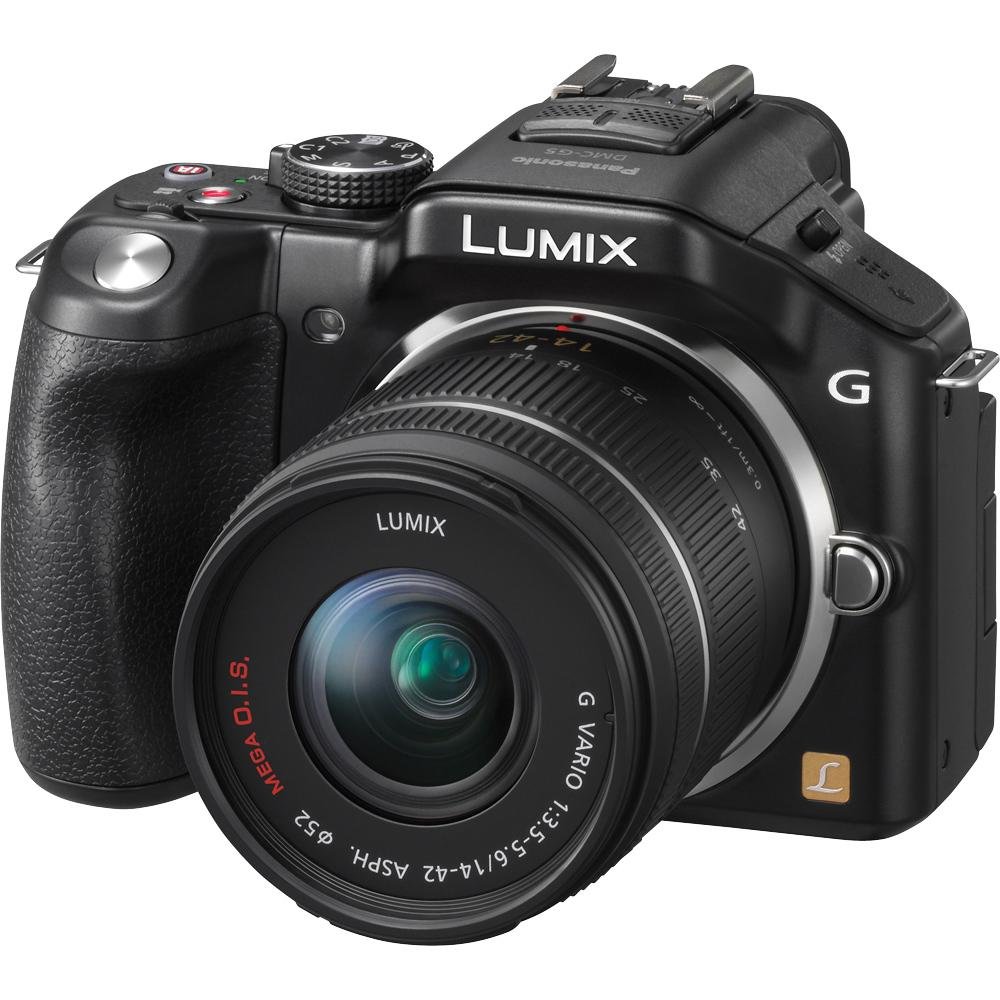


📸 Elevate your creative game with pro-level capture and style!
The Panasonic DMC-G5KK is a lightweight mirrorless camera featuring a 16MP Live MOS sensor paired with the Venus Engine 7FHD for high-quality stills and Full HD 1080p video. It boasts a versatile 14-42mm optical zoom lens, a 3-inch free-angle 920K-dot touchscreen LCD, and advanced autofocus modes including face detection and continuous servo AF. With built-in Wi-Fi, HDMI output, and compatibility with Micro Four Thirds lenses, it’s designed for professionals and enthusiasts seeking flexibility, connectivity, and superior image quality in a compact form.
| Connectivity Technology | USB, HDMI |
| Wireless Technology | Wi-Fi |
| Video Output | HDMI |
| Total USB 2.0 Ports | 1 |
| Total USB Ports | 1 |
| Total Video Out Ports | 1 |
| Shooting Modes | Automatic |
| Digital Scene Transition | zoom |
| Digital-Still | Yes |
| Movie Mode | Yes |
| Image Capture Type | Stills & Video |
| Night vision | No |
| Auto Focus Technology | Selective single-point, Face Detection, Tracking, Multi-area, Single, Continuous, Live View, Contrast Detection, Touch |
| Focus Features | Contrast Detection |
| Autofocus Points | 23 |
| Focus Type | Auto Focus |
| Focus Mode | Continuous-Servo AF (AF-C) |
| Autofocus | Yes |
| Aspect Ratio | 16:9 |
| File Format | RAW, RAW + Fine, RAW + Standard, Fine, Standard, MPO + Fine, MPO + Standard (with 3D lens in Micro Four Thirds System standard) |
| Effective Still Resolution | 16 |
| JPEG Quality Level | Normal |
| Supported Image Format | JPEG, MPO, RAW |
| Maximum Image Size | 6E+3 Pixels |
| Total Still Resolution | 16 MP |
| Maximum Focal Length | 84 Millimeters |
| Optical Zoom | 5 x |
| Lens Type | Zoom |
| Zoom | Optical Zoom |
| Camera Lens | Panasonic 14-42mm Zoom Lens |
| Minimum Focal Length | 28 Millimeters |
| Real Angle Of View | 61 Degrees |
| Digital Zoom | 2 |
| Metering Methods | Multi, Center-weighted, Spot |
| Exposure Control | Program, Manual, Aperture Priority, Shutter Priority |
| White Balance Settings | Auto |
| Self Timer | 10 seconds |
| Screen Size | 3 Inches |
| Display Type | LCD |
| Dots Per Screen | 920,000 dots |
| Display Fixture Type | Articulating |
| Touch Screen Type | Yes |
| Display Resolution Maximum | 920,000 |
| Has Color Screen | Yes |
| Flash Memory Type | SD/SDHC/SDXC |
| Write Speed | [1-20] MB/s |
| Flash Memory Speed Class | 10 or higher |
| Flash Memory Video Speed Class | Class 10 (UHS Class 1) |
| Flash Memory Bus Interface Type | SD bus interface |
| Compatible Mountings | Micro Four Thirds |
| Sensor Type | CMOS |
| Image stabilization | Optical |
| Maximum Aperture | 22 f |
| Expanded ISO Minimum | 160 |
| Photo Sensor Resolution | 16 MP |
| Photo Sensor Size | Four Thirds |
| Maximum Shutter Speed | 1/4000 seconds |
| Minimum Shutter Speed | 60 seconds |
| Form Factor | SLR-style mirrorless |
| Special Feature | Lightweight |
| Color | Black |
| Item Weight | 0.87 Pounds |
| Video Resolution | FHD 1080p |
| Viewfinder | Electronic |
| Flash Modes | Automatic |
| Camera Flash | Built-In |
| Skill Level | Professional |
| Compatible Devices | Micro Four Thirds lenses |
| Continuous Shooting | 6 |
| Aperture modes | Aperture Priority |
| Viewfinder Magnification | 1.4x |
| Audio Input | Stereo Microphone |
| Flash Sync Speed | 1/60_sec |
| Video Capture Format | MPEG-4, AVCHD |
| Expanded ISO Maximum | 12800 |
| Battery Weight | 28 Grams |
| Battery Cell Type | Lithium Ion |
| Battery Average Life | 320 Photos |
| Guide Number | 48 |
J**G
Accurate AF, Stunning Videos, Shutter Shock No More
To start with I have both the Panasonic GF5 and the G5 and I also shoot Nikon digital cameras. I've been very happy with the Panasonic G5 and M43 system. Many of the little things that bothered me with the GF5 like AF accuracy, AF hunting when recording videos, limited number of customizable function buttons, zoom lens blocking flash coverage at wide angle focal lengths, and no 1080p/60fps videos are resolved with the G5. Plus the G5 is 16MP vs the GF5 only being 12MP. The G5 also has features which my much more expensive Nikon doesn't have like an articulating touch screen and the ability to shoot 1080p/60fps videos.What I love about the G5:1. The G5 has a nice balance of buttons and customization which meets the needs of both novices and those wanting more control of their camera. For people purchasing a DSLR/DSLM camera for the time it probably won't feel as overwhelming as some DSLR's would. While it doesn't have the number of buttons as my Nikon DSLR with the use of the "Q Menu" I can get to more of what I want quicker than with my DSLR. The "Q Menu" allows you to create your personalized mini menu for quick access for those settings you adjust the most. In addition there are function buttons on the camera and touch screen which can be customized for the features you use all the time.2. The articulating screen was one of the main selling points for me when purchasing the G5. The articulating screen is great when photographing with the camera above your head and near to the ground. I actually use it almost all the time when I photograph. You are steadier when you shoot with your hands and camera at your chest versus held up to your eye. If you like shooting candids or documentary of people you can get better shots if the camera is at your chest or waist level. As soon as your camera is at your eye and pointed at a person, that person starts acting different.3. The articulating screen being a touch screen was another big selling point for me. The combination of the touch screen and pin point or single focus area creates a powerful tool for any photographer. I only shoot single focus area on my DSLR's. Unlike my Nikon DSLR which I have to hold a button down and use the pad on the back of the camera to scroll through the AF area points, with the G5 all I do is touch the area, any area except the very edge, on the screen I want the camera to focus on. Person moves from the right to the left of the frame, I touch their face, and hit the shutter button...that quick and simple. It is worth noting that the touch screen isn't as sensitive as a smart phone touch screen but it seems better than the GF5 screen.4. I found that the GF5 when shooting in the 23 AF area where the camera selects the AF point would commonly focus on the background instead the person in the foreground who was in the center of the frame and filling up a majority of the frame. The G5 doesn't have that issue. The AF with the G5 is speedy and silent which is great for photography but a must have when shooting videos. It's focus speed is as fast as much more expensive prosumer DSLR cameras. The only issue I've run into is that when shooting sequential frames in continuous AF the AF doesn't perform as accurately as my Nikon DSLR.5. The 1080p/60fps videos from the G5 are nothing short of beautiful. The 60fps produces very smooth looking videos. The 1080 resolution is very sharp and crisp looking, better than any other P&S, ILC, or DSLR I've had. The only other camera I have that shoots 60fps is the Sony HX20V. The G5 having a much larger sensor than the Sony HX20V produces a much shallower depth of field for beautiful videos. I actually like the depth of field with the G5 better than videos from APS-C cameras. The depth of field is shallow but a little greater than those from APS-C sensors. I find it to be a perfect blend for everyday videos. The AF while shooting videos is excellent also. Unlike my Nikon DSLR there is no focus hunting when shooting videos with the G5 and because the AF is silent I also don't hear the lens focusing. My GF5 even does some focus hunting.6. The digital viewfinder is actually usable with the G5. There have been considerable improvements in digital viewfinder resolution, color, and contrast in the last few years. I remember playing around with one of Sony's first DSLM cameras a few years ago which had a digital viewfinder and thinking to myself there is no way I could shoot with this camera because of the digital viewfinder.7. The G5 has an electronic shutter, E Shutter, feature to prevent shutter shock. Shutter shock occurs when the slapping of the shutter causes the sensor to vibrate when the picture is taken, some believe it can impact the OIS also, which results in a soft or slightly blurry image. It seems to primarily occur at shutter speeds of 1/60-1/250. When I heard about shutter shock and the E Shutter feature I was bit skeptical. I did a test shooting 100 frames with the E Shutter on and 100 with the E shutter off at shutter speeds of 1/60-1/320. For 50 of the frames with the E Shutter on and 50 with the E Shutter off, I used image stabilization. The other 50 for each I turned the stabilization off. People have tested the E Shutter photographing a chart while the camera was on a tripod (copy stand work), I wanted to see if there was a noticeable difference in real life photo situations. The images shot were of still life and I was hand holding the camera. When I used a telephoto focal length without stabilization I made sure my shutter speed was on the higher end of the range. The electronic shutter did give better results! I had no incidences of soft or blurry images with the E Shutter on and stabilization off. With stabilization and E Shutter on I had 2 soft or blurry images. With stabilization and E Shutter off, I had 4 soft or blurry images. The worst results came from stabilization on and E Shutter off in which I had 6 soft or blurry images. After the test I started photographing regularly with E Shutter on and have noticed more consistent, better results. Before doing the test I wasn't using E Shutter and was getting some mysteriously soft, blurry images. The downside of E Shutter is that it can't be used with the flash or ISOs greater than 1600. There can also be bending or distortion of shapes which are moving in the frame. I have witnessed the distortion once when taking a picture of someone moving in the frame while the picture was taken.8. The compactness of the G5 is a nice selling feature. While the G5 isn't as small or pocketable like the GF5 it is significantly smaller and lighter than any Nikon DSLR I've owned. It is much easier to carry around the G5 with a couple extra lenses than my Nikon with a couple extra lenses. Some people may equate the compactness and lightness of weight as being cheap or like a toy camera but I think they are missing one of the advantages of the camera and M43 system in general.What I don't like about the G5 kit:1. The biggest down side of the camera outfit is the 14-42mm kit lens. The kit lens is kind of what it is, an inexpensive lens with a plastic mount, plastic body, and sticky zoom. It takes decent enough pictures but the corners and edges are pretty soft, at times even when stopped down to f/8. I do have a full review of the kit lens for anyone interested.2. With the lowest ISO being 160 and a top shutter speed of 1/4000, on a sunny day the widest open your lens can be is f/2.8 or more commonly f/3.5. This really limits your ability to create images with a very shallow depth of field when using fast lenses.3. If you go back and forth between the screen and viewfinder the eye sensor on the camera is nice to have. It is designed to sense when your eye goes to the viewfinder. It then turn the display off and viewfinder on therefore saving battery life. Even with the eye sensor sensitivity adjusted to low it is WAY too sensitive. If a shadow passes over the eye sensor the display turns off and viewfinder turns on. Even on a cloudy day if my hand passes over the sensor, 3" inches from the camera, the display turns off.If you are already in the M43 system this is a great camera to add to your system or upgrade to. If you are looking at getting into a DSLR or DSLM camera system the decision to purchase this over other cameras similarly priced is a little more difficult decision to make. The G5 is a little more compact than an introductory DSLR. It is roughly a centimeter shorter in each dimension and weighs about 25% less than Nikon's D3200. The G5 has an articulating touch screen vs the D3200 which doesn't. The G5 shoots 1080p/60fps videos whereas the D3200 shoots 1080p/30fps. The G5 also costs $100 less than the D3200. The D3200 on the other hand has a larger sensor that performs better in low light. The D3200 has a better kit lens. The D3200 is 24MP vs the G5 which is 16MP. While M43 cameras have the best variety of lenses of any mirrorless system it still can't compete with the selection you have with Nikon or Canon. In the end it depends on which of those features are the most important to you as a buyer.
J**G
Small DSRL, big results
I have been using Panasonic Lumix cameras fort quite a while and have grown familiar with and become fond of the brand. In 2010, I bought the Lumix G1 micro 4/3 camera which was my first DSLR. I still own it and plan to use it as a backup.For a little while now, I've been looking to "upgrade" if you will and I knew a Lumix DSLR would be the way to go. After doing some research on cost and features, I decided to go with this little guy. In the short period of time I have had it and based on my own personal testing with the G5, I am pretty excited about the result.Possibly the best technical advances from my prior camera are the capability to use the LCD screen as a touch screen for controls and adjustments and the fact that this camera shoots video as well as still photographs. Another big consideration when buying this camera was that the ISO could go up to 128,000, significantly higher than the 32,000 maximum on my G1.When tested, the photo quality is very good and I have no complaints. The video is OK. It will suffice for casual recordings but if you're a serious videographer, you will likely be underwhelmed. As far as the audio for videos goes, it's more than adequate. When it comes to the camera's ISO options, I wanted to see how far I could take it before noise and graininess overwhelmed the image. I was happy to learn that noise was kept to a minimum and barely noticeable at 64,000. At the max of 128,000, noise was pretty evident but could possibly be cleaned up in a decent noise reduction program.There is a bit of a learning curve to the camera's controls and the focus can be a but temperamental with zoom lenses but overall I'm pretty happy with this purchase.
J**N
Not for someone new to DSLRs
As a parent of young kids, I wanted a camera that would be easy to use now in auto mode as I learn more about taking quality SLR photos, but this camera was not it.At this price, I thought it would be a good entry model, but I found the auto function still made focusing difficult and that indoor photos did not turn out well because of the size of the included lens along with the fact that the flash doesn't pop up automatically. I had an expert photographer friend go over it with me; he found the focusing frustrating (even after changing the focus mode) and controls cumbersome.I compared it to another, more expensive Canon camera recommended by my friend and found that one to be much simpler to use and learn on. I decided to return this one and spend a little bit more on a refurbished version of a more expensive model. Whatever DSLR you go with, you will need either a 40mm or 50mm lens for good indoor photos.Pros: The camera body is lightweight but still sturdy and is small enough to fit comfortably in a backpack or diaper bag. The menus make it easy to use right out of the box.Cons: The zoom is "sticky" as described by other reviewers. Intelligent auto mode is not as easy to use as a point and click. The special artistic modes are not as easy to use as I'd hoped (at least not to create a printable-worthy photo).Bottom-line: I did not feel I could take a quality photo right out of the box (as I could with the camera I bought after returning this one) and I would not recommend this for a first-time DSLR user because of the difficulty with proper focusing.. If you are new to DSLRs, find a friend with one you can use for a day or do multiple in-store tests before buying.
Trustpilot
1 week ago
1 month ago