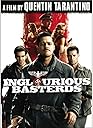

Brad Pitt takes no prisoners in Quentin Tarantino’s high-octane WWII revenge fantasy Inglourious Basterds. As war rages in Europe, a Nazi-scalping squad of American soldiers, known to their enemy as “The Basterds,” is on a daring mission to take down the leaders of the Third Reich. Bursting with “action, hair-trigger suspense and a machine-gun spray of killer dialogue” (Peter Travers, Rolling Stone), Inglourious Basterds is “another Tarantino masterpiece” (Jake Hamilton, CBS-TV)! Review: Good movie with bad title spelling - I'm not sure if the spelling of "Basterds" was intentional or not, because you never learn why it was incorrectly spelled for this movie. Anyway, the movie is great if you enjoy a good comedy with a lot blood, violence, and good looking actors. Everyone wants to see Nazis suffer, even Nazis, and this movie doesn't disappoint! Just don't let grandma watch it even if she lived during that time in history. Review: Gloriously brutal - Another epic from Q. Incredible performances from actors who are known as well as those who were unknown at that time.
| ASIN | B002T9H2LA |
| Actors | André Penvern, Brad Pitt, Christoph Waltz, Michael Bacall, Mike Myers |
| Aspect Ratio | 2.40:1 |
| Best Sellers Rank | #1,109 in Movies & TV ( See Top 100 in Movies & TV ) #7 in Military & War (Movies & TV) #114 in Drama DVDs #116 in Action & Adventure DVDs |
| Customer Reviews | 4.7 4.7 out of 5 stars (25,647) |
| Director | Quentin Tarantino |
| Dubbed: | French, Spanish |
| Is Discontinued By Manufacturer | No |
| Item model number | 1108380 |
| Language | English (Dolby Digital 5.1), French (Dolby Digital 2.0), Spanish (Dolby Digital 2.0) |
| MPAA rating | R (Restricted) |
| Media Format | AC-3, Color, Dolby, Dubbed, Multiple Formats, NTSC, Subtitled, Widescreen |
| Number of discs | 1 |
| Product Dimensions | 0.56 x 5.06 x 7.8 inches; 2.72 ounces |
| Release date | August 28, 2011 |
| Run time | 2 hours and 33 minutes |
| Studio | Universal Pictures Home Entertainment |
| Subtitles: | English |
T**R
Good movie with bad title spelling
I'm not sure if the spelling of "Basterds" was intentional or not, because you never learn why it was incorrectly spelled for this movie. Anyway, the movie is great if you enjoy a good comedy with a lot blood, violence, and good looking actors. Everyone wants to see Nazis suffer, even Nazis, and this movie doesn't disappoint! Just don't let grandma watch it even if she lived during that time in history.
S**D
Gloriously brutal
Another epic from Q. Incredible performances from actors who are known as well as those who were unknown at that time.
A**O
Great film! Magnificent!
A very dark and entertaining satirical masterpiece. The merge of history and fiction is thought provoking as well as entertaining! Bravo!
D**N
Great movie
Full of action and humor!
N**T
Something to see. Great movie!
I’m 40 years old and I’ve never seen this movie. If you haven’t seen this movie, I urge you too.
M**E
Great American film
Inglorious Basterds is, like some of Scorsese's, Paul Thomas Anderson's, Welles', and Sergio Leone's films, an operatic work about death -- or Death -- which is also amused about its own circling and coiling (and coiling and circling) around it. The best way to describe films like this is to compare them to Baroque art, a style of painting and sculpture that invites intense, even unbalanced emotional responses. Think of Bernini's intensely sexual sculptures against Michaelangelo's sculptures that show a balance of sensuality and intellect. Baroque films are edited so that scenes wittily push (or ram) together fear and comedy, anxiety, a dreamlike something in their preparation for violence, and humor. And characters take each other in often as pieces of theater, and perform for each other. As in opera they can be expressing themselves with a nearly cartoon exaggeration even as they unexpectedly stir emotions: I am dying, they seem to sing, with their guns, and this is my song of death. Song, and music in general, is key to any Tarantino film, from Reservoir Dogs ("Stuck in the Middle With You") to Pulp Fiction ("Flowers on the Wall") and Jackie Brown ("Didn't I Blow Your Mind This Time"). In Inglorious Basterds the key is the Morricone-like soundtrack that, as in Leone's films, asks us to feel the joy of the filmmaking -- the bravura assembly of images -- as well as take in more deeply the unfolding story. In this case, it is a tall tale, with many moving parts: a group of wild American Jews are put together by the American military in World War II to kill and scalp Nazis, and as the story spins up from scenes such as the early one in the German forest with the killing of a German soldier by baseball bat, we come, perhaps naturally, to an attack on the Fuhrer himself in a movie theater which has most recently played a G.W. Pabst film starring Leni Riefenstahl. There is the leader of the Basterds (played with opera buffa joy by Brad Pitt), there is the escaped Jewish girl (played with fragility and steel by Melanie Laurent) and, among a couple of dozen other speaking parts, there is the "Jew Hunter," played by Christoph Walz with a certain kind of aesthete's lightly curtailed rage that is exciting, terrifying and nervily humorous to watch. It is a film of wrought performances, and Walz's is the best. Note: if you purchase this Blu-ray/Digital package from a third-party seller, as I did, you may find that the code for downloading the digital copy has already been redeemed. You still get the Blu-ray disk, but half of the bargain is lost.
J**S
The Best Film of 2009 and one of the best of the decade!
Spoilers... I try to avoid them, but you should definitely see this film before reading this review! To say that I was eagerly anticipating this movie would be a drastic understatement. Quentin Tarantino is my favorite film maker. His films offer such an intense entertainment experience, equal parts action, comedic, and suspense. He makes films that he would like to watch, always focusing on the viewers experience above all other motivations. In my opinion, Tarantino's second film, Pulp Fiction, is the best film ever made. It's a master class in story telling, brilliantly using non-linear chapters filled with hilarious dialog and intense moments of violence to piece together a classic tale of betrayal and redemption, all while using completely unconventional and innovative script writing and film making techniques that have sense been copied to death by other screenwriters and directors. I have loved all six of Quentin's films leading up to Inglourious Basterds to varying degrees, but the anticipation hasn't been quite this high for me, this being his first "epic" since 2004's Kill Bill: Vol. 2, which combined with it's first volume, is the best film of this current decade. Even though I love Reservoir Dogs, Jackie Brown, and Death Proof, I particularly love what Quentin refers to as his "Mount Everests." These are massive undertakings for him, often taking many, many years to get on the page, much less actually production. Leading up to opening night, which was 12:01 AM on August 21, 2009, I had heard mixed reports coming from Cannes, but I knew that the art house crowd that populated the critic's screenings at that festival didn't always appreciate the wildly entertaining pulp classics that Quentin consistently provides his audiences. The trailer for the movie purposefully mis-marketed Inglourious Basterds as a bloodthirsty action movie, like a mix of The Dirty Dozen meets Hostel. It didn't completely appeal to me, but I knew Tarantino had way more up his sleeve. Inglourious Basterds is a story of Jewish vengeance, represented by a band of Jewish American soldiers (a.k.a. the Basterds, led by Brad Pitt as Lt. Aldo Raine) terrorizing Nazis behind enemy lines, and a young Jewish French girl seeking revenge for the murder of her family. The man personally responsible for this atrocity is also the one character that ties the entire film together, the antagonist Col. Hans Landa, played brilliantly and enthusiastically by German actor Christoph Waltz, as he is in almost every chapter. The quality of the performance is at least equal to other powerhouse performances this decade (e.g. Daniel Day-Lewis in There Will Be Blood and Javier Bardem in No Country For Old Men), but I cannot recall the last time I saw an actor this charismatic and so obviously in love with his craft. He won the Best Actor award at this year's Cannes Film Festival, and I fully expect him to take home an Oscar as well. The film is divided into five chapters, the first of which is titled "Once Upon a Time, in Nazi Occupied France..." This title, the beautiful opening shots of the French countryside, and the sampling from the scores from many Sergio Leone films and other westerns gives this scene the feel of a Spaghetti Western set in World War II. Once Hans Landa arrives on screen and enters the dairy farmer's house, there is about twenty minutes of typically great Quentin Tarantino dialogue, only we're having to read it in subtitles! Heaven forbid the mainstream masses knew about that before going to see the latest Brad Pitt movie! Hence, the (brilliant) mis-marketing. The majority of this film is actually in a language other than English, about equal parts German and French, with a dash of Italian for good measure. Our good friend Mr. Christoph Walt speaks each of these languages fluently throughout the film, adding to the already tour de force performance to the point of showing off. Back to the scene. It turns out that Col. Hans Landa is not only an expert linguist but a master detective hired by the Nazis for the express purpose of hunting Jews that have managed to escape the grasp of the German army. As he interrogates this dairy farmer (who looks suspiciously like Stanley Kubrick), the camera gives us more information, and tension builds until the camera finally puts us directly in front of the Col., staring into his heartless eyes for a few very uncomfortable moments. Excuse the hyperbole, but I feel that this is one of the best scenes Tarantino has ever written. It's not until the second chapter that we're introduced to the Basterds, and most of this scene is spent in the woods during an interrogation of a few hostages that the Basterds have taken after killing and scalping most of the Nazi unit. Here we meet Sgt. Hugo Stiglitz (Til Schweiger), who gets his own flashback, and Sgt. Donny Donowitz (Eli Roth), also known as the baseball bat wielding "Bear Jew." If there is one thing wrong with this movie, it's the amateur delivery of each of Eli Roth's lines. He doesn't have too many, but whenever he opens his mouth I found myself cringing; in my mind a slight casting misstep, in an otherwise flawless cast (yes, I even liked Mike Myers). We also get to see a very animated Hitler, played deliciously over-the-top by Martin Wuttke, rant about the Bear Jew to the point of delirium. Chapter three re-introduces us to the heroine Shosanna Dreyfus (Melanie Laurent), now the owner of a quaint movie theater in Paris, and her reluctant relationship to a young Private in the German army. This Private (Daniel Bruhl) is the catalyst for all of the events that follow, although Shosanna is obviously displeased by his advances. His playful banter and her distinct annoyance give us some lighter, humorous reprieve, before thrusting us again into the violent foray. This chapter also contains a great scene featuring a conversation between her and Landa over desert. The way Tarantino uses camera angles and close-ups to evoke the same feelings of tension he made us feel in the opening scene... Simply incredible. Chapter four features the longest scene in the film that has been described by some as a thirty minute version of Reservoir Dogs that takes place in a basement tavern. There are several moments during this scene in which Quentin's pacing seems to meander until he suddenly causes you to hold your breath in anticipation. The scene builds and builds and when the release comes, it is quick, violent, and glorious; a small taste of things to come. The fifth and final chapter culminates at the Shosanna's movie theater, at the premiere for a Nazi propaganda film which most of the German high command is attending. Each respective party of vengeful Jews gets basically the same idea, and the beauty is in the execution of each of these plans. One is a plan of desperation in which everything seems to go wrong. The other is a long gestating, deeply poetic, primal scream of a plan that culminates in some of the most haunting and enduring images Tarantino, or anyone, has put on screen. I've listened to and read many critics and film geeks argue the meaning and purpose of this film, and some have submitted some pretty good arguments. There is definitely much irony throughout the film, especially when related to the violence. When a German officer is beat to death with a baseball bat, Tarantino presents him as an honorable soldier rather than a repulsive monster, which makes the beating and subsequent guffaws from the audience sit uneasily with a discerning audience member. Then there are the images of a grossly over-animated Adolf Hitler and his cronies, in a movie theater, their laughter and cheers erupting into a blood-thirsty frenzy as they watch a propaganda film that glorifies the death of hundreds of American soldiers. All the while a group of blood-thirsty Americans clap and cheer at the insanity that ensues, which can be described as a violent orgasm of death, or maybe... a holocaust. There is so much substance here to be analyzed and scrutinized, but Tarantino himself has mentioned that he doesn't even try to examine the subtext of his films, although he recognizes it is there. Mostly he is determined to create a masterpiece each time he makes a film, and not for art's sake, but for ours. He is determined to create entertainment for an audience to enjoy over and over again, always finding something new to take away from it. I've seen Inglourious Basterds three times so far in the theater, and plan on seeing it once more before it leaves. Each time I notice more and more, and it leaves me somewhat contemplative, but always smiling. One obvious theme is the power of cinema, and Quentin has mentioned that this film is essentially a love letter to cinema. Tarantino has always been accused of stealing from other movies, however, the accusers hardly attempt to apply the same level of scrutiny to other beloved directors (e.g. Martin Scorsese) who have not only revolutionized film, but as devout students of film, borrowed heavily from the great film makers who have come before and inspired them to make film in the first place. With Inglourious Basterds, Quentin Tarantino has melded together classic themes, settings, camera shots and musical cues with his unique style of writing and directing to create a completely fresh and unique experience. The final scene is delivered almost like a punch-line, or maybe the closing message of a morality tale; either way it is just the right touch to top off his cinematic masterpiece. Monsieur Tarantino, to you, your cast, and your crew I say, "Bravo!" [...]
O**Y
good product meets expectations
Good movie
N**Y
great movie watched several times
J**E
Excelent Film .
J**S
Tenemos lo que todo un coleccionista le podria gustar. Un juego de cartas, y postales, ademas del librito con fotos de la pelicula. Si estas leyendo esto, sabes que es uno de entre los mejores trabajos de Tarantino. Si ya viste la pelicula, y buscas tenerla en una buena edicion. Esta es la buena, y tiene doblaje en latino, por si querias saber.
S**E
Tarantino ci regala una visione alternativa della seconda guerra mondiale nella Francia occupata dai nazisti. Spettacolare, crudo ma allo stesso tempo Intrattiene alla poltrona per dialoghi taglienti e trama curiosa.
S**A
...und eine weitere Rezension die Schar der Film-"Freunde" spalte! Ehrlich gesagt bin ich erschrocken, dass der Film solch zahlreiche negative Rezensionen erhält. Dies geschieht meines Erachtens völlig zu unrecht! "Langweilig", "mies", "schlecht", "der schlechteste Tarantino aller Zeiten" - das sind die Attribute, mit denen dieser Film beschrieben wird. Scheinbar waren viele Zuschauer mit "Inglourious Basterds" komplett überfordert!!! Hier nun der Versuch, in der Kürze einer Film-Rezension bei einem Internet-Shop einige Dinge zu (er)klären: Womit haben wir es hier überhaupt zu tun? IB ist in meinen Augen erst mal eine Spielwiese für den kreativsten Filmschaffenden (jedenfalls in der A-Liga) unserer Zeit. Der Film ist eine riesengroße Satire auf das, was die Amerikaner gerne gesehen hätten, auf das, wie sie sich selber sehen(oder am liebsten sehen würden) und den amerikanischen Blick auf die Welt in der Mitte des 20. Jahrhunderts (und vermutlich auch weit darüber hinaus). Macht dies schon eine Allegorie? Diese Frage soll jeder für sich selbst beantworten! Dieses gezeigte Weltbild wird jedoch immer wieder erschüttert durch Handlungen und Charaktereigenschaften einzelner Personen/Figuren, die in ihrer Komplexität plötzlich den selbsternannten "Rettern" turmhoch überlegen sind - sei es in Sachen Mut (Shoshanna, der dt. Feldwebel Rachtman), Intellekt und Gerissenheit (Hans Landa) oder Loyalität. Die amerikanische "Überlegenheit" erweist sich als purer Zufall. Die amerikanische Mentalität ("Wir tun das Richtige, also ist die Wahl der Mittel nebensächlich"), die heute noch Gültigkeit besitzt wird hier demnach komplett ad absurdum geführt! Doch begeben wir uns einmal weg von der politischen Ebene, hin zum Filmischen: Der Film hat die Form eines klassischen Dramas in fünf Akten, die Tarantino-typisch auch als solche plakativ deklariert werden: Den Einstieg bildet eine Hommage an den Italo-Western, repräsentiert durch die Anfangssequenz ("Once upon a time in Nazi-occupied France..." als Anspielung auf Leone!), untermal mit der Musik des absoluten Großmeisters Ennio Morricone! Landa verhört einen französischen Bauern wegen des Verdachts, eine jüdische Familie zu verstecken. An alle, denen das nicht aufgefallen ist: Schade! Euch wird noch viel mehr entgehen/ entgangen sein! Das zweite Kapitel - bitte nicht wieder Kritik an Mr. Pitts Schauspielkunst - soll uns den "Haufen" vorstellen, der sich durch die deutschen Reihen "arbeiten" wird. Hier, das gebe ich zu, wirkt die Ansprache von Aldo, dem Apachen in der Synchro weniger eindringlich als im Original mit prima Akzent! Die gefühlmäßige Kälte (Routine) wird hier auf den Punkt getroffen! Im weiteren Verlauf bekomme wir immer wieder Klischees vorgesetzt - den cholerischen "Führer", den "treuen und tapferen Deutschen" Werner Rachtman (hier besonders intensiv, da für amerikanische Verhältnisse im Grunde deutlich "zu" positiv dargestellt), den snobistischen Engländer, die unterkühlte deutsche Schauspielerin, den jungen Kriegshelden, die immer in den gleichen Platitüden plappernden Amis... Doch jede der Figuren wird von den entsprechenden Schauspielern mit teils unglaublicher Tiefe versehen! Besonders hervorheben möchte ich an dieser Stelle Daniel Brühl, bei dem man ständig zwischen Abscheu und Sympathie hin und her gerissen ist - und BLEIBT! Eine abschließende Festlegung auf eine Haltung bleibt meiner Meinung nach beinahe unmöglich! 3. Akt - Die Keller-/ Tavernensznene: hier jongliert QT erneut mit dutzenden Anspielungen, die von Karl May über Edgar Wallace bis hin zu Alfred Hitchkock reichen. Dazu werden Namen von Schauspielern und Filmen gleich im Dutzend genannt oder angedeutet... Ganz groß gemacht, denn es wirkt niemals aufdringlich! Dazu eines der ABSOLUTEN Highlights: es wird durch Dialog eine Spannung kreiert, die im Kino ihresgleichen sucht. August Diehl hat hier (s)einen Auftritt als SS-Mann, der dem Besucher mehr als nur in Erinnerung bleiben wird! Plötzlich und unversehen ändert sich hier auch der Lauf der Dinge... "Operation Kino" bildet den 4. Akt und zeigt die zeitweise Hilflosigkeit der agierenden Personen, die natürlich Konsequenzen hat: der Plan gerät mächtig aus dem Ruder! Köstlich hierbei der Auftritt von Herrn Pitt als italienischer "Ausnahmedarsteller" nebst seiner Kameraleute, die jedoch leider kaum ihre eigene "Muttersprache" sprechen. Optisch wird hier mit dem Aussehen von Marlon Brando in "Der Pate" kokettiert, die Gags sitzen. Dies war übrigens schon immer Tarantinos große Stärke, der sog. "comic relief", also dass unmittelbar nach besonders spannenden (oder grausamen) Momenten ein komisches Element eingebaut wird, das die Situation etwas entschärft. Das große Finale bildet dann der 5. Akt: "Die Rache des Riesengesichts". Hierauf möchte ich nicht näher eingehen, doch es sei gesagt, dass sich einige dinge vollkommen anders als erwartet entwickeln! Dieses "Drama" ist natürlich wieder "gewürzt" mit plakativen Schriftzügen und Einblendungen, die an die Trash-movies der 60er und 70er erinnern oder an Fernseh- und Printwerbung dieser Zeit: laut, grell, aufdringlich. "Die Botschaft MUSS in Eure Köpfe!" scheint das Motto zu sein! Abgesehen davon finden sich noch einige andere "Gags" im Film, die so gut versteckt sind, dass man schon genau hinschauen muss: Wer hat denn z.B. BOB ROSS im Film entdeckt??? Hadelt es sich vielleicht bei den kleineren und größeren Katastrophen im Film bloß um "happy little accidents", die wir zu unserem Vorteil nutzen können? Wer hat die Anspielung auf Keinohrhasen entdeckt??? Tarantinos Fußfetisch - auch hier wieder bedient??? Wir erinern uns - es begann eig. mit Salma Hayek in "From Dusk Till Dawn"... Dies alles wird von QT erneut mit einem Sountrack untermalt, den nur ER in dieser Form liefern kann. Besonders das musikalische Herzstück des Films "Cat People" von David Bowie mit der markanten Zeile "Turning out the fire with gasoline" zeigt uns doch, was wir von alledem zu halten haben: wenn man Feuer mit Benzin bekämpfen will, muss man verdammt noch mal GANZ GENAU wissen, was man da tut, denn ansonten verbrennt man sich ganz gehörig die Finger!!! Zuletzt möchte ich noch einige schauspielerische Leistungen ansprechen: Christoph Waltz - UNGLAUBLICH!!! Von Sherlock Holmes über wahnsinnigen Killer und eiskalt berechnende Bestie bis hin zu Fähnchen im Wind ist hier ALLES vertreten, glaubhafter als ich es bisher gesehen habe! Schon jetzt legendär! Melanie Laurent - spielt Diane Kruger locker an die Wand. Neues und unverbrauchtes Gesicht, tolle Tiefe! Großes Kino! Daniel Brühl - Laurents Gegenpart und Nemesis, großartig interpretiert! Alles in allem mehr als nur eine Empfehlung für größere Aufgaben! Til Schweiger - gewohnt stoisch in seiner Mimik und wortkarg, dennoch überzeugend! Diane Kruger und Eli Roth - die beiden schauspielerischen Tiefpunkte im Film August Diehl - BEÄNGSTIGEND GUT!!! Mehr braucht man nicht sagen! Denis Menochet - Puuuh!!! Intensiv!!! Was bleibt nun am Ende übrig? Eine Hommage an das Kino an sich, eine Kollage unverdauter amerikanischer Erinnerungen und sozio-kultureller Missstände? Ein modernes Märchen von dem, was hätte sein können? Hier möchte ich auf alle Fragen mit "JA" antworten. Vor allem bleibt in meinen Augen ein wirklich großes Stück Kino, das man kaum genug loben kann! Alles andere als 5 Sterne ist in meinen Augen ein Verkennen der Kunstfertigkeit dieses Regisseurs!
Trustpilot
4 days ago
1 month ago