Planet of Slums (Essential Mike Davis)
Product ID: 41402854
Desertcart purchases this item on your behalf and handles shipping, customs, and support to Ecuador.
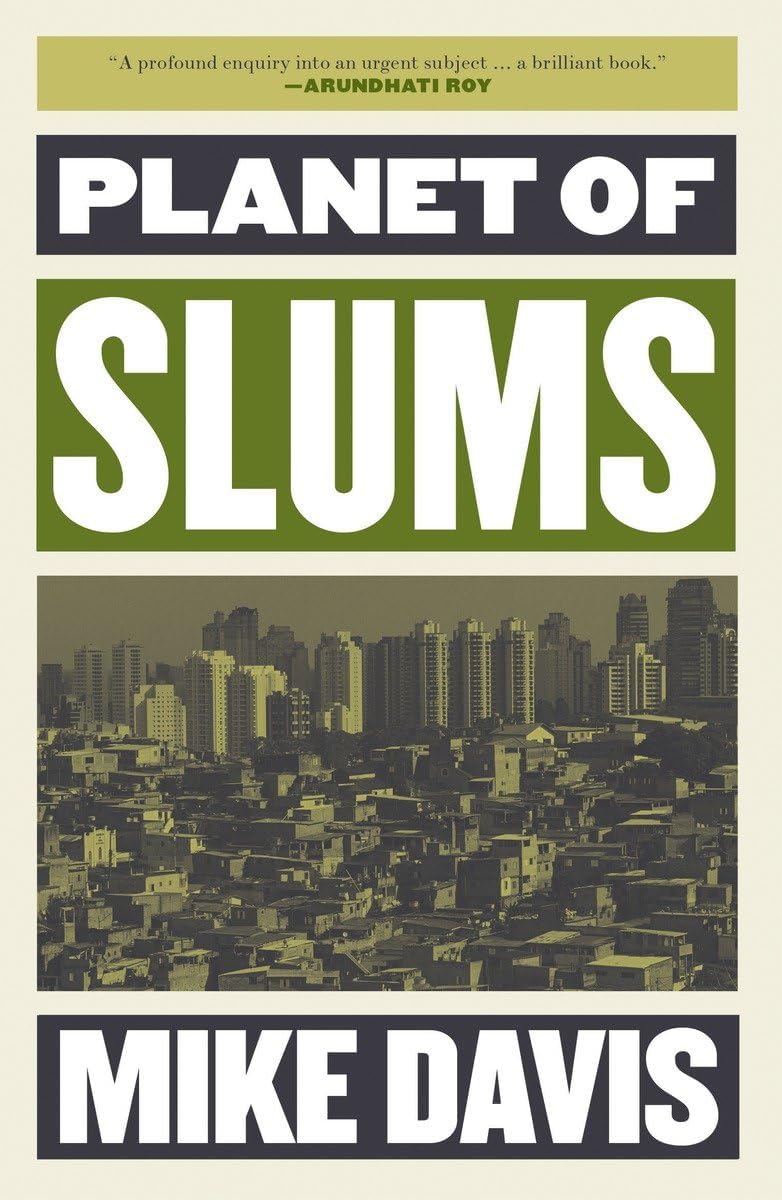
The “profound . . . brilliant” account of the rise of the world’s slums and the failures of modern urbanization—by the world’s leading urbanist (Arundhati Roy, activist and Booker Prize–winning author) According to the United Nations, more than one billion people now live in the slums of the cities of the South. In this brilliant and ambitious book, Mike Davis explores the future of a radically unequal and explosively unstable urban world. From the sprawling barricadas of Lima to the garbage hills of Manila, urbanization has been disconnected from industrialization, and even from economic growth. Davis portrays a vast humanity warehoused in shantytowns and exiled from the formal world economy. He argues that the rise of this informal urban proletariat is a wholly unforeseen development, and asks whether the great slums, as a terrified Victorian middle class once imagined, are volcanoes waiting to erupt. Review: important! - great book with important information about a huge problem that is mostly under the radar... Review: Depressing but true - If one just looked at the figures over the last twenty or so years there has been a lot of economic growth in Asia and Latin America. Africa is still troubled with a lot of the sub Sahara countries having negative growth. On balance though one would expect the lot of people in poor countries to be improving. Not so according to this book. What has been happening is incredible increases in urbanisation. However this urbanisation is in the form of slums. Slums in poorer countries are portrayed as hell holes. People live in grossly overcrowded housing with no access to fresh water. In the slum cities of the third world there is no provision for removal of sewerage so that it runs into the fresh water supply (Sao Paulo) or simply is deposited on the ground. The failure to treat sewerage results in large numbers of deaths mainly to children through dysentery and cholera. The vast majority of those who live in the slums have the most marginal of jobs. Sitting beside a road selling a few vegetables, cleaning shoes a few times a day. Driving taxis for a few dollars a day. (Apparently one in 7 cars in Lima is a taxi.) One of the tragedies of the slums is that the desperation of families leads to children below 14 being the bread winners of families. Working in Indian textile or carpet factories for minuscule wages for 12 hours a day, losing their childhood and any access to education. The book is a sustained attack on the Peruvian economist De Soto who posited a theory that the way to overcome the problem of slums is to give title to the slum dwellers of the land they squat on and to make available small loans for "business enterprises". What the book suggests is that in the last twenty or so years since the development of free market ideologies have led to the enforced retreat of the state in poorer countries from economic life there has only been disaster. Potentially the state could do something about water provision, housing or sewerage removal but the poorer countries are at the mercy of international institutions which prevent such anti market activity by tying conditions to loans. The life of slum dwellers is so marginalised that title to slum land will achieve nothing. The book rather resembles Engels' book on the condition of the English working class in 1844. It is full of rather depressing facts and figures with anecdotes to bring home the nature of the misery and the total degradation of life that exists in the slums. Not a pleasant read but something which is a sober reminder that growth rates alone do not translate automatically into the reduction of poverty or human misery.
| Best Sellers Rank | #804,501 in Books ( See Top 100 in Books ) #289 in Radical Political Thought #290 in Globalization & Politics #4,891 in Sociology Reference |
| Customer Reviews | 4.4 out of 5 stars 251 Reviews |
D**K
important!
great book with important information about a huge problem that is mostly under the radar...
T**O
Depressing but true
If one just looked at the figures over the last twenty or so years there has been a lot of economic growth in Asia and Latin America. Africa is still troubled with a lot of the sub Sahara countries having negative growth. On balance though one would expect the lot of people in poor countries to be improving. Not so according to this book. What has been happening is incredible increases in urbanisation. However this urbanisation is in the form of slums. Slums in poorer countries are portrayed as hell holes. People live in grossly overcrowded housing with no access to fresh water. In the slum cities of the third world there is no provision for removal of sewerage so that it runs into the fresh water supply (Sao Paulo) or simply is deposited on the ground. The failure to treat sewerage results in large numbers of deaths mainly to children through dysentery and cholera. The vast majority of those who live in the slums have the most marginal of jobs. Sitting beside a road selling a few vegetables, cleaning shoes a few times a day. Driving taxis for a few dollars a day. (Apparently one in 7 cars in Lima is a taxi.) One of the tragedies of the slums is that the desperation of families leads to children below 14 being the bread winners of families. Working in Indian textile or carpet factories for minuscule wages for 12 hours a day, losing their childhood and any access to education. The book is a sustained attack on the Peruvian economist De Soto who posited a theory that the way to overcome the problem of slums is to give title to the slum dwellers of the land they squat on and to make available small loans for "business enterprises". What the book suggests is that in the last twenty or so years since the development of free market ideologies have led to the enforced retreat of the state in poorer countries from economic life there has only been disaster. Potentially the state could do something about water provision, housing or sewerage removal but the poorer countries are at the mercy of international institutions which prevent such anti market activity by tying conditions to loans. The life of slum dwellers is so marginalised that title to slum land will achieve nothing. The book rather resembles Engels' book on the condition of the English working class in 1844. It is full of rather depressing facts and figures with anecdotes to bring home the nature of the misery and the total degradation of life that exists in the slums. Not a pleasant read but something which is a sober reminder that growth rates alone do not translate automatically into the reduction of poverty or human misery.
D**A
Essential Reading
Planet of Slums has several arguments but I would distill the primary ones as follows: 1. The end of the Cold War "liberated" capital to spread to all those portions of the world formerly dominated by the Soviet Union and its allies. Parallel to this economic theories known as "neoliberalism" arose in the 1970s and became dominant by the 1990s. Neoliberal ideology advocates deregulation of industry, the downsizing of government social programs, and a broken "truce" with labor that in the US had existed in fragile form since the New Deal. 2. This spread of capitalism, often referred to as "globalization," has produced for the first time a truly global labor force. The competitive pressure is so intense, as any job is better than no job at all, that workers the world over are willing to take what they can. The world is teeming with an awful, terrible, "surplus humanity" living marginalized lives of poverty, misery, and violence. 3. At the same time, the world's population keeps getting bigger, and more and more urban. This in turn continues to expand the potential labor pool, driving wages down even further. The wage gap between the rich and poor, both between nations *and* within nations, grows wider and deeper. The naked reality of this becomes more visible with each succeeding economic crisis. 4. Rather than face the consequences of what neoliberal ideology was allowed to unleash global elites, led by the military might of the United States, whose corporations continue to amass enormous profits, have focused on expanding and developing their instruments of order-keeping, cleverly disguised under misleading umbrellas of "wars on ...". Terrorism, drugs, piracy, are just so many smokescreens. 5. This process cannot continue permanently. There is a simmering anger beneath the surface that, for now, expresses itself only in isolated outbursts that high-tech campaigns of repression are capable of pacifying. Someday, however, the simmer may reach a boil and the eruption will be more than any nation can handle.
K**E
when you need to challenge you assumptions about the world we live in
there is no better place than to read a book written by Mike Davis. This is not the longest of tracks, nor the most poetic of his works, but what it lacks in length and drama it makes up for with succinct empirical analysis and the seriousness with which he addresses the plight of the vast majority of humanity. there is no easy way of getting around the issue of capitalism and the production of poverty and immiseration. Mike Davis makes sure you have a good understanding of why the planet is growing slums faster than it is growing the so called middle class. After reading this book, if you are not shaken by the new normal of global immiseration, you will at least be forced to question what you thought you knew about the world in which we live, and the policies of global elites driving this planet backwards into the abyss. if nothing else, reading this book will open some people's eyes to the fiction of the friedman's of the world peddling the nonsense of flat earth economics.
J**N
Problems of urbanization in the Third World
This book deals with the rise of urbanization in the Third World now and in the future. The consequences of millions of people packed into cities lacking the infrastructure to handle them are a public health and ecological disaster for their inhabitants and ultimately for the rest of the world. Imagine living in a city where there is one toilet per hundreds or even thousands of people. It is hard for people living in North America to reckon with this because, as Mike Davis points out, the worst examples of this are hidden in undeveloped areas of the Eastern Hemisphere. This is an excellent book that you should read with _The Monster at Our Door: The Global Threat of Avian Flu_ also by Mike Davis. UPDATE(O4/05/2011): Books that I recommend to read with this: _Urban Guerrilla Warfare_ by Anthony James Joes, _New Religions as Global Cultures: _Making the Human Sacred_ by Irving Hexham and Karla Poewe, and _The Next Christendom: The Coming of Global Christianity_ by Phillip Jenkins.
A**R
its nice to read and very interesting for everybody who wants ...
he has some points clearly. its nice to read and very interesting for everybody who wants to know more about a topic that is often treated in a very superficial way where international institutions and politicians are not blamed for what they are -partly- responsible. however it left me with two not so positive impressions: 1. sometimes he uses numbers that sound impressive but dont do anything to describe the bigger picture. the typical "in this period of time more people settled in slums than compared to the years of victorian colonialism ..." nice to know but this fact does not provide me with the bigger picture. it can even distort the truth, which relates to my second point. instead of giving seemingly random numbers of inequality, it would be nice to have the complete distributions and facts. the underlying fundament of facts seems rather thin for a book like this. at least he does not mention them. 2. he clearly had the intention to blame worldbank and imf for all the development. it is obvious that these institutions are not the charities and development helpers that some people think they may be but its common ground among most of the scientists in this area that they are not the only ones to blame. so i am not sure what share of the truth mr davis provided in his book ...
D**N
A Wake Up Call that will be Ignored
Davis has put together a thorough and damning indictment of the indifference of the human race to the plight of those who are victims of its very mixed economic success. By using mostly official and well credentialed sources, he builds up a picture of the third of humanity that must eke out its existence under conditions that those who are reading this review are unlikely to be able to even imagine. This situation, though Davis does not point the finger that sharply, is the result of both the success of modern medicine in reducing mortality (and hence increasing successful fertility) and an economic system that favors those who have already succeeded - those with education and contacts, however limited, against those without, many of whom have been kept there by the very governments purporting to be in the business of helping them. It is a terrible and tragic story, one likely to have consequences far more difficult to manage than even the daily miseries of the new urban migrants to the great slums of the third world cities. I can only hope that the world will wake up and begin to do something serious about the abuse of people that goes on daily in our midst, but after a lifetime of close personal contact with the situation in India, I am afraid that the very human tendency to look away will prevail, to our ultimate cost.
M**S
Landmark book on the bottom of the housing world
Should be a part of every educated person's knowledge. A huge proportion of people on the planet are living in slums. Davis describes the worldwide geographical distribution of slums, and provides important history on how major international financial governing agencies drastically increased the prevalence of slums in much of the third world.
A**E
Buen libro
Un libro más al estante.
R**L
Five Stars
All Good. Many thanks!
P**A
Très accessible
Excellent. Je recommande vivement ce livre à toutes les personnes ayant envie d'ouvrir leur horizons et de comprendre les phénomènes urbains.
A**O
Todo muy bien
Bien
N**I
happy with the purchse
Happy with the shipping. Great book by Mike Davis. Read it a while ago and just needed to own a copy.
Trustpilot
2 weeks ago
5 days ago