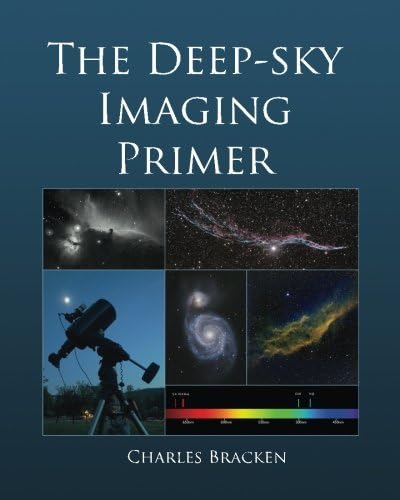
The Deep-sky Imaging Primer
Product ID: 3694821
Desertcart purchases this item on your behalf and handles shipping, customs, and support to Ecuador.
The Deep-sky Imaging Primer [Charles Bracken] on desertcart.com. *FREE* shipping on qualifying offers. The Deep-sky Imaging Primer Review: CCD Imaging for the non-PHDs in Math/Statistics/Engineering - Here's the "I'm too Lazy to Read the Whole Review Summary" Overall, this is an excellent reference and will provide a foundation to the beginning and intermediate imager. Excellent discussion of signal, noise, CCD operation, etc. There is information in this book even for the advanced imager. Review I purchased this book based on the other reviews and a desire to better understand CCDs, noise, signal and image calibration/processing as these topics relate to astronomical imaging. Charles Bracken delivers on all these subjects (and more) in a concise, understandable way. The first two chapters of the book deal with how a CCD sensors actually works, types of noise and signal to noise ratio. I think these chapters are so good they're worth the price of the book alone. Don't think if you're an imaging veteran these two chapters are too elementary - I would guess most people who read this book/chapter will walk away saying "I didn't know that..." or "So that's what ___ is". Bracken supports the topic with a small amount of math, but explains virtually all the math terms along the way; i.e. Standard Deviation, mean, etc. Other texts I've read quickly devolve into the mathematics without adequately preparing the reader. These initial chapters (chapters 1 and 2) are the best I've read on these subjects and will allow you to answer questions like "Do I need bias frames if I'm not scaling my darks?", "What is my true signal to noise ratio?", "Why does imaging under a dark sky matter?", "What is noise in a mathematical sense?". You may know these answers already, but after reading this book, I can say with confidence you'll have a deeper understanding of the underlying concepts. The other chapters are equally well written and applicable to both CCD and DSLR users. The chapters on image calibration are particularly good and there are detailed image processing examples to demonstrate the concepts. Review: I wish I had this book when I started with Astrophotography! - This is a great guide for the basics of astrophotography. There is a good balance between theory and application - and the theory is presented clearly and simply so it is understandable! Chapters are on the shorter side and don't overwhelm with information, nor are they so short they leave more questions than they answer. All aspects of deep space imaging are covered, and at the end of the book are two examples of image processing (including one for DSLR cameras!) Even though this is written for beginning imagers, I think anyone will benefit from the book. Reviewing the basics and creating a solid foundation go hand in hand. Like many other books being published on imaging, the information is out there already. In this case, you don't have to hunt the internet or get conflicting advice from well-meaning friends. Charles Bracken has brought together what you need to know and presents it in a format that makes it easy to grasp and apply. Well worth the money, you'll come back to this book again and again.
| Best Sellers Rank | #3,240,482 in Books ( See Top 100 in Books ) |
| Customer Reviews | 4.8 out of 5 stars 359 Reviews |
M**N
CCD Imaging for the non-PHDs in Math/Statistics/Engineering
Here's the "I'm too Lazy to Read the Whole Review Summary" Overall, this is an excellent reference and will provide a foundation to the beginning and intermediate imager. Excellent discussion of signal, noise, CCD operation, etc. There is information in this book even for the advanced imager. Review I purchased this book based on the other reviews and a desire to better understand CCDs, noise, signal and image calibration/processing as these topics relate to astronomical imaging. Charles Bracken delivers on all these subjects (and more) in a concise, understandable way. The first two chapters of the book deal with how a CCD sensors actually works, types of noise and signal to noise ratio. I think these chapters are so good they're worth the price of the book alone. Don't think if you're an imaging veteran these two chapters are too elementary - I would guess most people who read this book/chapter will walk away saying "I didn't know that..." or "So that's what ___ is". Bracken supports the topic with a small amount of math, but explains virtually all the math terms along the way; i.e. Standard Deviation, mean, etc. Other texts I've read quickly devolve into the mathematics without adequately preparing the reader. These initial chapters (chapters 1 and 2) are the best I've read on these subjects and will allow you to answer questions like "Do I need bias frames if I'm not scaling my darks?", "What is my true signal to noise ratio?", "Why does imaging under a dark sky matter?", "What is noise in a mathematical sense?". You may know these answers already, but after reading this book, I can say with confidence you'll have a deeper understanding of the underlying concepts. The other chapters are equally well written and applicable to both CCD and DSLR users. The chapters on image calibration are particularly good and there are detailed image processing examples to demonstrate the concepts.
F**D
I wish I had this book when I started with Astrophotography!
This is a great guide for the basics of astrophotography. There is a good balance between theory and application - and the theory is presented clearly and simply so it is understandable! Chapters are on the shorter side and don't overwhelm with information, nor are they so short they leave more questions than they answer. All aspects of deep space imaging are covered, and at the end of the book are two examples of image processing (including one for DSLR cameras!) Even though this is written for beginning imagers, I think anyone will benefit from the book. Reviewing the basics and creating a solid foundation go hand in hand. Like many other books being published on imaging, the information is out there already. In this case, you don't have to hunt the internet or get conflicting advice from well-meaning friends. Charles Bracken has brought together what you need to know and presents it in a format that makes it easy to grasp and apply. Well worth the money, you'll come back to this book again and again.
D**Y
DEFINITELY a title to start out with: A "must have" book.
I agree with the other 5-star reviewers in recommending this book, but have a couple of additional points to make. I purchased two books on this subject together: This one, "The Deep-Sky Imaging Guide" and the second title "Getting Started: Long Exposure Astrophotography" by Allan Hall (which I also plan on reviewing). I do not regret getting the two titles together. Charles Bracken has created a wonderful, and a BEAUTIFUL, book. For one thing, he uses a lot of COLOR photos and illustrations (where some do not). It may seem a little thin to some at 202 pages, but the type is smaller than "normal" and so this book could have easily been 300 pages if set at a different type size. He has used a two-column per page text layout, making it very readable. This means many of the illustrations, like software screenshots, are also one column wide which seems a little small but is still readable. Helpful tips and supplemental information are set off in darker boxes within the text. The first section of this book (through page 36) covers fundamental concepts of how electronic imaging works "with special attention given to the concepts of signal and noise. This will help you make informed decisions about equipment and processing". This information applies regardless of whether you are using a digital camera or a CCD device. I believe that too many people rush out to buy equipment before understanding these important concepts, and so often regret some of the purchases that they have made. The next section of the of the book (through page 98) covers concepts that it is necessary to understand in the Image Acquisition side of things. The 2nd half of the book (section 3) deals with processing those images to get the most out of the information you have captured. Post-processing sections of this book employ Photoshop. As the book itself says, "Version CS3 is used for the processing illustrations and examples, but the tools are nearly the same from CS3 on. In subsequent versions the interface has changed slightly and some new tools were added, but everything shown is possible in the newer versions. While expensive, Photoshop is the de facto image processing standard for other kinds of photography, and it currently appears to be the most popular choice for astronomical image processing as well." He also employs several Photoshop plug-ins. The end of the post-processing section concludes with two very helpful chapters covering start-to-finish walk-through examples of the concepts previously covered: "DSLR Processing Example: The Witch's Broom Nebula" and "CCD Processing Example: The Rosette Nebula in Narrowband". I have a hard time seeing how anyone would be disappointed by this wonderful book. If you are looking for specific equipment recommendations you will have to look elsewhere. In my opinion, Bracken has, for the most part, wisely avoided this thus making his information a little more "timeless" than those that spend a lot of time on specific equipment and tools. But you will feel far better informed in understanding the various trade-offs between different approaches and in order to choose which pieces are right for you and your pocketbook.
K**R
A good book that should be a part of your collection, but not the only part.
As others have mentioned, this is in many ways a fantastic technical reference book. It covers most aspects of astrophotography nicely and is a great source for esoterica not readily available outside of a textbook. It is packed full of information and covers many (not all) subjects in exquisite detail. It is a reference that can be pulled from the shelf to brush up on topics, and parts of it could serve as a textbook in a serious beginner’s class on the subject. I highly recommend it to the person who has at least some prior knowledge of the topic, has a keen desire and aptitude to learn the mysteries of taking pictures of deep space, and wishes to know why that labor intensive pursuit is simultaneously frustrating and rewarding. I do have a couple of nitpicks, however. First, although it tackles many relevant topics, it is a little thin on bringing them all together. For instance, it goes into great detail on how sensors work, how noise versus signal can confound the imager and yet be overcome, and how spatial separation, angular separation, focal length, and aperture size determine what size photosites are most appropriate. In addition, the sections on color theory and image processing are excellent. But at the end of the day, there is not a strong emphasis on how to make this work in the real world. A person may not be able to take these individual entities and fuse them into a plan for buying the right telescope and camera. Second, I think this book finds itself in that odd place where it is either too technical or not quite technical enough, kind of like warm tea: it should either go into more detail and explain completely the theories behind many of the subjects, or strip away some of the deeper stuff and leave just the goodies at the end. My profession required years of intense study in optics, and as such I find that many of the concepts (diffraction, quantum theory, Rayleigh’s limits, Strehl ratio, etc.) are addressed either too lightly for the professional or too heavily for the beginner. It seems that the author touches the tips of many icebergs, but often dips below the water’s surface in an attempt to explore the remaining ninety percent of the topic while only succeeding in drowning the uninitiated in details. I might suggest that edition three of this book take one of two directions: either double its size, add in the theory, and make it a real textbook, or take away some of the deeper points and make it a proper introduction for the serious amateur. The author certainly has abundant knowledge and experience, and perhaps by more closely defining a target audience he could satisfy either type of reader more deeply. Nevertheless, despite my complaints, this is actually a high quality book full of useful information, and I recommend it to any serious enthusiast.
S**Z
Get Sirius
If you are at all interested in astrophotography, and are slightly more than a rank beginner but less than a PhD authority, then this is the book for you. Forget the manuals of MaximDL, PixInsight, CCDOPs and EOS for awhile, and put aside the Photoshop Astronomy or the New CCD Astronomy bibles, and clarify your palate with this pricey, but totally worthwhile, overview of the subject. While all those programs, manuals and bibles are certainly necessary, this book flies high above the details and protocols, and instead presents the general concepts common to all of the programs. Braken does not trivialize, but simplifies, using clearly written prose that seems determined to make us understand, as well as many colorful and convincing charts and diagrams, If you want to get serious about concepts, without bogging down in the quicksand of the Internet , then get this Primer and use it as a trusty guidebook. (PS Much as I like this book, I fear there is a serious typo in the second equation on Page 60. I think the numerator should be "d"(the size of one dimension of the sensor, as stated in the first equation) and not "a"(which usually refers to aperature.)
J**Q
THE BEST BOOK ON (deep space) ASTROPHOTOGRAPHY period!
I have purchased many books on the subject but this is by far THE BEST BOOK ON (deep space) ASTROPHOTOGRAPHY period! ... Mr. Bracken writes intelligently and to the point on how and why to do things and how to make informed decisions. His illustrations are perfect and there are no stories and B.S. to get in the way. He also explains things scientifically and will state that "Some people think this and some people think that" and then goes on to explain it objectively. I wish I would have purchased this book first BEFORE WASTING A TON OF MONEY on the wrong equipment. THANK YOU Mr. Bracken for this wonderful book, it will remain in my library front and center
B**R
To the point…
After purchasing 5 Astrophotography/ Astronomy books this is by far the best written, most organized and most informative-with the end goal in mind. Two of the 5 are novels of experience with some advice thrown in, another a catalog of equipment and the 4th a great book. That book is The Astrophotography Manual by Chris Woodhouse. The Deep-Sky Imaging Primer is just that and well worth the price.
L**S
and it was a great resource, with PI up on the screen
This is the first book review I have ever written - and this book deserves the 5 stars that I am giving it. Yes, it may take several subsequent reads of the same topic to really get a grasp, but it is thorough, thoughtful and very well written. In my case, I am a new user to Pixinsight, and it was a great resource, with PI up on the screen, to get to know the basics and then some. Great book! WHT IS THERE NOT A KINDLE VERSION? - I would purchase that as well.
Trustpilot
1 month ago
3 weeks ago