
Buy anything from 5,000+ international stores. One checkout price. No surprise fees. Join 2M+ shoppers on Desertcart.
Desertcart purchases this item on your behalf and handles shipping, customs, and support to Ecuador.
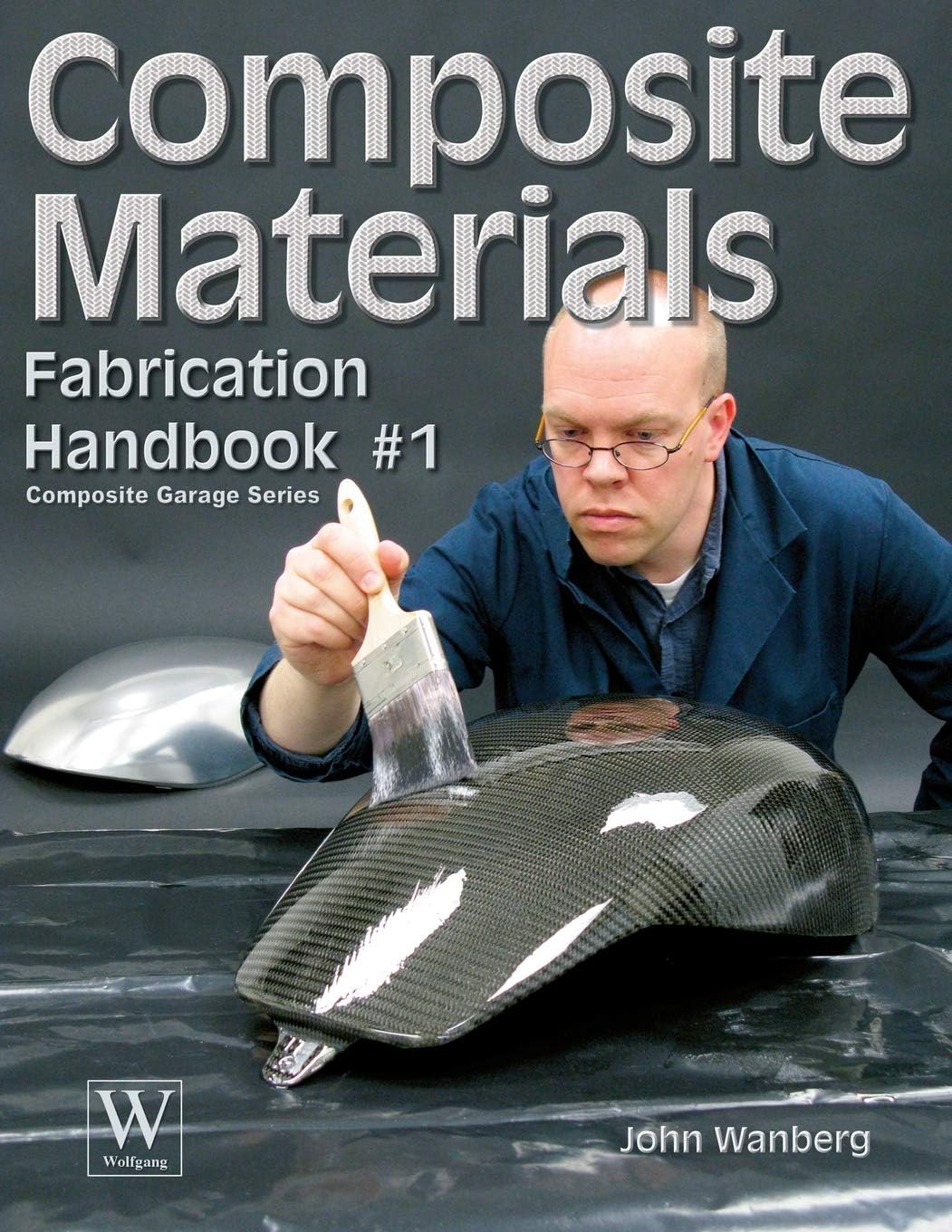
Buy Composite Materials: Fabrication Handbook #1 by Wanberg, John online on desertcart.ae at best prices. ✓ Fast and free shipping ✓ free returns ✓ cash on delivery available on eligible purchase. Review: As it states in its introduction, this book is intended as a PRACTICAL, hands-on guide to learning the basics of working with composites. It spends almost no time on designing composite structures and instead focuses on the actual techniques you need to learn in order to build those structures yourself. It begins by describing the most common materials and how and why they are used, then moves on to safety (very important) and helpful tools, and then into how to actually make some basic composite structures via various wet layup techniques. To me, one of the strong points of this book is that it isn't too discipline-specific, i.e. it doesn't seem to have a bias toward any one type of structure. Almost every other book from which I've tried to learn some of these basic techniques has been aimed toward building either an airplane or a boat of some sort, and used examples (and terminology) specific to them. This book might have just a *slight* bias toward automobiles, but that's it. By showing how to lay up a flat panel, a tube and a couple of other structures, it shows several basic techniques that can be applied to a wide variety of projects. It also shows how to make different types of molds, the pros and cons of different types of resin (and how to choose the best one depending on what you're trying to build) and different types of reinforcement. And it shows a variety of finishing techniques as well, which I've rarely seen in any of the books I've encountered in the five-plus years I've been working with composites--including a couple I *wish* I had learned much sooner. Another strong point is the clear COLOR photographs, which are consistently well composed and well lit, so you can actually see what's really going on. Every photo and diagram also has a descriptive caption, which are consistently excellent. My only quibble, and it's a very small one, is that the photos sometimes run ahead of the text by a couple of pages. But even if you just follow the photos (there are hundreds of them), you will still get a very good idea of the process being shown. One other observation: Many of the photos are arranged six to a page (two across and three down) and read in order down the left-hand column, then back to the top of the right-hand column. It was a bit confusing at first, as I would've expected to read across the page first and then down to the next row. But again, that's easy enough to get used to--and the photos are numbered. The author's language is conversational and informal throughout, a perfect match for a practical guide. Also, the paper is thick and glossy, the layout is clean, uncluttered and easy to read, and the perfect-bound construction seems well done. So the book should last for quite a while. If you're looking for a book that covers many of the basics, but geared toward aviation and with a somewhat more theoretical approach, check out Composite Basics by Andrew C. Marshall. But if you're looking for a consistently superior guide to the basics of working with composites, Composite Materials Fabrication Handbook is the one you want. NOTE: This book (Fabrication Handbook #1) covers basic wet layups only. It does NOT cover prepregs, compression molding, vacuum bagging or resin infusion. However, those topics and others are covered in Composite Materials Fabrication Handbook #2 by the same author, which is just as good as Handbook #1 and also worth every penny. Do what I did and just buy both at the same time. You won't regret it. Review: Someone once wrote, the main thing is to keep the main thing a main thing. This is the handbook that gonna give you the good basic overall picture. If the one wants to go deeper into topic, I believe other sources would need to be find. Or just get your hands dirty …
| Best Sellers Rank | #28,899 in Crafts, Hobbies & Home |
| Customer reviews | 4.6 4.6 out of 5 stars (160) |
| Dimensions | 21.59 x 0.95 x 27.94 cm |
| Edition | Illustrated |
| ISBN-10 | 1929133766 |
| ISBN-13 | 978-1929133765 |
| Item weight | 499 g |
| Language | English |
| Print length | 144 pages |
| Publication date | 1 August 2009 |
| Publisher | Wolfgang Publications |
J**3
As it states in its introduction, this book is intended as a PRACTICAL, hands-on guide to learning the basics of working with composites. It spends almost no time on designing composite structures and instead focuses on the actual techniques you need to learn in order to build those structures yourself. It begins by describing the most common materials and how and why they are used, then moves on to safety (very important) and helpful tools, and then into how to actually make some basic composite structures via various wet layup techniques. To me, one of the strong points of this book is that it isn't too discipline-specific, i.e. it doesn't seem to have a bias toward any one type of structure. Almost every other book from which I've tried to learn some of these basic techniques has been aimed toward building either an airplane or a boat of some sort, and used examples (and terminology) specific to them. This book might have just a *slight* bias toward automobiles, but that's it. By showing how to lay up a flat panel, a tube and a couple of other structures, it shows several basic techniques that can be applied to a wide variety of projects. It also shows how to make different types of molds, the pros and cons of different types of resin (and how to choose the best one depending on what you're trying to build) and different types of reinforcement. And it shows a variety of finishing techniques as well, which I've rarely seen in any of the books I've encountered in the five-plus years I've been working with composites--including a couple I *wish* I had learned much sooner. Another strong point is the clear COLOR photographs, which are consistently well composed and well lit, so you can actually see what's really going on. Every photo and diagram also has a descriptive caption, which are consistently excellent. My only quibble, and it's a very small one, is that the photos sometimes run ahead of the text by a couple of pages. But even if you just follow the photos (there are hundreds of them), you will still get a very good idea of the process being shown. One other observation: Many of the photos are arranged six to a page (two across and three down) and read in order down the left-hand column, then back to the top of the right-hand column. It was a bit confusing at first, as I would've expected to read across the page first and then down to the next row. But again, that's easy enough to get used to--and the photos are numbered. The author's language is conversational and informal throughout, a perfect match for a practical guide. Also, the paper is thick and glossy, the layout is clean, uncluttered and easy to read, and the perfect-bound construction seems well done. So the book should last for quite a while. If you're looking for a book that covers many of the basics, but geared toward aviation and with a somewhat more theoretical approach, check out Composite Basics by Andrew C. Marshall. But if you're looking for a consistently superior guide to the basics of working with composites, Composite Materials Fabrication Handbook is the one you want. NOTE: This book (Fabrication Handbook #1) covers basic wet layups only. It does NOT cover prepregs, compression molding, vacuum bagging or resin infusion. However, those topics and others are covered in Composite Materials Fabrication Handbook #2 by the same author, which is just as good as Handbook #1 and also worth every penny. Do what I did and just buy both at the same time. You won't regret it.
D**I
Someone once wrote, the main thing is to keep the main thing a main thing. This is the handbook that gonna give you the good basic overall picture. If the one wants to go deeper into topic, I believe other sources would need to be find. Or just get your hands dirty …
A**Y
Excellent pics help explain the text. Like a community college course in a small textbook!! Great!!!
M**S
le foto sono molto utili e fatte bene e descrivono passo dopo passo le azioni da intraprendere. Manuale pratico con indicazioni utili per l'attrezzatura da utilizzare e i prodotti però non sempre facili da individuare. Per una più semplice e completa spiegazione sia pratica che teorica consiglio il libro di Emiliano Benvenuti semplice e intuitivo, con tabelle e descrizione dei materiali e prodotti con le caratteristiche fisiche e chimiche di facile comprensione. Le tecniche attuabili sono descritte in maniera facile e applicabile sin da subito.
D**R
A good no nonsense guide to Composites
Trustpilot
4 days ago
1 week ago