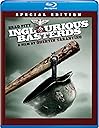
![Inglourious Basterds [Blu-ray]](https://m.media-amazon.com/images/I/815KT4acC4L._AC_SL3840_.jpg)


Buy anything from 5,000+ international stores. One checkout price. No surprise fees. Join 2M+ shoppers on Desertcart.
Desertcart purchases this item on your behalf and handles shipping, customs, and support to Ecuador.
Brad Pitt takes no prisoners in Quentin Tarantino's high-octane WWII revenge fantasy Inglourious Basterds. As war rages in Europe, a Nazi-scalping squad of American soldiers, known to their enemy as "The Basterds," is on a daring mission to take down the leaders of the Third Reich. Bursting with "action, hair-trigger suspense and a machine-gun spray of killer dialogue" (Peter Travers, Rolling Stone), Inglourious Basterds is "another Tarantino masterpiece" (Jake Hamilton, CBS-TV)! Review: The Best Film of 2009 and one of the best of the decade! - Spoilers... I try to avoid them, but you should definitely see this film before reading this review! To say that I was eagerly anticipating this movie would be a drastic understatement. Quentin Tarantino is my favorite film maker. His films offer such an intense entertainment experience, equal parts action, comedic, and suspense. He makes films that he would like to watch, always focusing on the viewers experience above all other motivations. In my opinion, Tarantino's second film, Pulp Fiction, is the best film ever made. It's a master class in story telling, brilliantly using non-linear chapters filled with hilarious dialog and intense moments of violence to piece together a classic tale of betrayal and redemption, all while using completely unconventional and innovative script writing and film making techniques that have sense been copied to death by other screenwriters and directors. I have loved all six of Quentin's films leading up to Inglourious Basterds to varying degrees, but the anticipation hasn't been quite this high for me, this being his first "epic" since 2004's Kill Bill: Vol. 2, which combined with it's first volume, is the best film of this current decade. Even though I love Reservoir Dogs, Jackie Brown, and Death Proof, I particularly love what Quentin refers to as his "Mount Everests." These are massive undertakings for him, often taking many, many years to get on the page, much less actually production. Leading up to opening night, which was 12:01 AM on August 21, 2009, I had heard mixed reports coming from Cannes, but I knew that the art house crowd that populated the critic's screenings at that festival didn't always appreciate the wildly entertaining pulp classics that Quentin consistently provides his audiences. The trailer for the movie purposefully mis-marketed Inglourious Basterds as a bloodthirsty action movie, like a mix of The Dirty Dozen meets Hostel. It didn't completely appeal to me, but I knew Tarantino had way more up his sleeve. Inglourious Basterds is a story of Jewish vengeance, represented by a band of Jewish American soldiers (a.k.a. the Basterds, led by Brad Pitt as Lt. Aldo Raine) terrorizing Nazis behind enemy lines, and a young Jewish French girl seeking revenge for the murder of her family. The man personally responsible for this atrocity is also the one character that ties the entire film together, the antagonist Col. Hans Landa, played brilliantly and enthusiastically by German actor Christoph Waltz, as he is in almost every chapter. The quality of the performance is at least equal to other powerhouse performances this decade (e.g. Daniel Day-Lewis in There Will Be Blood and Javier Bardem in No Country For Old Men), but I cannot recall the last time I saw an actor this charismatic and so obviously in love with his craft. He won the Best Actor award at this year's Cannes Film Festival, and I fully expect him to take home an Oscar as well. The film is divided into five chapters, the first of which is titled "Once Upon a Time, in Nazi Occupied France..." This title, the beautiful opening shots of the French countryside, and the sampling from the scores from many Sergio Leone films and other westerns gives this scene the feel of a Spaghetti Western set in World War II. Once Hans Landa arrives on screen and enters the dairy farmer's house, there is about twenty minutes of typically great Quentin Tarantino dialogue, only we're having to read it in subtitles! Heaven forbid the mainstream masses knew about that before going to see the latest Brad Pitt movie! Hence, the (brilliant) mis-marketing. The majority of this film is actually in a language other than English, about equal parts German and French, with a dash of Italian for good measure. Our good friend Mr. Christoph Walt speaks each of these languages fluently throughout the film, adding to the already tour de force performance to the point of showing off. Back to the scene. It turns out that Col. Hans Landa is not only an expert linguist but a master detective hired by the Nazis for the express purpose of hunting Jews that have managed to escape the grasp of the German army. As he interrogates this dairy farmer (who looks suspiciously like Stanley Kubrick), the camera gives us more information, and tension builds until the camera finally puts us directly in front of the Col., staring into his heartless eyes for a few very uncomfortable moments. Excuse the hyperbole, but I feel that this is one of the best scenes Tarantino has ever written. It's not until the second chapter that we're introduced to the Basterds, and most of this scene is spent in the woods during an interrogation of a few hostages that the Basterds have taken after killing and scalping most of the Nazi unit. Here we meet Sgt. Hugo Stiglitz (Til Schweiger), who gets his own flashback, and Sgt. Donny Donowitz (Eli Roth), also known as the baseball bat wielding "Bear Jew." If there is one thing wrong with this movie, it's the amateur delivery of each of Eli Roth's lines. He doesn't have too many, but whenever he opens his mouth I found myself cringing; in my mind a slight casting misstep, in an otherwise flawless cast (yes, I even liked Mike Myers). We also get to see a very animated Hitler, played deliciously over-the-top by Martin Wuttke, rant about the Bear Jew to the point of delirium. Chapter three re-introduces us to the heroine Shosanna Dreyfus (Melanie Laurent), now the owner of a quaint movie theater in Paris, and her reluctant relationship to a young Private in the German army. This Private (Daniel Bruhl) is the catalyst for all of the events that follow, although Shosanna is obviously displeased by his advances. His playful banter and her distinct annoyance give us some lighter, humorous reprieve, before thrusting us again into the violent foray. This chapter also contains a great scene featuring a conversation between her and Landa over desert. The way Tarantino uses camera angles and close-ups to evoke the same feelings of tension he made us feel in the opening scene... Simply incredible. Chapter four features the longest scene in the film that has been described by some as a thirty minute version of Reservoir Dogs that takes place in a basement tavern. There are several moments during this scene in which Quentin's pacing seems to meander until he suddenly causes you to hold your breath in anticipation. The scene builds and builds and when the release comes, it is quick, violent, and glorious; a small taste of things to come. The fifth and final chapter culminates at the Shosanna's movie theater, at the premiere for a Nazi propaganda film which most of the German high command is attending. Each respective party of vengeful Jews gets basically the same idea, and the beauty is in the execution of each of these plans. One is a plan of desperation in which everything seems to go wrong. The other is a long gestating, deeply poetic, primal scream of a plan that culminates in some of the most haunting and enduring images Tarantino, or anyone, has put on screen. I've listened to and read many critics and film geeks argue the meaning and purpose of this film, and some have submitted some pretty good arguments. There is definitely much irony throughout the film, especially when related to the violence. When a German officer is beat to death with a baseball bat, Tarantino presents him as an honorable soldier rather than a repulsive monster, which makes the beating and subsequent guffaws from the audience sit uneasily with a discerning audience member. Then there are the images of a grossly over-animated Adolf Hitler and his cronies, in a movie theater, their laughter and cheers erupting into a blood-thirsty frenzy as they watch a propaganda film that glorifies the death of hundreds of American soldiers. All the while a group of blood-thirsty Americans clap and cheer at the insanity that ensues, which can be described as a violent orgasm of death, or maybe... a holocaust. There is so much substance here to be analyzed and scrutinized, but Tarantino himself has mentioned that he doesn't even try to examine the subtext of his films, although he recognizes it is there. Mostly he is determined to create a masterpiece each time he makes a film, and not for art's sake, but for ours. He is determined to create entertainment for an audience to enjoy over and over again, always finding something new to take away from it. I've seen Inglourious Basterds three times so far in the theater, and plan on seeing it once more before it leaves. Each time I notice more and more, and it leaves me somewhat contemplative, but always smiling. One obvious theme is the power of cinema, and Quentin has mentioned that this film is essentially a love letter to cinema. Tarantino has always been accused of stealing from other movies, however, the accusers hardly attempt to apply the same level of scrutiny to other beloved directors (e.g. Martin Scorsese) who have not only revolutionized film, but as devout students of film, borrowed heavily from the great film makers who have come before and inspired them to make film in the first place. With Inglourious Basterds, Quentin Tarantino has melded together classic themes, settings, camera shots and musical cues with his unique style of writing and directing to create a completely fresh and unique experience. The final scene is delivered almost like a punch-line, or maybe the closing message of a morality tale; either way it is just the right touch to top off his cinematic masterpiece. Monsieur Tarantino, to you, your cast, and your crew I say, "Bravo!" [...] Review: Tarantino's take on WWII - This is my second favorite Tarantino movie (after the legendary "Pulp Fiction"). In fact, IMO this is the best movie he has done SINCE Pulp Fiction (Jackie Brown was very good but a little too slow paced for my taste; Kill Bill I and II were disastrous, IMO; and I am probably one of the few who hated Django because some of the scenes in that movie were so unsavory they made me physically ill). What did I like about this movie? Firstly there are the performances, several of them from new, breakout stars: Christopher Waltz, of course, is the film's true revelation. He plays SS Colonel Landa whose task it is to hunt for Jewish fugitives in Nazi occupied France. Waltz plays the character in a very interesting fashion. He never gives the impression that he truly hates Jewish people and wants them eradicated. He additionally does not give the impression that he is intensely loyal to the Nazi party and wants soley to see its goals carried out (as was the case with Joseph Goebbels, also featured in the film). He is simply is a professional, a detective of sorts whose job is to discover the whereabouts of wanted fugitives, and then secure their capture. That his job has unsavory aspects to it does not unsettle him, nor does it, in some perverse manner, motivate him. It simply is what it is, and as a professional he must pursue it to its logical conclusion. The film also features excellent performances by Micheal Fassbender (this being his first big commercial film), the stunning beauty Diane Kruger (as the double agent Bridget Von Hammersmark), and August Diehl, who plays a cunning and ruthless SS Officer with remarkable authenticity. Brad Pitt surprising does an excellent job in this film as tough as nails Lieutenant "Apache" Raine. I say surprsingly, because Pitt has had to redefine himself as he enters middle age. He can no longer sell movies based on his hearthrob status of his 20s and 30s (where he basically had to just show up and hordes of women were guaranteed to go watch his movies). In his search for a new identity, he has had his share of flops (eg. I thought he was terrible in "Moneyball"). But with this movie, it appears he found a role that suits him to a tee. Namely, that of a kind of tough guy, a poor man's John Wayne, complete with generous amounts of wit, charm, charisma and humor. Beyond the acting, the movies story and script is first rate. My favorite scene in the movie, just a classic Tarantino scene that would be right at home in a movie like "Pulp Fiction", is the tavern scene towards the middle of the film. This is where British Agent Micheal Fassbender must make a rendezvous with his contact, double agent Bridget von Hammersmark. Now Hammersmark happens to be a famous German actress, and she is approached in the tavern by a regiment of off duty German soldiers (several of whom are getting alarmingly drunk). When Fassbender is finally able to pry her away from these admirers, a covert SS Officer, played brillantly but August Diehl, makes a surprise entrance, and, suspicious of Fassbender's curious German accent, decides to interrogate him and his party. The scene is brillantly scripted, and the tension between the aggressive Diehl and the calm and collected Fassbender is palpable. This scene alone makes the movie worth watching. This is not a movie for everybody. There is plenty of violence and gore in this movie, which may offend more sensitive viewers. However, if you are a fan of Tarantino films, and you are curious how Tarantino would approach a WW2 movie, then this is a film you need to see.


| Contributor | Brad Pitt, Christoph Waltz, Daniel Bruhl, Diane Kruger, Eli Roth, Lawrence Bender, Mark Ulano, Melanie Laurent, Michael Fassbender, Michael Minkler, Quentin Tarantino, Robert Richardson, Sally Menke, Til Schweiger, Tony Lamberti, Wylie Stateman Contributor Brad Pitt, Christoph Waltz, Daniel Bruhl, Diane Kruger, Eli Roth, Lawrence Bender, Mark Ulano, Melanie Laurent, Michael Fassbender, Michael Minkler, Quentin Tarantino, Robert Richardson, Sally Menke, Til Schweiger, Tony Lamberti, Wylie Stateman See more |
| Customer Reviews | 4.7 out of 5 stars 25,736 Reviews |
| Format | Blu-ray, Multiple Formats, Widescreen |
| Genre | Action & Adventure, Art House & International, Military & War, Mystery & Suspense/Thrillers Genre Action & Adventure, Art House & International, Military & War, Mystery & Suspense/Thrillers See more |
| Initial release date | 2011-08-30 |
| Language | English |
J**S
The Best Film of 2009 and one of the best of the decade!
Spoilers... I try to avoid them, but you should definitely see this film before reading this review! To say that I was eagerly anticipating this movie would be a drastic understatement. Quentin Tarantino is my favorite film maker. His films offer such an intense entertainment experience, equal parts action, comedic, and suspense. He makes films that he would like to watch, always focusing on the viewers experience above all other motivations. In my opinion, Tarantino's second film, Pulp Fiction, is the best film ever made. It's a master class in story telling, brilliantly using non-linear chapters filled with hilarious dialog and intense moments of violence to piece together a classic tale of betrayal and redemption, all while using completely unconventional and innovative script writing and film making techniques that have sense been copied to death by other screenwriters and directors. I have loved all six of Quentin's films leading up to Inglourious Basterds to varying degrees, but the anticipation hasn't been quite this high for me, this being his first "epic" since 2004's Kill Bill: Vol. 2, which combined with it's first volume, is the best film of this current decade. Even though I love Reservoir Dogs, Jackie Brown, and Death Proof, I particularly love what Quentin refers to as his "Mount Everests." These are massive undertakings for him, often taking many, many years to get on the page, much less actually production. Leading up to opening night, which was 12:01 AM on August 21, 2009, I had heard mixed reports coming from Cannes, but I knew that the art house crowd that populated the critic's screenings at that festival didn't always appreciate the wildly entertaining pulp classics that Quentin consistently provides his audiences. The trailer for the movie purposefully mis-marketed Inglourious Basterds as a bloodthirsty action movie, like a mix of The Dirty Dozen meets Hostel. It didn't completely appeal to me, but I knew Tarantino had way more up his sleeve. Inglourious Basterds is a story of Jewish vengeance, represented by a band of Jewish American soldiers (a.k.a. the Basterds, led by Brad Pitt as Lt. Aldo Raine) terrorizing Nazis behind enemy lines, and a young Jewish French girl seeking revenge for the murder of her family. The man personally responsible for this atrocity is also the one character that ties the entire film together, the antagonist Col. Hans Landa, played brilliantly and enthusiastically by German actor Christoph Waltz, as he is in almost every chapter. The quality of the performance is at least equal to other powerhouse performances this decade (e.g. Daniel Day-Lewis in There Will Be Blood and Javier Bardem in No Country For Old Men), but I cannot recall the last time I saw an actor this charismatic and so obviously in love with his craft. He won the Best Actor award at this year's Cannes Film Festival, and I fully expect him to take home an Oscar as well. The film is divided into five chapters, the first of which is titled "Once Upon a Time, in Nazi Occupied France..." This title, the beautiful opening shots of the French countryside, and the sampling from the scores from many Sergio Leone films and other westerns gives this scene the feel of a Spaghetti Western set in World War II. Once Hans Landa arrives on screen and enters the dairy farmer's house, there is about twenty minutes of typically great Quentin Tarantino dialogue, only we're having to read it in subtitles! Heaven forbid the mainstream masses knew about that before going to see the latest Brad Pitt movie! Hence, the (brilliant) mis-marketing. The majority of this film is actually in a language other than English, about equal parts German and French, with a dash of Italian for good measure. Our good friend Mr. Christoph Walt speaks each of these languages fluently throughout the film, adding to the already tour de force performance to the point of showing off. Back to the scene. It turns out that Col. Hans Landa is not only an expert linguist but a master detective hired by the Nazis for the express purpose of hunting Jews that have managed to escape the grasp of the German army. As he interrogates this dairy farmer (who looks suspiciously like Stanley Kubrick), the camera gives us more information, and tension builds until the camera finally puts us directly in front of the Col., staring into his heartless eyes for a few very uncomfortable moments. Excuse the hyperbole, but I feel that this is one of the best scenes Tarantino has ever written. It's not until the second chapter that we're introduced to the Basterds, and most of this scene is spent in the woods during an interrogation of a few hostages that the Basterds have taken after killing and scalping most of the Nazi unit. Here we meet Sgt. Hugo Stiglitz (Til Schweiger), who gets his own flashback, and Sgt. Donny Donowitz (Eli Roth), also known as the baseball bat wielding "Bear Jew." If there is one thing wrong with this movie, it's the amateur delivery of each of Eli Roth's lines. He doesn't have too many, but whenever he opens his mouth I found myself cringing; in my mind a slight casting misstep, in an otherwise flawless cast (yes, I even liked Mike Myers). We also get to see a very animated Hitler, played deliciously over-the-top by Martin Wuttke, rant about the Bear Jew to the point of delirium. Chapter three re-introduces us to the heroine Shosanna Dreyfus (Melanie Laurent), now the owner of a quaint movie theater in Paris, and her reluctant relationship to a young Private in the German army. This Private (Daniel Bruhl) is the catalyst for all of the events that follow, although Shosanna is obviously displeased by his advances. His playful banter and her distinct annoyance give us some lighter, humorous reprieve, before thrusting us again into the violent foray. This chapter also contains a great scene featuring a conversation between her and Landa over desert. The way Tarantino uses camera angles and close-ups to evoke the same feelings of tension he made us feel in the opening scene... Simply incredible. Chapter four features the longest scene in the film that has been described by some as a thirty minute version of Reservoir Dogs that takes place in a basement tavern. There are several moments during this scene in which Quentin's pacing seems to meander until he suddenly causes you to hold your breath in anticipation. The scene builds and builds and when the release comes, it is quick, violent, and glorious; a small taste of things to come. The fifth and final chapter culminates at the Shosanna's movie theater, at the premiere for a Nazi propaganda film which most of the German high command is attending. Each respective party of vengeful Jews gets basically the same idea, and the beauty is in the execution of each of these plans. One is a plan of desperation in which everything seems to go wrong. The other is a long gestating, deeply poetic, primal scream of a plan that culminates in some of the most haunting and enduring images Tarantino, or anyone, has put on screen. I've listened to and read many critics and film geeks argue the meaning and purpose of this film, and some have submitted some pretty good arguments. There is definitely much irony throughout the film, especially when related to the violence. When a German officer is beat to death with a baseball bat, Tarantino presents him as an honorable soldier rather than a repulsive monster, which makes the beating and subsequent guffaws from the audience sit uneasily with a discerning audience member. Then there are the images of a grossly over-animated Adolf Hitler and his cronies, in a movie theater, their laughter and cheers erupting into a blood-thirsty frenzy as they watch a propaganda film that glorifies the death of hundreds of American soldiers. All the while a group of blood-thirsty Americans clap and cheer at the insanity that ensues, which can be described as a violent orgasm of death, or maybe... a holocaust. There is so much substance here to be analyzed and scrutinized, but Tarantino himself has mentioned that he doesn't even try to examine the subtext of his films, although he recognizes it is there. Mostly he is determined to create a masterpiece each time he makes a film, and not for art's sake, but for ours. He is determined to create entertainment for an audience to enjoy over and over again, always finding something new to take away from it. I've seen Inglourious Basterds three times so far in the theater, and plan on seeing it once more before it leaves. Each time I notice more and more, and it leaves me somewhat contemplative, but always smiling. One obvious theme is the power of cinema, and Quentin has mentioned that this film is essentially a love letter to cinema. Tarantino has always been accused of stealing from other movies, however, the accusers hardly attempt to apply the same level of scrutiny to other beloved directors (e.g. Martin Scorsese) who have not only revolutionized film, but as devout students of film, borrowed heavily from the great film makers who have come before and inspired them to make film in the first place. With Inglourious Basterds, Quentin Tarantino has melded together classic themes, settings, camera shots and musical cues with his unique style of writing and directing to create a completely fresh and unique experience. The final scene is delivered almost like a punch-line, or maybe the closing message of a morality tale; either way it is just the right touch to top off his cinematic masterpiece. Monsieur Tarantino, to you, your cast, and your crew I say, "Bravo!" [...]
K**E
Tarantino's take on WWII
This is my second favorite Tarantino movie (after the legendary "Pulp Fiction"). In fact, IMO this is the best movie he has done SINCE Pulp Fiction (Jackie Brown was very good but a little too slow paced for my taste; Kill Bill I and II were disastrous, IMO; and I am probably one of the few who hated Django because some of the scenes in that movie were so unsavory they made me physically ill). What did I like about this movie? Firstly there are the performances, several of them from new, breakout stars: Christopher Waltz, of course, is the film's true revelation. He plays SS Colonel Landa whose task it is to hunt for Jewish fugitives in Nazi occupied France. Waltz plays the character in a very interesting fashion. He never gives the impression that he truly hates Jewish people and wants them eradicated. He additionally does not give the impression that he is intensely loyal to the Nazi party and wants soley to see its goals carried out (as was the case with Joseph Goebbels, also featured in the film). He is simply is a professional, a detective of sorts whose job is to discover the whereabouts of wanted fugitives, and then secure their capture. That his job has unsavory aspects to it does not unsettle him, nor does it, in some perverse manner, motivate him. It simply is what it is, and as a professional he must pursue it to its logical conclusion. The film also features excellent performances by Micheal Fassbender (this being his first big commercial film), the stunning beauty Diane Kruger (as the double agent Bridget Von Hammersmark), and August Diehl, who plays a cunning and ruthless SS Officer with remarkable authenticity. Brad Pitt surprising does an excellent job in this film as tough as nails Lieutenant "Apache" Raine. I say surprsingly, because Pitt has had to redefine himself as he enters middle age. He can no longer sell movies based on his hearthrob status of his 20s and 30s (where he basically had to just show up and hordes of women were guaranteed to go watch his movies). In his search for a new identity, he has had his share of flops (eg. I thought he was terrible in "Moneyball"). But with this movie, it appears he found a role that suits him to a tee. Namely, that of a kind of tough guy, a poor man's John Wayne, complete with generous amounts of wit, charm, charisma and humor. Beyond the acting, the movies story and script is first rate. My favorite scene in the movie, just a classic Tarantino scene that would be right at home in a movie like "Pulp Fiction", is the tavern scene towards the middle of the film. This is where British Agent Micheal Fassbender must make a rendezvous with his contact, double agent Bridget von Hammersmark. Now Hammersmark happens to be a famous German actress, and she is approached in the tavern by a regiment of off duty German soldiers (several of whom are getting alarmingly drunk). When Fassbender is finally able to pry her away from these admirers, a covert SS Officer, played brillantly but August Diehl, makes a surprise entrance, and, suspicious of Fassbender's curious German accent, decides to interrogate him and his party. The scene is brillantly scripted, and the tension between the aggressive Diehl and the calm and collected Fassbender is palpable. This scene alone makes the movie worth watching. This is not a movie for everybody. There is plenty of violence and gore in this movie, which may offend more sensitive viewers. However, if you are a fan of Tarantino films, and you are curious how Tarantino would approach a WW2 movie, then this is a film you need to see.
T**R
Good movie with bad title spelling
I'm not sure if the spelling of "Basterds" was intentional or not, because you never learn why it was incorrectly spelled for this movie. Anyway, the movie is great if you enjoy a good comedy with a lot blood, violence, and good looking actors. Everyone wants to see Nazis suffer, even Nazis, and this movie doesn't disappoint! Just don't let grandma watch it even if she lived during that time in history.
J**H
Great Product
Great Product and Transaction
B**E
Great WWII "what if" movie
If you haven't seen this movie your in for a treat. It is loud and gory and unapologetic. But it's a instant classic.
M**E
Great American film
Inglorious Basterds is, like some of Scorsese's, Paul Thomas Anderson's, Welles', and Sergio Leone's films, an operatic work about death -- or Death -- which is also amused about its own circling and coiling (and coiling and circling) around it. The best way to describe films like this is to compare them to Baroque art, a style of painting and sculpture that invites intense, even unbalanced emotional responses. Think of Bernini's intensely sexual sculptures against Michaelangelo's sculptures that show a balance of sensuality and intellect. Baroque films are edited so that scenes wittily push (or ram) together fear and comedy, anxiety, a dreamlike something in their preparation for violence, and humor. And characters take each other in often as pieces of theater, and perform for each other. As in opera they can be expressing themselves with a nearly cartoon exaggeration even as they unexpectedly stir emotions: I am dying, they seem to sing, with their guns, and this is my song of death. Song, and music in general, is key to any Tarantino film, from Reservoir Dogs ("Stuck in the Middle With You") to Pulp Fiction ("Flowers on the Wall") and Jackie Brown ("Didn't I Blow Your Mind This Time"). In Inglorious Basterds the key is the Morricone-like soundtrack that, as in Leone's films, asks us to feel the joy of the filmmaking -- the bravura assembly of images -- as well as take in more deeply the unfolding story. In this case, it is a tall tale, with many moving parts: a group of wild American Jews are put together by the American military in World War II to kill and scalp Nazis, and as the story spins up from scenes such as the early one in the German forest with the killing of a German soldier by baseball bat, we come, perhaps naturally, to an attack on the Fuhrer himself in a movie theater which has most recently played a G.W. Pabst film starring Leni Riefenstahl. There is the leader of the Basterds (played with opera buffa joy by Brad Pitt), there is the escaped Jewish girl (played with fragility and steel by Melanie Laurent) and, among a couple of dozen other speaking parts, there is the "Jew Hunter," played by Christoph Walz with a certain kind of aesthete's lightly curtailed rage that is exciting, terrifying and nervily humorous to watch. It is a film of wrought performances, and Walz's is the best. Note: if you purchase this Blu-ray/Digital package from a third-party seller, as I did, you may find that the code for downloading the digital copy has already been redeemed. You still get the Blu-ray disk, but half of the bargain is lost.
A**R
Great movie
Great movie
S**N
Using Grindhouse Tools to Make Arthouse Films
I was fortunate enough in 1994 to attend a test screening of Quentin Tarantino's Pulp Fiction, shortly after its triumph at Cannes and months before it premiered in the U.S. Because I saw it before it was acknowledged as a game-changing sensation, I was completely unprepared for my mind being blown. I remember sitting in the dark theater, sort of giggling to myself in a low voice, because I was in absolutely alien territory; I had no idea what was going to come next, and I knew I'd never seen anything like it before. (Tarantino attended the screening and I got a chance afterwards to shake his hand, after which I just walked away, rather than say, "huminah-huminah-huminah.") Coming out of Inglourious Basterds, I realized that Tarantino is still blowing my mind, as he has with each of his post-Pulp Fiction films. This is not because I think his films are perfect, and not even necessarily because he's my favorite director, but rather because I think Tarantino is trying for something in his films that's absolutely different than anyone else's work. Basterds is a multi-threaded take on a World War II film. It weaves together a series of stories taking place in Nazi-occupied France, and it's exciting, suspenseful, thoughtful and funny (Brad Pitt is an absolute hoot, and he, Christoph Waltz and Melanie Laurent pretty much walk away with the film). But like every other Tarantino film, it's actually really all about movies above all other concerns, including plot. That's where Tarantino runs into trouble with some critics. They say that his films are all about movies, not real life, that the films are simply a series of film references. The worst criticism? His films are mere exercises in genre. I think that's missing the point. Yes, Tarantino loves genre films and loves to mix genres. But he's doing some remarkable things with them. I think he's trying to build serious art with the raw materials of genre. It's akin to taking an electric guitar, an accordion and a triangle and writing a symphony with them - and succeeding. Some say that Pulp Fiction was his most mature work, if by "mature" we mean conventionally artistic. Under this view, later films, which more explicitly take use the mechanics of gangster, blaxploitation, revenge and, oddly enough, European art cinema, are less "personal," less serious. But that may reflect more about what you think about genre than about anything else. If you believe genre is artless, low-brow moviemaking, then the use of the film vocabulary from genre in service of personal, artistic filmmaking is confusing and unsettling. If you can accept that art is about personal vision, not the tools you use to express that vision, then Tarantino's approach can be exhilarating and thrilling. Employing that personal vision, Tarantino has no problem using David Bowie's great "Cat People (Putting Out Fire)" in a period film, or splashing a blaxploitation-era logo to flash the name of one particularly colorful character, or using narration when it's necessary and forgetting about it when it's not, or opting for long stretches of subtitled dialog (I think this was Tarantino - who's calling card is his expertise in dialogue - tying one hand behind his back for the fun of it). Tarantino even uses little signifiers - signifiers as little as the fonts he uses in his "chapter" markers and in the end credits - to let you know you're in his unique, personal world. As Tarantino himself said in a great appearance on the Howard Stern radio show recently, his work is unambiguously his work - you'll either love him or hate him, and that's because he has a singular, idiosyncratic voice. I love his work and I can't wait to see what he comes up with next. One more thought [and mild spoiler alert] - I hope it doesn't become an issue that in Basterds, Tarantino is playing fast and loose with the facts of world history (let's just say that at some point Basterds and history go down different roads). It's called an alternate history - a device used by everyone from comic book artists to serious writers like James Ellroy. Is there any real concern that people will mistake Tarantino-esque fiction for historical fact? If that's the case, we should worry a little less about Tarantino and a little more about our education system.
Trustpilot
1 month ago
1 month ago