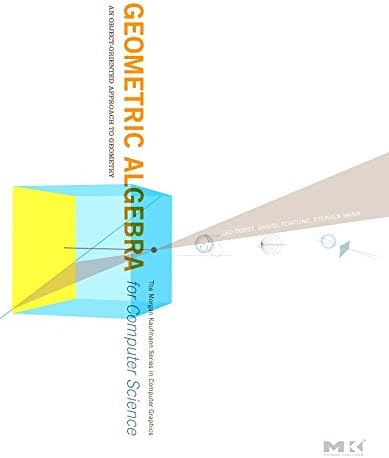
Geometric Algebra for Computer Science (Revised Edition): An Object-Oriented Approach to Geometry (The Morgan Kaufmann Series in Computer Graphics)
Product ID: 159447476
Buy anything from 5,000+ international stores. One checkout price. No surprise fees. Join 2M+ shoppers on Desertcart.
Desertcart purchases this item on your behalf and handles shipping, customs, and support to Ecuador.
Geometric Algebra for Computer Science (Revised Edition): An Object-Oriented Approach to Geometry (The Morgan Kaufmann Series in Computer Graphics) [Dorst, Leo, Fontijne, Daniel, Mann, Stephen] on desertcart.com. *FREE* shipping on qualifying offers. Geometric Algebra for Computer Science (Revised Edition): An Object-Oriented Approach to Geometry (The Morgan Kaufmann Series in Computer Graphics) Review: Professional Jewel Book in the Top Ten Class of the Geometric Algebra (GA) - After the first year of GA studies this book is a must to read. When you arrive to a deadlock in your GA efforts this book supports you always as a compass of how to continue. It is not an application oriented classic but it is the missing part of the GA books forming the ring of the accepted core materials. Even more it is radiating a kind of balanced harmony between the secondary mismatchings of the divergent parts of the full Grassmann-Clifford-Hestenes arsenal. In itself the book does fill uniquely the gap between the GA and OO Computer Sciences & Programming and to utilize the GA it gives a good starting point toward the sophisticated geometrical examples of the past history. Review: Book: Geometric Algebra for Computer Scientists - I've pencil-whipped Geometric Algebra for over a decade - had never learned how to instruct a computer to do the same thing, until I began to read this book. I found myself mentoring a very bright but untutored young man who was in process of teaching himself to do terrific things where geometry and algebra meet, and I offered a shortcut - from this book.
| Best Sellers Rank | #1,293,628 in Books ( See Top 100 in Books ) #247 in Object-Oriented Design #1,978 in Computer Graphics & Design #2,398 in Computer Software (Books) |
| Customer Reviews | 4.5 4.5 out of 5 stars (32) |
| Dimensions | 7.7 x 1.6 x 9.4 inches |
| Edition | 1st |
| ISBN-10 | 0123749425 |
| ISBN-13 | 978-0123749420 |
| Item Weight | 3.95 pounds |
| Language | English |
| Part of series | The Morgan Kaufmann Series in Computer Graphics |
| Print length | 664 pages |
| Publication date | April 6, 2007 |
| Publisher | Morgan Kaufmann |
E**I
Professional Jewel Book in the Top Ten Class of the Geometric Algebra (GA)
After the first year of GA studies this book is a must to read. When you arrive to a deadlock in your GA efforts this book supports you always as a compass of how to continue. It is not an application oriented classic but it is the missing part of the GA books forming the ring of the accepted core materials. Even more it is radiating a kind of balanced harmony between the secondary mismatchings of the divergent parts of the full Grassmann-Clifford-Hestenes arsenal. In itself the book does fill uniquely the gap between the GA and OO Computer Sciences & Programming and to utilize the GA it gives a good starting point toward the sophisticated geometrical examples of the past history.
N**Y
Book: Geometric Algebra for Computer Scientists
I've pencil-whipped Geometric Algebra for over a decade - had never learned how to instruct a computer to do the same thing, until I began to read this book. I found myself mentoring a very bright but untutored young man who was in process of teaching himself to do terrific things where geometry and algebra meet, and I offered a shortcut - from this book.
M**M
Geometric algebra as a programming language for geometry
A lot of math textbooks will often follow the format of Definition -> Theorem -> Proof ad nauseum so it becomes easy to talk about how beautiful something is with no regards to reality. It's also possible for proofs to be wrong and be totally undetectable. This book takes a different approach and introduces the primitives of geometric algebra and uses them to construct various kinds of interesting geometric transformations like projections, reflections etc.. If you've ever read a graphics book, linear algebra book or topological robotics book then you're bound to find something you'll find interesting. The authors also produced a free online tool which you can use to write your own geometric scripts and test your intuition. I'm by no means an expert on geometric algebra but I'm really appreciating the methodology of this book and wish I could find a similar book for generic abstract algebra
F**O
ok, but...
It's a good book, but the mathematics is poorly treated, not enough rigorous as would be expected.
J**K
I bought this for my son-in-law who is a computer ...
I bought this for my son-in-law who is a computer science prof at a college. He spend a lot of time reading and rereading parts of it during their stay at Christmastime. He was greatly enjoying learning concepts and ideas from the book. It had been on his wish list since the book was published.
A**V
good book
happy I bought the book
P**T
An excellent introduction to the subject.
The book Geometric Algebra For Computer Science, by Dorst, Fontijne, and Mann has one of the best introductions to the subject that I have seen. It contains particularly good introductions to the dot and wedge products and how they can be applied and what they can be used to model. After one gets comfortable with these ideas they introduce the subject axiomatically. Much of the pre-axiomatic introductory material is based on the use of the scalar product, defined as a determinant. You'll have to be patient to see where and why that comes from, but this choice allows the authors to defer some of the mathematical learning overhead until one is ready for the ideas a bit better. Having started study of the subject with papers of Hestenes, Cambridge, and Baylis papers, I found the alternate notation for the generalized dot product (L and backwards L for contraction) distracting at first but adjusting to it does not end up being that hard. This book has three sections, the first covering the basics, the second covering the conformal applications for graphics, and the last covering implementation. As one reads geometric algebra books it is natural to wonder about this, and the pros, cons and efficiencies of various implementation techniques are discussed. There are other web resources available associated with this book that are quite good. The best of these is GAViewer, a graphical geometric calculator that was the product of some of the research that generated this book. Performing the GAViewer tutorial exercises is a great way to build some intuition to go along with the math, putting the geometric back in the algebra. There are specific GAViewer exercises that you can do independent of the book, and there is also an excellent interactive tutorial available. Browse the book website, or Search for '2003 Game Developer Lecture, Interactive GA tutorial. UvA GA Website: Tutorials'. Even if one decided not to learn GA, using this to play with the graphical cross product manipulation, with the ability to rotate viewpoints, is quite neat and worthwhile.
M**N
Great seller
Despite all mishaps (on my side mostly), the item got delivered ahead of time - everybody is happy.
S**.
As a C++ software engineer in video game industry with mathematical physics background, I thought this book was well suited for me. However, even though I respect its authors, I must admit it is not very appropriate for what I was looking for (neither as a Library nor as a reference book). I must admit though that this book is very nice to get some illustrations of some properties of multivectors, which may be nice on its own! It is also got a nice brief discussion about affine (homogeneous) and conformal spaces in addition to traditionnal linear space. I would suggest any interested readers either one (or both) of David Estenes books on geometric algebra or Doran and Lasenby's Geometric Algebra for Physicists. The later is a very good introduction to the subject and goes in some great détails. Interested readers will then want to have a look at Estenes' books.
Trustpilot
1 month ago
2 days ago