We remain fully operational. Our teams are working around the clock to ensure your deliveries continue safely.

Descargar la aplicación


Servicios al cliente
Sobre nosotros
Copyright © 2025 Desertcart Holdings Limited
Descargar la aplicación
📐 Unlock your geometric genius before your peers do!
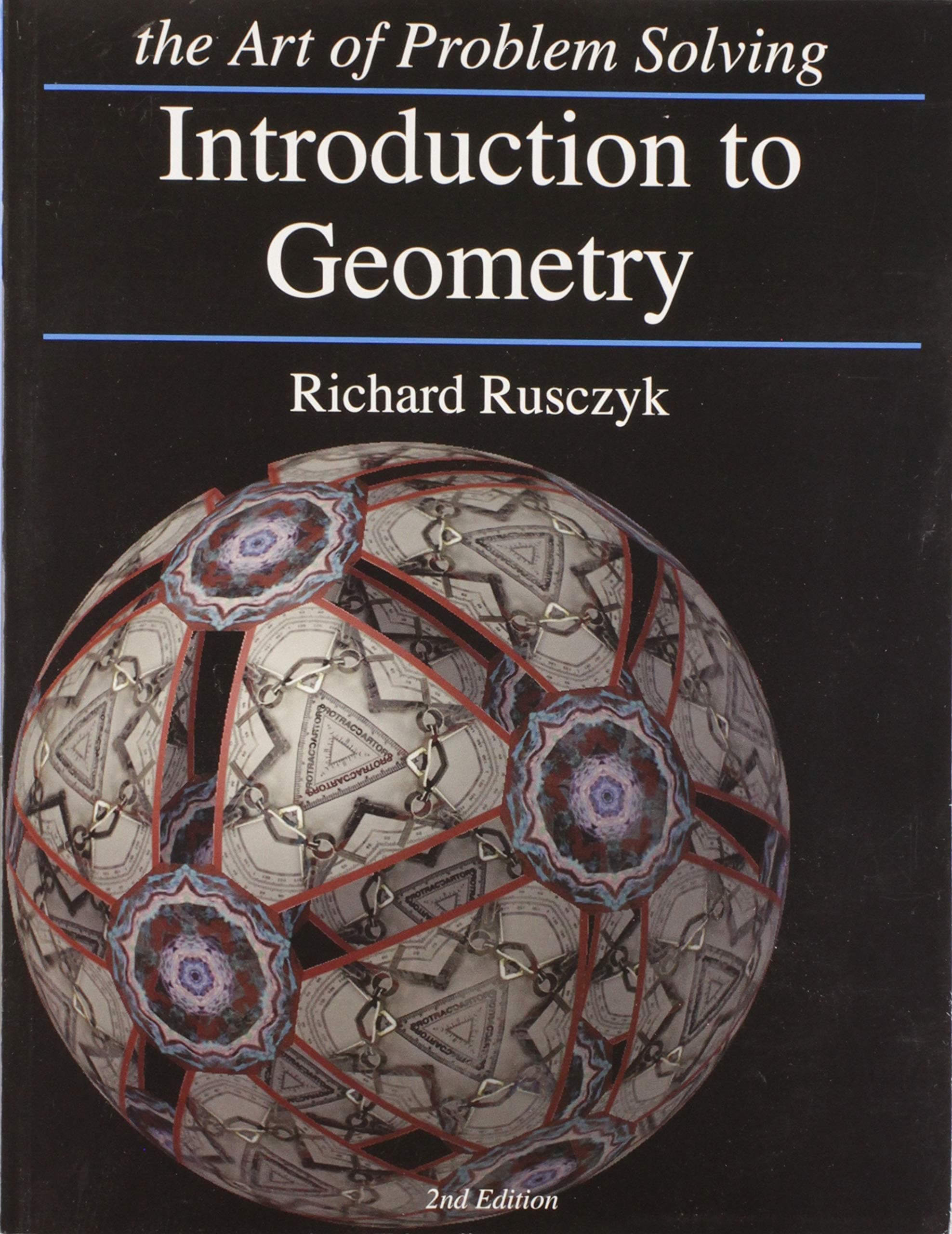
Introduction to Geometry is a highly rated, like-new educational book designed for teens and young adults. It offers clear, structured lessons that enhance understanding of geometry fundamentals, backed by a responsive seller and top rankings in its category. Free shipping and excellent customer support make it a smart, value-driven choice for ambitious learners.
| Best Sellers Rank | #111,246 in Books ( See Top 100 in Books ) #13 in Teen & Young Adult Geometry #14 in Intermediate Algebra (Books) |
| Customer Reviews | 4.5 4.5 out of 5 stars (83) |
| Dimensions | 8.25 x 1.25 x 10.5 inches |
| Edition | 2nd |
| Grade level | 7 - 9 |
| ISBN-10 | 1934124087 |
| ISBN-13 | 978-1934124086 |
| Item Weight | 2.9 pounds |
| Language | English |
| Print length | 557 pages |
| Publication date | January 1, 2007 |
| Publisher | AoPS |
H**N
Great buying experience and product
The seller give me feedback about my questions about the book and I got the perfect book at very good price. Great!
I**S
Great book and great seller
Great book, of course, but also wonderful job by the seller. Timely and quick delivery, and very friendly email with additional links for kids’ studies!
J**W
Great shop great book
Great shop great book
M**N
Speedy delivery
I liked the speedy delivery. Office Tutoring
A**D
Five Stars
Good for my 5th grade kids
A**W
Bought new, got 5 year old print.
I paid for new book. Got a used one.
A**G
Great series with formatting shortcomings
I've been running a math/computer afterschool program, and have used these and a number of other (older) textbooks extensively. I've even gone through all of them and cross referenced everything to a very detailed curriculum I have. I had gone to the same National Mathcounts Richard did years ago, and this is one of the few texts written primarily by a math person, and not a doctorate in education (the ones written by engineers can be good too; my 2 favorite algebra books are all written by phenomenal high school teachers). I really like that even good students won't be able to handle 100% of the material. Most texts seem to cater to the lower 3 quartiles of the population, not the upper. AoPS has by far the best problems (and their online Alcumus problems are even better). I like that similar to Saxon and the other good texts, it mostly lacks pictures (but lots of diagrams), and the fluff that goes into other books (when you include 3 pages of computer programming in a textbook, 3 pages of math get deleted; that biography of X mathematician just displaced a proof of the pythagorean theorem; etc). Some of the problems are hard, and this book makes a good attempt to incrementally introduce complex problem solving skills. I don't recommend this book for someone who has been struggling with the normal texts, or even one that has muddled around with the normal texts their whole life. I do recommend it as a supplement for EVERY student that is considering the math/engineering/computer/science track for a career. Diagrams are good and copious, and typesetting appears to be nicely done in LaTeX (and probably Tikz or PGF) My main problem with it is the organization. I'm not talking about the overall order of topics and presentation which are fine and comparable to others, but the organization within a chapter. There is a little bit of exposition, then a problem in gray box. Then some more material, more gray boxes then a blue box with the SAME first problem again. Then a solution in white outside the box. Then more exposition, blue, and gray boxes. Then invariably some more boxes with "Important" or "Concept". Then exercises with no solution (which are in a separate book) and sometime Challenge problems. The text is full width, which is harder to read, and the diagrams are sometimes flowed on the right, sometimes left, and sometimes centered in the middle. Sometimes the diagram is for the problem above, and sometime below. Sometimes you have to guess which problem the unlabeled diagram corresponds to. My other texts tend to be 2/3 width column with much better offsetting of text/problems/sample-problems and better flow. Overall, it's just hard on the eyes to read and pickout where to read. If you want to flip back a few pages and find X, it's really hard to do so. This is one of my favorite texts for content, and least favorite for production values. Material-wise, there is more material in here than almost all the texts with the exception of Jacobs. Many topics covered are outside the "mainstream" common core. The Extra! topics are good, and mathematically relevant, not just the usual How to Key Your Calculator. Small amount of constructions, and the same minimal amount of trig that is now included in most geometry books (trig up to law of sines/cosines). Above average quantity of proofs. I like that many of the later chapters on surfaces, volumes, and analytic geometry aren't just a regurgitation of volume of sphere is X, but rather setting the student up for really understanding the more difficult material they're find in Introductory Analysis (pre-calc, calc) courses. The other nit to pick is the lack of a hardback textbook option. Your other good alternatives are a) Dolciani/Jurgensen/Brown (unfortunately, I don't have their edition from the 60's yet) b) Saxon pre-2003 (which organizes topics in short incremental bites with lots of review; I don't like that they interweave geometry with algebra). One of my favorite for nice formatting and very clear explanations, but the spiral method doesn't work well after beginning algebra. c) Jacobs from 80s (good organization, very good topics/material) d) Moise/Downs probably the best if you like proofs and mathematical rigor. e) Rhoad (1991) isn't too bad, but like many modern books is far too busy. f) Isodore Dressler (old, my copy is in the mail to me) For the record, I'm not giving any of the texts 5-stars.
N**C
great book, my daughter likes it
great book , my daughter likes it
D**L
Easy to read and follow. Very thorough. Wish the solutions manual was included and not needing to be bought separately. Can't fault these math books though, they really do the trick.
A**V
This book is a great introduction to geometry. My daughter loves it. There are many exercises of various levels, from elementary to challenging. I wish this book was used in schools to teach geometry (note: I'm a professional mathematician).
Trustpilot
Hace 1 mes
Hace 2 meses