🌊 Ride the wave of knowledge with clarity and confidence!
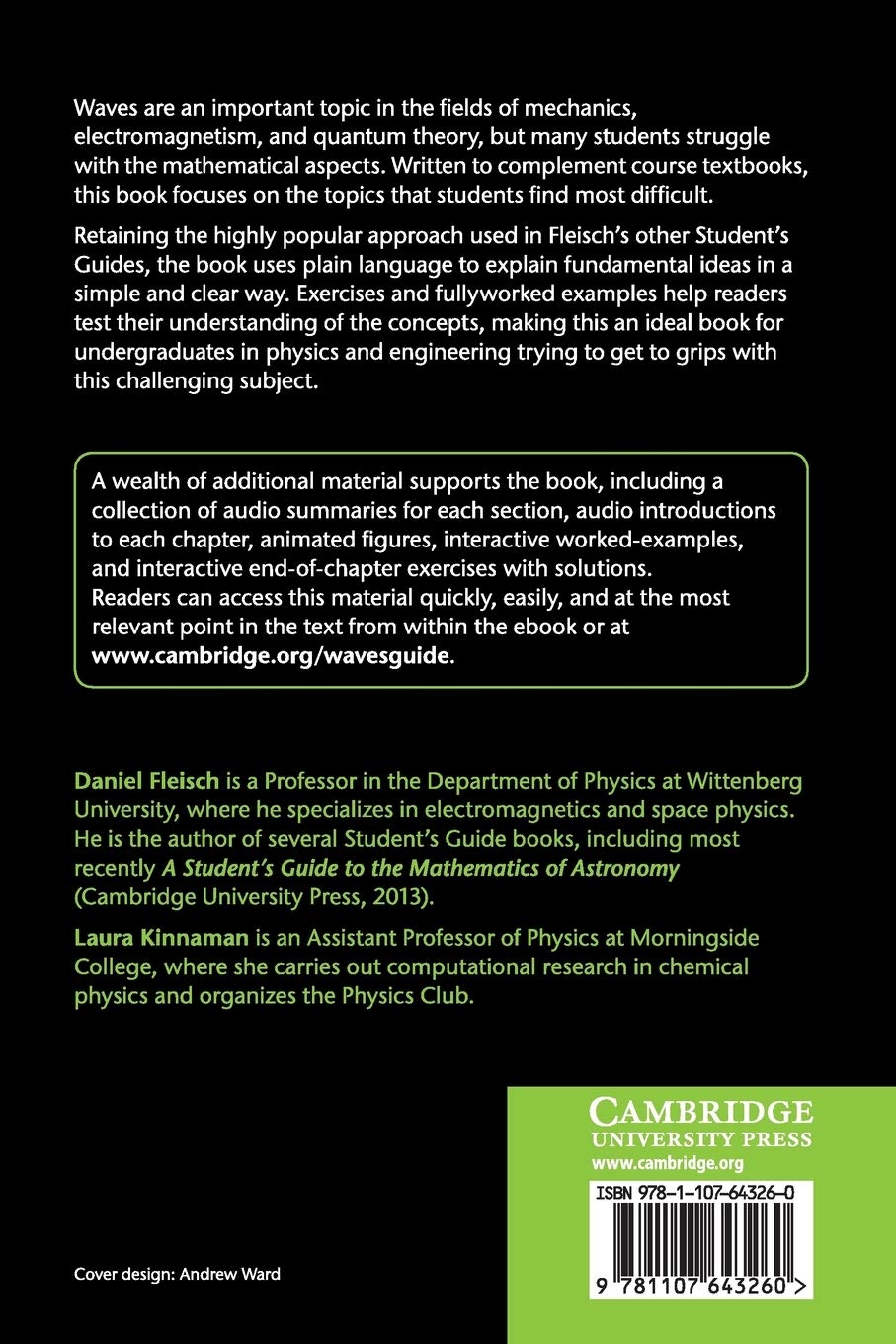
A Student's Guide to Waves by Daniel Fleisch offers an in-depth, mathematically grounded exploration of wave phenomena across mechanical, electromagnetic, and quantum domains. Designed for readers comfortable with calculus, it uniquely combines rigorous theory with accessible explanations, enhanced by audio summaries and online examples. Highly rated and recommended for engineering and physics students seeking a comprehensive yet approachable study resource.
| ASIN | 1107643260 |
| Best Sellers Rank | 54,057 in Books ( See Top 100 in Books ) 36 in Engineering Physics 37 in Applied Mathematics (Books) 39 in Higher Mathematical Education |
| Customer reviews | 4.7 4.7 out of 5 stars (260) |
| Dimensions | 15.19 x 1.32 x 22.78 cm |
| ISBN-10 | 9781107643260 |
| ISBN-13 | 978-1107643260 |
| Item weight | 363 g |
| Language | English |
| Part of series | Student's Guides |
| Print length | 230 pages |
| Publication date | 9 April 2015 |
| Publisher | Cambridge University Press |
C**Y
An in-depth look at a phenomenon (rather than a single topic)
A good mix of maths and interpretation of the physics of waves and some key wave-related phenomena. Need to be fairly comfortable with differential calculus (differentiating basic trig functions and some fairly non-threatening differential equations) but the book does walk you through most of the maths it uses and does it pretty well. Starts by building up a picture of waves that is both descriptive and mathematically based, so you feel you know the subject well and what the maths means, and then uses it to explore the physics of mechanical and electromagnetic waves and quantum wave functions. That's an unusual (and well chosen) mix of topics and for a single volume and the fact that it's done well makes it worth 5 stars. There are links to audio chapter summaries and online examples (which are quite helpful and will hopefully become more common in text books), so there's a fair amount of effort gone into making the content accessible and understandable. Probably not the book for someone trying to get a PhD between haircuts but good if you like a little patient explanation. Worth noting that on a Kindle the equations display as quite small images that won't resize, but they show up ok on the Kindle app for PC.
V**W
Highly recommended
Despite having 2 engineering degrees, I still found this book practically useful. Daniel managed to explain a complex topic with simple language. The first few chapters provided a mathematical foundation for elaborating further concepts. This study guide is a must-have for any persons trying to understand the topic.
C**H
Excellent
This is another excellent book by Daniel Fleisch. Waves may not seem like an interesting subject but the maths here is compelling and relevant to many other areas of physics and the authors do a great job explaining important concepts. The first chapter which introduces the reader to concepts linking vectors, imaginary numbers and the Euler equation is a must read.
J**Y
Good reading, not too in depth
Good reading,not too in depth,recommend.
E**.
A first class primer
An excellent book that makes few assumptions of previous knowledge of the subject. The mathematical processes are spelt out in detail, step by step, which makes them easy to follow (in my experience, many mathematical works miss out the intermediate steps, which can discourage the less adept mathematician) . A first class introduction and reference work that will be found useful well beyond the student stage. (I am writing from the perspective of an electrical engineer with more than 40 years experience).
D**G
A good introduction to waves
It's obvious when reading this book that the author has a very clear idea of what he wants to teach, and plenty of experience teaching it. This is very evident on several occasions when he uses the phrase "a common misconception". If you are an undergrad who is just beginning their study of waves then this is probably a good book to get you started.
D**J
Best ever concise guide to the physics of waves?
A first class book. If I had to have to have a single book on the topic - this would be it. I just wish I had possessed such a book many years ago! Both format and style of presentation are extraordinarily clear, with website support giving plenty of worked problems. Perfectly suited for use as an introduction to the topic, for supporting undergraduate courses or even as a concise reference book on the topic for the practising engineer/physicist. Highly recommended.
A**S
This is a great book if you know why you are buying it
This is a great book if you know why you are buying it. You cannot pass a course reading only this, so it's not complete as it covers some aspects of waves and it does not fully cover them. But, it is full of intuition that other books only dream of
C**R
'A Student's Guide to Waves' by Danel Fleisch (he has different student's guides, all very good, check it out), it is such a pleasant reading that I wish I have read it when I first studied waves. I recommend anyone wants to learn waves, or have already learned to go through this book (you will find it you go through it very fast). It is truly a student's guide and if in the future I will teach this subject, I am sure, this will be my class text ^)^ The very nice part of this book is that it explains everything in plain English. All the concepts and equations are explained like reading a story that you just want to follow with the author to understand deeper. Besides, the book is only ~200 pages, and each section is short, makes it a book that you can read anywhere (I actually read this book mostly on the flight or on Bart). The author has very deep understanding of the subject that he gives a lot of the nice explanation that I never read from other books (I am a student in Seismology, I read many books talking about the mechanical waves, but most of the time, I finish the book with more confused view about waves, it took me long time to understand it). This book starts with the fundamentals of waves, concepts like the wavenumber, complex numbers, Euler relations, wavefunctions, etc. are introduced here. These are basics for learning more of the waves. The author did very nice job showing how did these concepts come up, and accompany with the figures, these concepts become very clear. Afterwards, the book talks about the wave equation. How the wave equation derived in a simple way, and why it is the 2nd partial derivative are all nicely explained it here. Also, there are many details in the equations that we often ignore but pointed out by the author which help us to understand better of the subject. Later, the book gives the general solutions to the wave equation and the importance of the boundary conditions. After all these, the Fourier synthesis and Fourier analysis are discussed with the aids of many figures that you will find that the important Fourier synthesis and analysis are really simple and will store into your mind forever. It even talks about the 'uncertainty principle' between the time/frequency domain and the distance/wavenumber domain that dominant many analysis in practice. The last part of the book deals with specific types of waves, i.e. mechanical wave equation, electromagnetic wave equation and the quantum wave equation. Armed with the concepts and equations you learned before, you will find how to apply them to specific types of waves in the real world to address some of the interesting problems. Even though I am a seismologist, and mostly interested in the mechanical waves, but I found the electromagnetic and quantum wave equations are also very interesting. I was so impressed by the way all the nature phenomenon links to wave equation in various forms. Overal, it is a great short book that suitable for beginners or more advanced researchers.
R**I
Un libro raro per la chiarezza e l'eleganza con le quali sono spiegati argomenti piuttosto ostici.
A**R
Great book. Excellent presentation by Dr. Fleisch, as usual. An excellent addition to my technical library Thank you for the excellent delivery service.
A**O
It's a very useful book for everyone who can take approach for this issue. You only need a very basic knowledge on mathematics to follow in a very pleasantly way all subjects.
D**K
I would’ve appreciated further definitions regarding phase velocity and group velocity. Especially transverse velocity. Section 4.5 introduction was the most confusing, a diagram would’ve been helpful.
Trustpilot
Hace 2 semanas
Hace 2 meses