We remain fully operational. Our teams are working around the clock to ensure your deliveries continue safely.

Descargar la aplicación


Servicios al cliente
Sobre nosotros
Copyright © 2025 Desertcart Holdings Limited
Descargar la aplicación
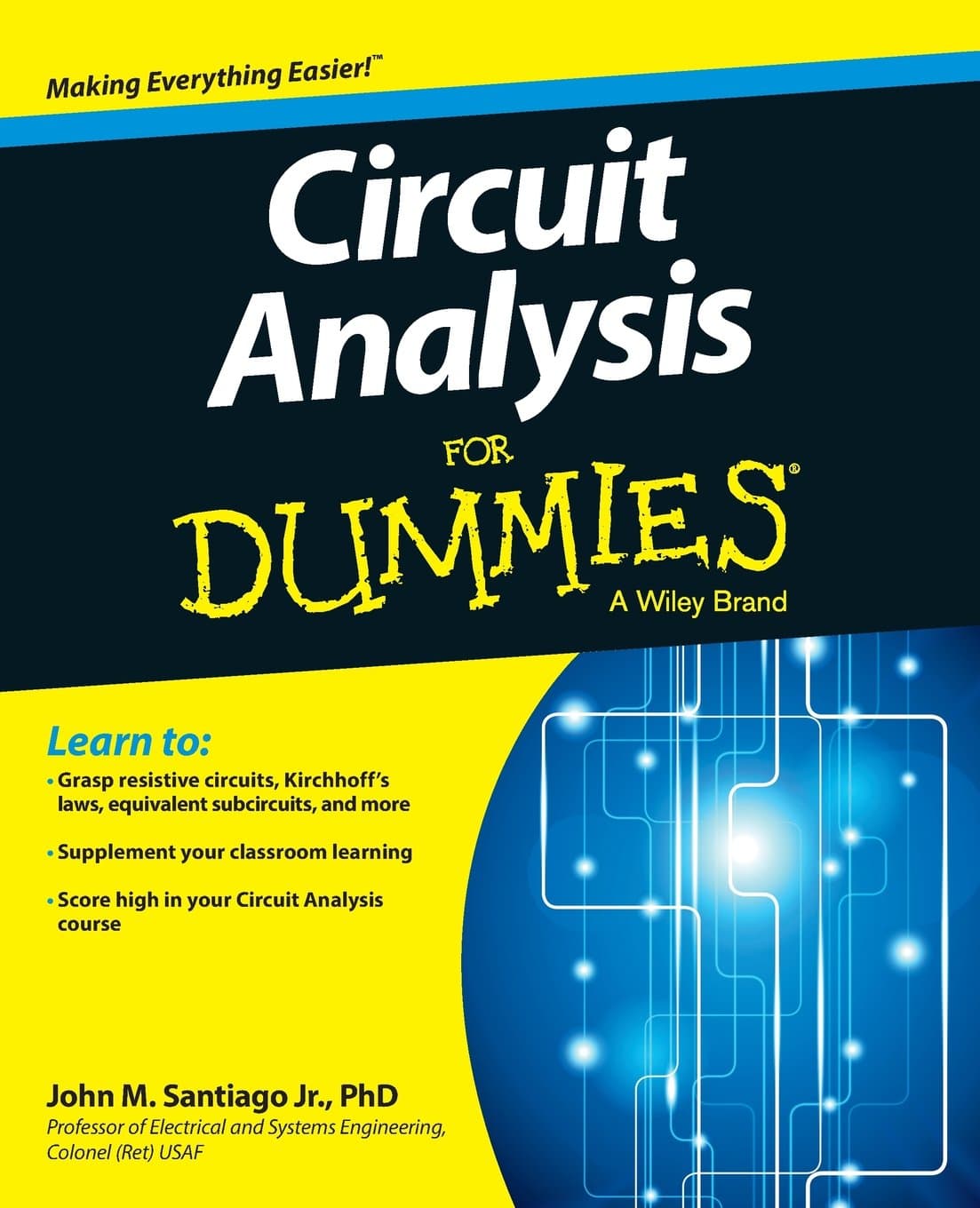
⚡️ Power Up Your Knowledge with Circuit Analysis!
Circuit Analysis For Dummies is an essential resource for anyone looking to grasp the fundamentals of circuit analysis. This guide breaks down complex concepts into digestible sections, complete with real-world examples and interactive tools to enhance learning. Perfect for students and professionals alike, it offers expert insights that make mastering circuits accessible and engaging.
| Best Sellers Rank | #257,666 in Books ( See Top 100 in Books ) #7 in Integrated Circuits #12 in Transistors Electrical Engineering (Books) #46 in Physics of Electricity |
| Customer Reviews | 4.5 4.5 out of 5 stars (436) |
| Dimensions | 7.4 x 1 x 9 inches |
| Edition | 1st |
| ISBN-10 | 1118493125 |
| ISBN-13 | 978-1118493120 |
| Item Weight | 2.31 pounds |
| Language | English |
| Print length | 384 pages |
| Publication date | April 22, 2013 |
| Publisher | For Dummies |
P**Z
Outstanding Advanced Review, but get Schaum's for Beginners
Of all the Dummies books, and I've reviewed dozens, this is the least likely to fit the "series" philosphy as a beginner's book. Still, by definition, if you get a book on Fourier Transforms for "dummies" for example, the title is already an oxymoron. Same with this little gem. If you don't have deep linear algebra (vectors, matrices, reduction to diagonals via numeric methods, etc.) and a good solid ability to solve differential equations (in advanced classes circuits use Fourier analysis and Laplace transforms as well as, today, Lagrangians in dynamical systems), PASS on this book, even though it's a great price/value for the material if you are ADVANCED-grad level, but not necessarily an EE. If there can be such a thing, Schaum's is the real "beginners" circuit analysis book-- Schaum's Outline of Basic Circuit Analysis, Second Edition (Schaum's Outline Series) -- IF you get it from an Amazon third party, be SURE it is the SECOND edition--, because it is filled with WORKED problems. (This fine "dummies" book has answers, but no explanations of the steps, such as the fact that if you find a transform, the tough part of the answer is then in "transforming" by going back to the inverse). ODE's are equations of functions, and without at least a year of linear algebra, you'll be lost). I think what some other reviewers miss is that this book IS a five star wonder for advanced students. It should NOT have been included in a "dummies" title without more warning. Don't get me wrong, there are other "dummies" books on advanced topics, like differential equations or linear algebra themselves, but circuit analysis involves representing first component boards, then diagrams, mathematically. This takes very advanced trig (voltages are signals and information, not just potential changes), and the ability to see what is negative and positive and how that becomes part of the equation. As a PhD EE and roboticist, I can humbly say that this is as much art as science, and can take a lifetime to learn! In that sense, MOST EE's have felt, at one time or another, like dummies when trying to "get" a circuit in Matlab or Simulink, let alone VHDL or a user friendly helpmate like Spice. Robbins and Miller are really the "go to" authors in this field, and I am sorry to say as a budget conscious person that, in this area, you get what you pay for. In our librarian database they are preferred nearly 6 to 1 over any other circuit analysis text, for both undergrad and computer scientists in grad school taking an ancillary EE course. Even if you're a hobbyist, you need to first get the basics of Maxwell etc. before tackling dynamical systems and PDE's, even if you DO know linear algebra. You can see some reviews of R and M at: Circuit Analysis: Theory and Practice . All that said, for the price, this Dummies pony is highly recommended for the right audience, such as computer scientists with advanced math who only need circuits in passing rather than, as the publisher promotes, "to make the cut." If you are using Spice or another circuit analysis software package, the problems here will let you see what's beneath the ice, but the author does not get into code here. Get Robbins if you want/ need to make some "cut." Significantly, our patent circuit-analysis company (my day job) at payroy dot com has seen numerous Chinese translations of this and two similar texts for Chinese beginning undergrads. "Discrete math" has not been removed from the High School curriculum there, and includes linear algebra. Telling. For the hobbyist or truly budget conscious, a GREAT oldie but goodie from Schaums (still outstanding at this writing) is: 3,000 Solved Problems in Electrical Circuits . It covers not only analysis problems, but also design, components, rules of thumb, etc. for the "practical" circuit designer and analyst in both A and D. In that regard, NOTE that this latter little book (which, even from 1988 is a little more expensive than the dummies books) is for ELECTRIC, not just electronic circuits, so you're dealing with analog as well as digital topics, problems, examples and solutions. If you're in signal processing or other a/d fields, this might be the one for you. Millions of copies of the 3,000 series have been sold-- they're keepers! HOBBYISTS: For the BEST options in this field on a TIGHT budget, search Amazon with these two keyword combinations: 1. "Circuit Analysis Dover" and 2. "Circuits Dover". Dozens of wonderful classics will come up, some new for as little as $7 US. Especially if you're into RF/analog, etc. there is NO reason not to take advantage of the wonderful detailed math explanations even if you have to put up with a few outdated "vacuum tube" references. (Unless you're in VERY high voltage storage and transmission, where you still find 'em!). Library Picks reviews only for the benefit of Amazon shoppers and has nothing to do with Amazon, the authors, manufacturers or publishers of the items we review. We always buy the items we review for the sake of objectivity, and although we search for gems, are not shy about trashing an item if it's a waste of time or money for Amazon shoppers. If the reviewer identifies herself, her job or her field, it is only as a point of reference to help you gauge the background and any biases.
G**0
Circuit Analysis is not for Dummies!
After reading the reviews, my end conclusion is the same as when Dr. J. told us he was writing this book. There is no such thing as "Circuit Analysis for Dummies", as much as there is no "Brain Surgery for Dummies". The title of the book is so very inappropriate for the complexity of the material. As a recent graduate, this book would have been helpful when I was taking the courses. More helpful than Schuams, which I have several copies. The Schuams gives a lot of equations, and short cuts to reference material, but if you want to understand the material, you need a full fledged book. It is unfortunate that the 'for Dummies" series are the people who contact Dr. J. to write the book. I feel if McGraw-Hill or some other publisher asked him to write it, then the reviews would not be as near critical. However, as a student of Dr. Santiago's, and I am reading the text, I don't find it very complicated, but at the same time the author was one of my professors until I graduated, so it's a matter of perception. So, in conclusion folks, there is nothing "for Dummies" about circuit analysis. Stick to "Sex for Dummies" if that's what your looking for. I will state this as clearly as I possibly can, and I hope other reviewers understand the point: Circuit Analysis is an ADVANCED discipline for Electrical Engineers. If you are a layman seeking to understand the basics of electrical devices, I suggest a course at your local community college. It is cheap and you will get the advanced mathematical concepts needed in order to perform circuit analysis. If you are a student, I will tell you he based his assumptions on what the reader will have to know upon a A.B.E.T. accredited program. In other words, as a student, you should have already passed all those calculus and physics courses before you took a circuits analysis course. Not all books labeled "for Dummies" means that the subject matter is easy to grasp. For a fact, circuit analysis cannot be performed without knowledge of Laplace or Fourier transform, calculus, or physics. There is a reason that Electrical Engineer programs have the title "The Second Toughest Degree Program in the United States" - because it is tough. This book was not written to be a short-cut to education, or a alternative to studying. It was written to help those struggling with the concepts to add some clarity to their perception. In that respect, Dr. Santiago aced it. I found the book well written, entertaining to read, and it is arranged in a linear fashion from simple to complex. I enjoyed it immensely.
K**R
Focused and well organized
This book is well organized for a quick trip through circuit analysis. I studied math at school and this Dummies' approach did minimize the math knowledge and sophistication generally required to actually derive the formulas needed which in my case was exactly what I needed. I am just trying to help my son learn a little more about circuit design so he can continue being interested in, rather than become frustrated with, electronics. This book was perfect for my objective.
M**R
Easy & Simple
The book gives a factual and rather fun method of learning basics about circuit analysis. This can be a very difficult topic to learn, but the author ateempts to simplify it while using strong examples. Is this a book to use as a text - NO!However, this book is a great addition to a textbook to help define some of the points that are frequently skipped or glossed over by standard textbooks. I have enjoyed this book and continued to use it for supplemntal reference. It is well worth the investment of money and time.
J**.
Recommended For College Students And College Graduates
I graduated as an MS aerospace engineer in the 80's. After 15 years as an engineering program manager my basic engineering skills had diminished. For personal reasons I wanted get reacquainted with some of these basic engineering skills. I bought a few Engineering For Dummies books (Circuits, Thermodynamics, ect) and started reading them for entertainment. They are easy to following and understand. It was nice to brush up on basic engineering skills I had not used for many years. I wish I had these books available during my school years. They present the basics without all the details you get in an entry level engineering college textbook. A quick reading of the Dummies book prior to reading a more detailed college textbook probably would have made the learning process much easier and more fun.
C**E
Not sure why engineering faculties are sadists who enjoy hazing first years by failing them but book will help you hit the ground running.
R**O
The author makes it interesting especially for people who don't like calculus.
T**M
The book is somehow not bad but there are much better books especially for beginners (e.g. floyd).
A**C
* Physical This softback book has 362 pages and is of a reasonable font size so those with specs can read it easily. There are many grey scale images, mathematical fonts and the book is light to hold when reading. * Target audience, A -level, / H.N.D, Undergraduate, graduate, post graduate? This book is targeted as H.N.D (1) or (2) and first year degree electrical engineering types. * Explain what you like about this book This book is a lovely, rich and clear exploration of the basics of circuit analysis using mathematical and engineering techniques and eventually solving first and second differential equations. The usage of Ohm's, Kirchhoff's voltage and current laws, Nodal analysis, superposition techniques is very well explained. The aim, being to grasp small circuits with components modelling by differential equations. These good bits are held back to the latter half of the book. I thought initially this was lacking in some way, but this book held the best for last. Can i explain i have learned to use these in other books but this book is as well designed as any i have encountered prior to this book. The only downside being is there are few questions and answers in this book to practice these skill on and to test your comprehension with. So you may need to work with other sources for questions. * Summary This book is as clear as it can be to explain and learn this fundamental topic. Its real quality work by the author and is both helpful and enjoyable to learn from. In my case its a refresher that's real quality.
S**O
Veramente mi sono sentito un IGNORANTE nel senso che il libro è per utenti con avanzato livello di conoscenza della materia. Non è un libro per chi vuole imparare le basi
Trustpilot
Hace 1 mes
Hace 1 mes