
Descargar la aplicación


Servicios al cliente
Sobre nosotros
Copyright © 2025 Desertcart Holdings Limited
Descargar la aplicación
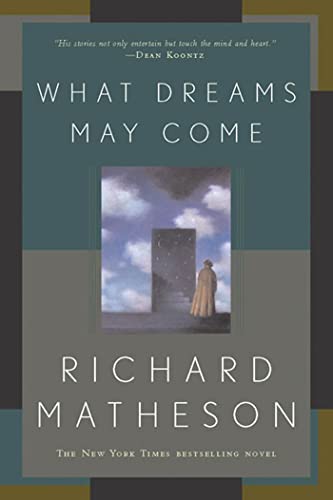
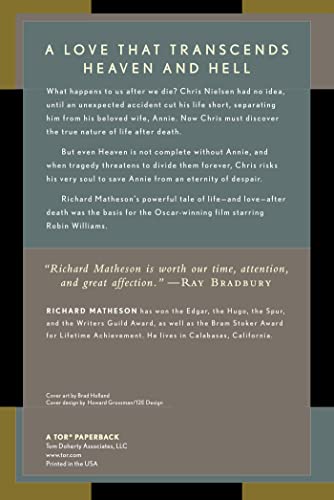


What Dreams May Come: A Novel [Matheson, Richard] on desertcart.com. *FREE* shipping on qualifying offers. What Dreams May Come: A Novel Review: So much better than the film it's scary - This novel is the most vivid, complex, and surprisingly convincing depiction of afterlife I have ever encountered in a work of fiction. Nothing else I have seen on the subject, in literature or in film, comes close--certainly not the 1998 film. Before I read the novel, I had no idea that a story about Heaven and Hell could have such a profound effect on me. In the metaphysics of the film and the book, dying involves shedding your physical body and entering a mental environment shaped by thoughts. Your fate in such an environment is largely self-imposed. That much of the movie intrigued me, the first time I saw it. The problem was the schmaltz. I mean real schmaltz, piled on in large mounds, in place of strong narrative. It's hard for me to convey just how very different the novel is. Of course there are major differences in the plot. One such difference is the ending. (Even Roger Ebert, who heaped high praise on the film, was disappointed by the ending.) Another is the beginning, where the film adds Chris's children to the list of characters who die and go to Heaven. In doing this, the movie (1) makes the early scenes so depressing they become surreal (2) needlessly clutters the story with extra characters (3) introduces a silly and confusing subplot about Chris's attempts to find his children, who are in disguise. In the book, Chris's children are adults, not youngsters, and they're minor characters who never die in the course of the story. The details of Chris's life on Earth differ so greatly between the book and the film that it's like reading about a completely different person. Even though I saw the movie first, the image of Robin Williams completely vanished from my mind as I read, because he was so unlike the character described in the book. The entire feel of the book is different, telling a touching love story that uses real characterization, not cheap manipulation, to move the audience. And Matheson's vision of the afterlife truly comes alive on the page. The Hell scenes are actually terrifying, reminding us, as the movie does not, why Matheson is primarily famous as a horror writer. I won't overlook the movie's gorgeous visual effects, which earned the film a well-deserved Academy Award. They just aren't put to good purpose. The movie's vision of the afterlife as like being inside giant paintings fails to evoke a sense of reality. The book, in contrast, bases its afterlife imagery (vividly brought to life by Matheson's skillful prose) much more on Earth-like scenery. This approach ironically leads to far more exotic ideas, such as architects who build things using their minds, and a library containing history books more objective than those on Earth. One of Matheson's unique qualities as a fantasy writer has always been his almost scientific approach to the supernatural. Here, Matheson makes Heaven and Hell seem like a scientific, natural process, and one of the joys of the book is discerning all the intricate "rules" of how everything works. (That's another area where the movie falls short.) What needs to be kept in mind, however, is that Matheson doesn't do this just for entertainment purposes. In the novel's introduction, he tells his readers that the characters are the only fictional component of the novel, and that almost everything else is based on research. The book even includes a lengthy bibliography. Thus, the afterlife that Matheson describes isn't some fantasy world he concocted from his own head, but something he believes to be an accurate description of reality. Some people may wonder, at this point, about Matheson's religious background. He was raised a Christian Scientist, but gradually developed what he calls his own religion, taking elements from many sources. One of the book's main influences, I believe, is eighteenth-century Christian mystic Emanuel Swedenborg. From what I've seen, people react negatively to this book based on how far it departs from their personal beliefs. Christians complain about the absence of Jesus, while those who don't believe in any afterlife consider the story too nonsensical to accept. Most readers, it seems, are put off by the New Age terminology and concepts scattered throughout the book. These reactions are puzzling, if you stop to think about it. Books about elves, fairies, dragons, and wizards remain popular even though nobody believes in any of those things. Why should people be bothered by a fiction book portraying a Heaven and Hell that conflicts with what they believe? The book is perfectly enjoyable whether or not you accept Matheson's metaphysics. Of course, I personally do think Matheson provides insight into the subject--though I admit I'm a little wary of his acceptance of paranormal phenomena. But it amazes me how so many people refuse to even touch the book, thinking that any story with such a plot must automatically be hokey. In most cases, they'd be right. "What Dreams May Come" is a big exception. It suggests the endless possibilities in a subject that normally is dead weight for fiction. And it really makes you think. Review: Schmaltzy but good - Bought this book ages ago but finally got around to reading now. No point going over the plot since most will be familiar with it from the movie, but in terms of writing, I thought it was a little schmaltzier than the movie, though something feel good is always nice. It's also a lot more 'tell' rather than 'show' so to speak, large chunks of it are just the protagonist listening to angels (or friendly companions, more specifically) explaining stuff about etheric bodies and all that the author obviously read in some of the 'occult' books listed in the bibliography. I enjoyed it, though. I'd give it 4.5 stars but I'll round it up to 5. For my copy, printing and binding were clean too, so thats good.
| ASIN | 0765308703 |
| Best Sellers Rank | #49,969 in Books ( See Top 100 in Books ) #59 in Ghost Fiction #97 in Metaphysical & Visionary Fiction (Books) #2,567 in Literary Fiction (Books) |
| Customer Reviews | 4.5 4.5 out of 5 stars (1,914) |
| Dimensions | 5.5 x 0.68 x 8.25 inches |
| Edition | First Edition |
| ISBN-10 | 9780765308702 |
| ISBN-13 | 978-0765308702 |
| Item Weight | 2.31 pounds |
| Language | English |
| Print length | 288 pages |
| Publication date | January 1, 2004 |
| Publisher | Tor Books |
K**D
So much better than the film it's scary
This novel is the most vivid, complex, and surprisingly convincing depiction of afterlife I have ever encountered in a work of fiction. Nothing else I have seen on the subject, in literature or in film, comes close--certainly not the 1998 film. Before I read the novel, I had no idea that a story about Heaven and Hell could have such a profound effect on me. In the metaphysics of the film and the book, dying involves shedding your physical body and entering a mental environment shaped by thoughts. Your fate in such an environment is largely self-imposed. That much of the movie intrigued me, the first time I saw it. The problem was the schmaltz. I mean real schmaltz, piled on in large mounds, in place of strong narrative. It's hard for me to convey just how very different the novel is. Of course there are major differences in the plot. One such difference is the ending. (Even Roger Ebert, who heaped high praise on the film, was disappointed by the ending.) Another is the beginning, where the film adds Chris's children to the list of characters who die and go to Heaven. In doing this, the movie (1) makes the early scenes so depressing they become surreal (2) needlessly clutters the story with extra characters (3) introduces a silly and confusing subplot about Chris's attempts to find his children, who are in disguise. In the book, Chris's children are adults, not youngsters, and they're minor characters who never die in the course of the story. The details of Chris's life on Earth differ so greatly between the book and the film that it's like reading about a completely different person. Even though I saw the movie first, the image of Robin Williams completely vanished from my mind as I read, because he was so unlike the character described in the book. The entire feel of the book is different, telling a touching love story that uses real characterization, not cheap manipulation, to move the audience. And Matheson's vision of the afterlife truly comes alive on the page. The Hell scenes are actually terrifying, reminding us, as the movie does not, why Matheson is primarily famous as a horror writer. I won't overlook the movie's gorgeous visual effects, which earned the film a well-deserved Academy Award. They just aren't put to good purpose. The movie's vision of the afterlife as like being inside giant paintings fails to evoke a sense of reality. The book, in contrast, bases its afterlife imagery (vividly brought to life by Matheson's skillful prose) much more on Earth-like scenery. This approach ironically leads to far more exotic ideas, such as architects who build things using their minds, and a library containing history books more objective than those on Earth. One of Matheson's unique qualities as a fantasy writer has always been his almost scientific approach to the supernatural. Here, Matheson makes Heaven and Hell seem like a scientific, natural process, and one of the joys of the book is discerning all the intricate "rules" of how everything works. (That's another area where the movie falls short.) What needs to be kept in mind, however, is that Matheson doesn't do this just for entertainment purposes. In the novel's introduction, he tells his readers that the characters are the only fictional component of the novel, and that almost everything else is based on research. The book even includes a lengthy bibliography. Thus, the afterlife that Matheson describes isn't some fantasy world he concocted from his own head, but something he believes to be an accurate description of reality. Some people may wonder, at this point, about Matheson's religious background. He was raised a Christian Scientist, but gradually developed what he calls his own religion, taking elements from many sources. One of the book's main influences, I believe, is eighteenth-century Christian mystic Emanuel Swedenborg. From what I've seen, people react negatively to this book based on how far it departs from their personal beliefs. Christians complain about the absence of Jesus, while those who don't believe in any afterlife consider the story too nonsensical to accept. Most readers, it seems, are put off by the New Age terminology and concepts scattered throughout the book. These reactions are puzzling, if you stop to think about it. Books about elves, fairies, dragons, and wizards remain popular even though nobody believes in any of those things. Why should people be bothered by a fiction book portraying a Heaven and Hell that conflicts with what they believe? The book is perfectly enjoyable whether or not you accept Matheson's metaphysics. Of course, I personally do think Matheson provides insight into the subject--though I admit I'm a little wary of his acceptance of paranormal phenomena. But it amazes me how so many people refuse to even touch the book, thinking that any story with such a plot must automatically be hokey. In most cases, they'd be right. "What Dreams May Come" is a big exception. It suggests the endless possibilities in a subject that normally is dead weight for fiction. And it really makes you think.
G**D
Schmaltzy but good
Bought this book ages ago but finally got around to reading now. No point going over the plot since most will be familiar with it from the movie, but in terms of writing, I thought it was a little schmaltzier than the movie, though something feel good is always nice. It's also a lot more 'tell' rather than 'show' so to speak, large chunks of it are just the protagonist listening to angels (or friendly companions, more specifically) explaining stuff about etheric bodies and all that the author obviously read in some of the 'occult' books listed in the bibliography. I enjoyed it, though. I'd give it 4.5 stars but I'll round it up to 5. For my copy, printing and binding were clean too, so thats good.
R**K
Genius Story, the Ending Not So Much
I thoroughly enjoyed this novel. It is an exquisite, genius blend of metaphysical knowledge into what we're told is a fiction story. I'm not ashamed to admit that I wept with joy and sorrow through much of the first third of the book, especially Chris's death at the very beginning. I thought the entire book resonated quite well with my own belief system, which has been aquired from many books on mysticism, spiritualism, and metaphysics in general. While I speak about the ending in the sentences that follow, I will attempt to not put out any spoilers and try to speak about things in broad, general terms. I was very disappointed and upset by the ending of this book. More than disappointed, angry, enraged. Upon reflection I felt that the ending was a complete contradiction of the principles established in the first third of the book. It felt like an immoral and contradictory conclusion to an otherwise flawless masterpiece. The ending for me was nothing more than dogma. Having read it, I understand now why the movie's creators were so conflicted about how the story should end, but I believe that the movie got it right here and the book, wrong. I prefer the book to the movie's everything else for the most part though. And the following paragraphs DO CONTAIN SPOILERS... As a hopeless, head over heals romantic, I more than identified with the story. It felt like I was reading a real account of the afterlife from a real person. The ending felt as hollow as Ann did in hell. It felt like a punishment, not like a balancing of the scales. And I do not accept the idea of karma as described by the author. The idea of karma ends when a soul realizes, learns, accepts, and repents the wrong of their actions, no further action is required. Why would there be? If the requisite knowledge becomes a part of the soul, it does not need to be learned again through some forced action of retribution. There is no karma as retribution. Karma is a tool to teach, empathy, compassion, patience, and so on. Not a tool of punishment. I do not believe that a soul would ever be forced to be reborn, first, without their own choice in the matter, and, second, with any handicap or ailment that soul hasn't specifically selected for itself for it's personal growth, no matter what its past life deeds. And I do not accept that any person so brought to the pit of despair to commit suicide will have any conclusion forced on them as a result of leaving the earthly plane before their scheduled departure. As the book establishes, reality for any soul is a result of that soul's thoughts, this is as true for a soul that has been taken naturally or one that takes itself through suicide. It is also unacceptable that the hall of records would not have known about this potential suicide. Each thought is a chain, one leads to the next, the examiners there would have certainly known of Ann's plan to take her own life, especially at that moment of her intense suffering and despair on earth. She would have been surrounded by guides and helpers to help her at the moment of her crossing to attempt to prevent her from sinking into the turmoil of hell. The ending was completely unacceptable to me. So much so that I feel that every single copy of this book should be recalled and the ending rewritten completely. Keeping two souls, who love and are devoted to each other so completly, apart from each other after so much anguish and despair and toiling just feels cruel and way over the top. Even if they were eventually brought together in a new life. What about their children? Wouldn't they like to see their parents in the great hereafter after /their/ heartache? It makes no sense. I do not accept (at least in the context of this story) that rebirth could possibly take place so quickly. Furthermore, if a soul's thoughts and will create their own reality, how can it be said that Ann must be reborn immediately? No one would possibly choose such a path after that experience. I have other issues with the story here and there. The concept of a soul's ultimate goal being to be reunited with God is written about an awful lot. Personally, I believe we all already reunited with God since we all contain the essence of God already, as does everything around us. So, what would be the point? I can imagine no greater boredom than becoming little more than a fixture. Perhaps there is more to it that my tiny, feeble mind does not yet understand. But this thought goes to my greater point, life, afterlife, whatever, is what God does to keep eternity interesting. The book was so much more detailed, expansive. I hated that the movie dumbed down so much, introduced unnecessary characters, and added far more drama and grief to a story that already had more than enough grief. This is just Hollywood making things more dramatic than necessary.
A**E
Da ich keine deutsche Übersetzung gefunden habe, habe ich mich an das Original gewagt und es nicht bereut! Auch wenn ich mit meinem durchschnittlich gutem English immer wieder mal ein Wort nachsehen musste, war der Lesegenuß ungetrübt. Wer an einen "Live-Bericht" von den Vorgängen nach dem Tod interessiert ist, wird hier viel erfahren. Auch wenn es für jeden anders ist, so sind doch die Nach-Todes-Erlebnisse von Chris Nielson spannend und aufschlussreich.
T**I
Excelente libro. Una historia que te envuelve y deja pensando en como vemos la vida y lo que pasa después. Me encanto.
D**N
Non è assolutamente all'altezza del film. Grande il regista Vincent Ward a ricavare un film così stupendo da un racconto così mediocre. Valido come esercitazione per lettura dell'inglese.
A**A
After seeing the film over the years on several occasions, I have now read the wonderful book. As a Medium, and having seen my loved-ones on a regular basis over the years, I smiled while reading Richard Matheson's story as a lot of the detailed information within it is indeed factual and true. Of course, I respect that not everyone in this world believes in an afterlife, but one day they will see - to their surprise and happiness (and relief) - that there is one and that life goes on. Mr Matheson conveys detailed imagery and mentions what many NED's (near death experience) survivors have documented over many decades, that there is something on the 'other side'. Richard Matheson is one of my favourite authors, he was an amazing writer; not just because this is my favourite book (and film) but because he was a gifted writer who carries readers on a fantastic journey throughout time, beautiful experiences, he gets to the heart of the matter in an eloquent and moving manner and you just cannot get enough of his work as you turn each page eagerly and feel genuinely sad when you reach the final page, as you truly want to read more, and more, and more of this talented man's inspiring and interesting words. He doesn't just stimulate your mind, he touches your heart and soul too and that is rare of most storytellers. I highly-recommend this book - What Dreams May Come - to anyone who is ever curious as to what lies behind the thin veil that we call 'the spirit world' and how we can still interact with our loved-ones once we have passed (or crossed-over) from this realm of existence into the next, and that love really does conquer everything. Just because we die physically, that is not the end of us as a soul...far from it. I'm not religious, but I do know that there is an afterlife for us, and many beautiful things (the spirit world is very much like here on earth - but colours and scenery are more vivid - seeing our loved-ones and even pets again) awaits us. It truly is comforting and provides much hope for anyone grieving the loss of a loved-one. Nothing (and no-one) is ever really lost. The consequences of suicide are described within the book but, from my understanding, those who take their own lives in real life are not punished (my sister wasn't), they are given help and comfort to see where they went wrong on their life path and are given opportunities to put it right in a future life. After reading What Dreams May Come, you will question everything about life and 'death' and you will come to the conclusion that there must be something more than our existence here on earth... That there is more. And it's all great. Despite this story in the book being labelled as fictional, there is a lot of truth within it and I believe that Mr Matheson knew this... The man had a glimpse of the other side for real, and through his written work he has helped and has comforted countless people worldwide, and has instilled much hope to them - how wonderful is that. Although the details in the film version contain different things in parts, compared to what is in the book version, the lessons are the same; that life - and love - are eternal, and the dreams that await us after physical death are very much real and spectacular. What Dreams May Come. A brilliant wonderful book. No doubt Mr Matheson is still telling fabulous stories to friends and family in the spirit world. What a lovely man. I sincerely hope that anyone who has read his book, regardless of whether they have had a loved-one pass away or not, feels comforted and happier as a result of reading this breathtakingly-beautiful story.
U**L
Je me suis tellement attachée à ce livre, quand je l'ai fini j'ai ressenti un vide. J'aimerai trouver un livre similaire afin de rester dans la même ambiance.
Trustpilot
Hace 2 semanas
Hace 3 semanas