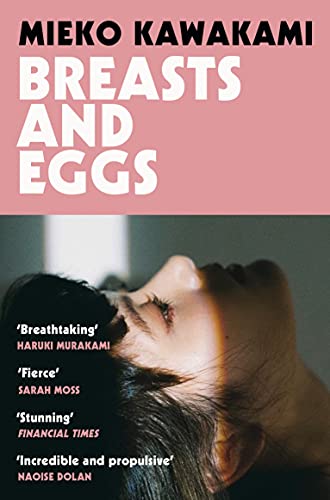


Buy Breasts and Eggs: A powerful and intimate novel about what it means to be a woman in modern Japan by Kawakami, Mieko, Bett, Sam, Boyd, David from desertcart's Fiction Books Store. Everyday low prices on a huge range of new releases and classic fiction. Review: beautiful book - loveeee meiko kawakami, wonderful book Review: Really good - definitely will read more of the author - Breasts and Eggs is a Tokyo-based story set in two different parts. The first section (Breasts) follows the narrator Natsuko as she is visited by her older sister Makiko and her teenage niece Midoriko. Makiko has come to Tokyo to look into breast augmentation surgery, and Midoriko is having a hard time with this, alongside all the other horrors of being a young teenage girl on the verge of a whole load of body/hormonal changes. The second part of the book (Eggs) follows Natsuko on her own, around 10 years later, as she continues to pursue her career of being an author and looks into finally having her own child via IVF which is complicated in itself as a single woman. This story was just so interesting and well-written with a character who I felt was peeled back and revealed to us layer by layer as she continue to dive into the core of her being, and examining her wishes and desires. First off, the translation of this book is really excellent. I'm no expert by any means but I found it just so easy to read, the language and writing flowed really, really well. Absolutely seamless. I thought the exploration of Natsuko in this book was so thought-provoking and hard-hitting as well as just all kinds of raw. The book very much explores what it means to be a woman, particularly in Japanese society, and everything that comes with that mark of being a woman - being young and beautiful, and if not young, making yourself look as perfect as you can through beauty treatments and invasive surgery. The fears of growing older but also just growing up - how terrifying it can be to be on the periphery of girl to woman, and knowing all the different things your body will go through for years and years, and feeling disconnected from that body somehow because of the horror of it all. And then making decisions about motherhood, how womanhood and being a mother are linked in different ways whether you have a child, or remain childless. How it can define you even if you don't want it to. One of the things I found very interesting was the discussions around IVF/sperm donation and women choosing to have children without a partner. I didn't know there was so much red tape for single women who wanted to have a child and the sometimes dangerous ways women would have to choose to have a child via sperm donation if they want one. Loads of big questions here too around the population of the world and if it's ethical to have any children at all seeing as no-one asks to be born. You can take a lot from that, and everyone will probably have a different opinion. Natsuko goes through a lot in this book, and I feel like we just see her on the edge of a lot of things all the time. I just wanted her to keep going, and trying and believing in herself. I always felt like she could give a little bit more to everything. I did think for a while this would be a 5-star read for me but it did lose me near the end, as I felt just a little bit fatigued by the story I think. I also did miss the inclusion of Makiko and Midoriko in the later story as I felt like they were so interesting in the first half and they both had great but different dynamics with Natsuko.


| Best Sellers Rank | 11,185 in Books ( See Top 100 in Books ) 386 in Women's Literary Fiction (Books) 1,335 in Literary Fiction (Books) 1,804 in Contemporary Fiction (Books) |
| Customer reviews | 4.1 4.1 out of 5 stars (4,067) |
| Dimensions | 13 x 3 x 19.6 cm |
| Edition | Main Market |
| ISBN-10 | 152907441X |
| ISBN-13 | 978-1529074413 |
| Item weight | 307 g |
| Language | English |
| Print length | 432 pages |
| Publication date | 10 Jun. 2021 |
| Publisher | Picador |
| Reading age | 18 years and up |
H**H
beautiful book
loveeee meiko kawakami, wonderful book
A**E
Really good - definitely will read more of the author
Breasts and Eggs is a Tokyo-based story set in two different parts. The first section (Breasts) follows the narrator Natsuko as she is visited by her older sister Makiko and her teenage niece Midoriko. Makiko has come to Tokyo to look into breast augmentation surgery, and Midoriko is having a hard time with this, alongside all the other horrors of being a young teenage girl on the verge of a whole load of body/hormonal changes. The second part of the book (Eggs) follows Natsuko on her own, around 10 years later, as she continues to pursue her career of being an author and looks into finally having her own child via IVF which is complicated in itself as a single woman. This story was just so interesting and well-written with a character who I felt was peeled back and revealed to us layer by layer as she continue to dive into the core of her being, and examining her wishes and desires. First off, the translation of this book is really excellent. I'm no expert by any means but I found it just so easy to read, the language and writing flowed really, really well. Absolutely seamless. I thought the exploration of Natsuko in this book was so thought-provoking and hard-hitting as well as just all kinds of raw. The book very much explores what it means to be a woman, particularly in Japanese society, and everything that comes with that mark of being a woman - being young and beautiful, and if not young, making yourself look as perfect as you can through beauty treatments and invasive surgery. The fears of growing older but also just growing up - how terrifying it can be to be on the periphery of girl to woman, and knowing all the different things your body will go through for years and years, and feeling disconnected from that body somehow because of the horror of it all. And then making decisions about motherhood, how womanhood and being a mother are linked in different ways whether you have a child, or remain childless. How it can define you even if you don't want it to. One of the things I found very interesting was the discussions around IVF/sperm donation and women choosing to have children without a partner. I didn't know there was so much red tape for single women who wanted to have a child and the sometimes dangerous ways women would have to choose to have a child via sperm donation if they want one. Loads of big questions here too around the population of the world and if it's ethical to have any children at all seeing as no-one asks to be born. You can take a lot from that, and everyone will probably have a different opinion. Natsuko goes through a lot in this book, and I feel like we just see her on the edge of a lot of things all the time. I just wanted her to keep going, and trying and believing in herself. I always felt like she could give a little bit more to everything. I did think for a while this would be a 5-star read for me but it did lose me near the end, as I felt just a little bit fatigued by the story I think. I also did miss the inclusion of Makiko and Midoriko in the later story as I felt like they were so interesting in the first half and they both had great but different dynamics with Natsuko.
J**G
The Right to Procreate
The anti-heroine in Kawakami’s whimsically and provocatively titled novel is centred on a budding writer, whose real name, Natsuko Natsume is often wrongly assumed to be a pseudonym. Much else is misunderstood about Natsu, such as her wish to be a single parent via artificial insemination from a sperm donor. Natsu has ruled out having a baby in the “conventional” manner, as she is adverse to sex, having had a broken relationship because of it. Perhaps her impoverished background and abandonment of the family by her father are contributing factors to her views on marriage and family, though this is not a link the author makes explicit. Natsu’s biological clock is ticking, even as she struggles career-wise to realise her dreams of writing more than one measly novel to make a living and wonders about the practicalities of having another mouth to feed. As such, this novel appears to be somewhat of a feminist manifesto that reclaims the woman’s autonomy and her own body’s reproductive rights against societal norms and expectations. But partway through the novel, complications enter Natsu’s life, in the form of Aizawa, a donor-conceived child, now an adult looking for his progenitor. He alerts Natsu to the implications on her future child’s life if she should proceed on this venture. Is it not selfish to deprive a child of a relationship with her father? What ensues is a series of philosophical and ethical debates between them and other viewpoints from the people in Natsu’s life as she comes to reconsider her decision. What appears to move a little predictably (no spoilers here) is somewhat thwarted by a sleight of hand, which, to me, was a little forced, as if Kawakami was too determined for her novel to stay the course against type, in its conclusion. Nonetheless, this was an interesting-enough novel, though I was not as fully engaged in it as I has thought I would be.
W**D
Meiko Kawakami's novel, Breasts and Eggs, is her first to be published in English. The publisher, Europa Editions, says that it will be publishing two more, Heaven and The Night Belongs to Lovers. Let's start with the book's title. The original title is Natsumonogatari, which could be translated as A Summer Story. Because the character telling her story is named Natsuko, a pun is buried in the title, which similar to the Genji Monogatari might also be read as The Tale of Natsu[ko]. Be that as it may, Breasts and Eggs is both appropriate more tempting title than A Summer Story. In Book One, Natsuko's older sister Makiko comes up to Tokyo from Osaka in the summer with her daughter Midoriko intent on obtaining breast enlargement surgery, staying with Natsuko. In Book Two, ten years later, Natsuko—single, childless, now economically secure, and pushing forty—begins to consider having a child. There are two problems with this impulse: Natsuko finds sexual intercourse worse than distasteful. She tried it in her late teens, early twenties with a boyfriend, so coitus is out. Also Japanese society discourages single women from having artificial insemination. It exists, but it's for married couples who cannot have a child. Natsuko is 29 in Book One; Makiko is 39; and Midoriko is 12 (and communicates with her mother and aunt only in writing; she'll talk to her friends but not to her mother). The girls grew up in Osaka in a cramped and gloomy apartment over an izakaya. One day when Natsuko came home from elementary school, her layabout father was gone and they never saw him again. They moved in with grandmother and mother worked a couple jobs and in a bar. Mom died when Natsuko, was 13 and two years later grandmother died. At the beginning of Breasts and Eggs Natsuko has been living in Tokyo, working in a bookstore to support herself with ambitions of being a writer. Makiko is a single mother working as a bar hostess having made an unfortunate and short-lived marriage. The novel is worth reading for several reasons. Kawakami is able to covey Natsuko's daily life, family history and relationships, her friendships, and the—I guess—texture of her lived experience. We know who she is, what she wants, why she wants it. And we can understand why her sister could want improved breasts. The book also conveys a sharp picture of a contemporary Japanese life. This is what it is like to live as this aspiring woman in Japan today. Is Natsuko typical? Probably not. Is she representative? Probably not. Is she Japanese? Absolutely. In Book One Kawakami does allow the reader access to information Natsuko doesn't have. These are the entries from her 12-year-old niece's journal, thoughts like: "It feels like I'm trapped inside my body. It decides when I get hungry, and when I'll get my period. From birth to death, you have to keep eating and making money just to stay alive. I see what working every night does to my mom. It takes it out of her. But what's it all for. Life is hard enough with just one body. Why would anyone want to make another one? . . ." The book is more than the sisters' dilemmas about their breasts and eggs. At one point, Natsuko and a writer friend talk about dialect in fiction. The friend says that in Osaka she heard "these three women just talking, a million miles an hour, getting everything in there. There was so much going on. Multiple perspectives, mixed tenses, the whole shebang. They were cracking up, but they were having a real conversation. Nothing like on TV. Everything on TV is tailored for TV . . . What gets me is how writing always fails to capture it. Like, the way those three women were talking. I mean, you couldn't reproduce that performance on the page and get the same dynamic . . ." Sam Bett, a prize-winning translator, and David Boyd, an assistant professor Japanese at the University of North Carolina, translated Breasts and Eggs. The translation is, as I hope my two short quotes indicate, smooth and resourceful ("shebang"!). They did not translate every Japanese term—izakaya, mugicha, okonomiyaki, tanto—which means they did not have to slow a sentence down by explaining, and the context provides the approximate meaning for readers who have no Japanese at all. The jacket flap copy says "Kawakami, who exploded onto the cultural scene first as a musician, then as a poet and popular blogger, is now one of Japan's most important and best-selling writers." Based on Breasts and Eggs, she should be
J**L
Livré en bon état, hate de le lire
D**E
Poor condition, edge is creased
S**.
Prodotto come da foto, bella lettura. Consegna puntuale.
L**A
Esta autora nunca decepciona
Trustpilot
Hace 2 meses
Hace 1 mes