We remain fully operational. Our teams are working around the clock to ensure your deliveries continue safely.

Descargar la aplicación


Servicios al cliente
Sobre nosotros
Copyright © 2025 Desertcart Holdings Limited
Descargar la aplicación
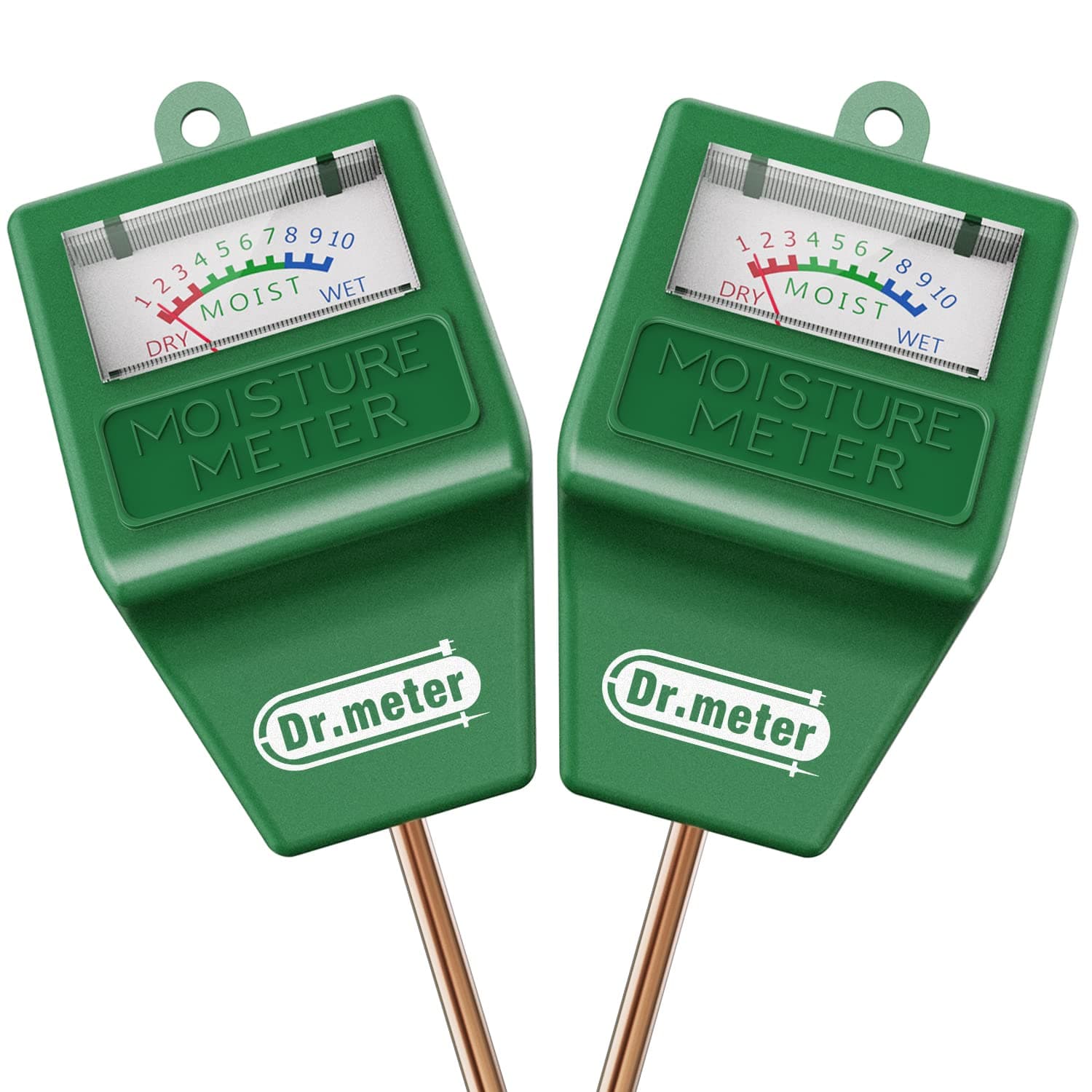
🌿 Water Smarter, Grow Stronger — Never Guess, Always Thrive!
The Dr.meter Soil Moisture Meter 2-pack offers a compact, battery-free solution for precise soil moisture measurement. Featuring a 10-scale color-coded display and a gentle single-probe sensor, it ensures accurate readings without disturbing plant roots. Ideal for indoor and outdoor use, this easy-to-use kit empowers gardeners to optimize watering schedules, promoting healthier plants and water savings.


| ASIN | B014P97TXM |
| Battery Description | No batteries needed |
| Best Sellers Rank | #24,114 in Patio, Lawn & Garden ( See Top 100 in Patio, Lawn & Garden ) #48 in Soil Meters |
| Brand Name | Dr.meter |
| Color | Green |
| Customer Reviews | 4.4 4.4 out of 5 stars (4,302) |
| Global Trade Identification Number | 06958446338444 |
| Included Components | 2pcs soil moisture meter |
| Item Dimensions W x H | 2.02"W x 10.97"H |
| Item Type Name | Hygrometer Moisture Sensor Meter for Garden, Farm, Lawn Plants Indoor & Outdoor, No Battery needed |
| Item Weight | 0.01 Ounces |
| Manufacturer | Dr.meter |
| Mounting Type | Tabletop |
| Unit Count | 2.0 Count |
| Warranty Description | 1 |
S**D
Every Gardener Needs One of These Meters!
This moisture meter works beautifully and has quickly become one of my must-have gardening tools. It takes the guesswork out of watering and has already saved me from drowning half my plants out of “just in case” paranoia. It does its job perfectly, but handle it gently, these meters don’t exactly thrive in rough, rocky soil and can bend or break if you get too enthusiastic. Treat it like the delicate little garden whisperer it is. Despite its fragility, it’s absolutely crucial for any gardener who wants healthy plants and a lower water bill. The acid meter is great for testing your soil and knowing what amendments are needed. I won’t garden without them now.
J**L
Works great!
There basic and work great.
E**N
Good meters as-is for cacti, need to be modified for water-loving plants. (modification instructions and photos included)
As they come from the factory, these (at least the two I got) seem to only be good for desert plants (cacti & succulents) that need to be totally bone dry before watering. First let me debunk a couple of reviews I read that said these were 'crap' because when the customer put them in a glass of water they read 'dry'. They are NOT made to read the presence of PURE water! They only take a reading on water that has impurities. I got some clean pure water, stuck the probe in it and it read 'dry'. I then boiled the water and made a cup of strong black coffee, and a cup of strong black 'Earl Gray' tea;stuck the probe in each one of those and the meter pegged over to a 10++ reading. If you get a pot of good soil, and soak it well with water until it's dripping out of the bottom of the pot (waiting until all water dripping stops first) and then stick it in the dirt, it also reads 10++. Makes sense, the water in the pot is also impure due to the soil. OK, so now we know what these are designed to read, and how the work. Now I'll discuss what they are good for as they come, new from the factory; they are VERY sensitive to moisture. Almost all cacti & succulents need to have the soil get bone dry between waterings. For those types of plants, you really don't need these meters so long as you are willing to invest in a large supply of disposable tongue depressors or pop-sickle sticks. The way to check the dirt in your cacti is to insert the dry stick; if it comes out even slightly discolored (indicating some moisture in the soil has impregnated into the wood) then you need to withhold water longer. Only when the stick comes out just as dry and the same color as before you inserted it, do you add water to your cacti (and even then, it's usually best to withhold water an additional 2 weeks in most climates except for low desert southern Arizona where it's 110+ degrees). The way this meter comes from the factory it's perfectly calibrated for this type of water monitoring. However, if you are trying to keep sensitive water-loving tropical plants alive (such as papaya, guava, pineapple, passion fruit, etc.), especially in a hot dry place like low desert southern Arizona in summer time, these meters WILL kill your plants if you simply go by the readings they give rather than by common sense and how you wilty plants are actually looking! If you wait until these meters read in the 4-7 (moist) range before you water these types of plants, your water loving tropicals will wilt and start to die (even in the Arizona winter when it's only in the low 70's outside). But that's 'OK' because I've got a fix for you that you can implement. I took the back off of one of the meters and took it into my electronics lab to see what makes it tick. There are no markings on the meter to indicate it's full scale deflection; I'm going by my 45 year's experience as an electronics tech to go out on a limb and say they must be either 100uA or 500uA meters (uA means micro-Amperes for you non-technical types - a very small amount of current that's non-lethal even to a baby newborn mouse). One micro-Ampere is one millionth of an amp. Remember above I said the probes are very sensitive? OK, so I carefully pried the back off of one of the meters - they are held on by the press-fit of 6 little plastic pins protruding from the back of the case, that fit into 6 little sockets in the main case of the instrument. None of mine were actually glues, but still they are a tight fir and you have to VERY carefully pry off the back a little at a time. I eventually got mine apart, and even though they are not glues, I still broke off one of the 6 little pins (no big deal). I then got some banana-to-minigrabber test leads and hooked them up to the output of the probe (right on the little soldered tabs on the back of the meter). I connected the other end of the test leads to a calibrated Hewlett-Packard model 34401A bench-top DMM, set to read DC millivolts. Sticking the probe into the cup of black coffee (or the black Earl Gray tea) gave a reading of 485 millivolts (or or just a tad under 1/2 volt for non-technical types). That was a lot more than I anticipated it would read, considering there is no battery in these things. Then I desoldered the red wire going to the meter and read the output of the probe without the meter movement's internal resistance to load it down; back into the cup of tea and it read 5512 millivolts (just a tad over 1/2 volt). Then I dried off the probe with a paper wipe and a little application of gentle heat from a heat gun. Next experiment was to get my hungover coworker with the obnoxiously strong stale old alcohol breath to breath some humid exhaled air over the probe tip - that gave an open circuit reading of 4.3 millivolts! So yeas, this probe is sensitive indeed! Obviously what was needed is a way to reduce the sensitivity of the thing so that is would better read the correct water level in the soil of water-loving tropical plants. I found an extra sealed mini-potentiometer laying around (well, actually I had 6 different values to choose from) so I chose a 1,000 ohm trimpot. I didn't think one of a larger ohmic value would be needed, and the size of the potentiometer was such that it easily fit inside the instrument's case. It's the type of potentiometer that has a 1/8" slotted shaft for adjustment with a small screwdriver, and it has a 5/16" nut that you can lock down the shaft after making the adjustment so's it won't change afterwards. It's a sealed military grade 1/2W linear taper potentiometer, part number RV6NAYSD102; these are available at digikey.com or mouser.com (and maybe Amazon though I didn't check). There was plenty of extra red wire inside the instrument already, so no additional wire was needed. I put the potentiometer in series with the red wire going to the meter, and I wired it so that rotating the slotted shaft will result in decreasing the instrument's sensitivity. Next experiment was to insert the probe back into the coffee and the Earl Gray tea (no potted plants in the lab to check it in soil); I rotated the shaft of the potentiometer so that instead of the meter reading 10++ it was now reading 9.5. I then hooked up the Hewlett-Packard 34401A DMM across the potentiometer and I found that I had set it up so that only 178 ohms out of the 1000 ohms available were used in order to get that reading of 9.5. So I considered that a good outcome for my experiment - I still had plenty of adjustment range in case I needed to make it even less sensitive to moisture level in actual soil. Then I used a 'P-Touch' label maker to make two 1/2" high labels (white letters on black tape); one label says "Desert Plants" (for the un-modified instrument) and "Tropical Plants" (for the modified instrument). You can see the results of this in the attached photos. After work I checked out my work in actual soil. I used the "Desert" one to check out the pots of cacti, and verified (by checking it against the pop-sickle stick method) that my wife has been over watering those plants because the meter was reading between 8 and 10++ depending on the pot I checked - I counseled her to stop watering those cacti & succulents for a month or so, then check them again. After that I looked at several potted tropical plants with the "Tropical" meter - these pots had all been watered yesterday until water came running out the hoeld in the bottoms of the pots. I decided to reduce sensitivity a bit more on the modified meter, based on how the soil looked and felt in the fist of my hand (it had drip-dried out a bit more since watering yesterday). So now, overall, I'm satisfied with my purchase and these meters. It's good that they came in a pair, that way I have a perfectly calibrated meter for each type of plant that I'm raising in pots. I was going to give a 4-star review, because the meters aren't perfect. But after my lab experiments, I decided to up the review to 5-stars; reason being is that I think all of the meters like this that you can buy (different brands) are all going to be the same basic thing (regardless of price and outward appearance). No one meter would be the perfect meter for all kinds of plants! Unless the meter came with a toggle or rotary switch and two (or more) trimpots, so that you could self-calibrate them to the sensitivity you need for what ever type of plants you are raising (in the case of wanting to use one meter for multiple types of plants). Or at the minimum the meters should have at least one trimpot in them so that you can self calibrate it to one given setting at least. And indeed I DID find such a meter on Amazon - it had a much stiffer 3/8" diameter stainless steel probe, and the box at the top of the probe was heavy duty metal and it had a trimpot in it for calibrating it. I suppose THAT meter would be the perfect one, but then again it's priced like a perfect meter and I didn't want to pay that much. So I'm happy with this inexpensive purchase of a pair of meters, and using the un-modded one for plants that want dry soil, and the modded one for my water loving plants.
J**Y
Good Product and Excellent Customer Service
I have purchased Dr. Meter's Moisture Sensor Meters for years and my plants have thrived because I no longer over water my plants. However, two of the last meters I purchased gave out before the end of the one year warranty. I did not contact the company about the first malfunction; however, I did contact them on the most recent malfunction. I was delighted and honestly surprised at how responsive the company was to my request for a replacement or refund. Dr. Meter immediately sent me a pack of 2 meters. There are other price competitive companies and I ordered from one of them but I have not seen any companies which advertise a warranty. I am loyal to Dr. Meter for a good product, competitive price, and outstanding customer service. I will stick with Dr. Meter products. (I could not find my Dr. Meter Amazon order of October 2019 to attach this review but I hope this helps those who are researching soil moisture meters.) Judy W, Carlsbad, CA
L**R
Effective
Simple, inexpensive and works well for me. No fancy digital readout, wifi rigamarol. Stick the probe into the soil and the guage will tell you if you need to water. Effectively eliminates guesswork. I have used these for years and they work well.
M**W
winner winner
It took a lot to commit to any soil meter - there are so many reviews of all these types of meters, written by people who are frustrated with broken and unreliable meters. I will say that I held my breath when unpacking these... and I will even admit I made my confused hubby read the instructions and try them for the first time (while I watched from a bit of a distance). He tested with about 15 plants, with both meters, wiping gently between plants. FIRST: the 2 meters showed identical results from each plant. SECOND: the results were exactly as I expected them to be with every plant. Recently watered plants showed it.... ones that intuition told me needed water showed that. So, I've owned these 2 meters for 24hrs, I have zero complaints, and they earn 5 stars!
L**N
Just ok
One never worked and the other was just ok. I didn’t contact the seller or ask for a refund because they required that I send it back and that presented too many headaches. It just was not worth it. The one that did work didn’t work well. I ordered 4 different brands of these meters to find the best one. The Dr Meter brand ranked last. I have 4 raised beds for vegetables and wanted to make sure they get enough water. To test these moisture meters I filled a bucket with soil. I placed them all the same depth in the soil, waited 10 minutes, then read them all. They all read dry. Then I watered the soil evenly with a pint of water, waited 10 minutes and read again. One of the Dr Meters didn’t budge while the others moved a little closer to moist. Then I really watered the soil so it was very wet, waited 10 minutes and read the meters. Only one, not Dr Meter, read in the wet area. All the others moved towards the wet area but never really got there, except the one Dr Meter that was obviously broken and never budged from the same spot on Dry.
N**C
Water help!
These are great for helping you decide when to water. I keep one indoors for my houseplants and one outside for my container plants. It takes the guesswork out of watering and even made it easy to explain to my neighbor what to do while I was on vacation.
L**T
Alles super, gerne wieder. Schnelle Lieferung. Prima Produkte, kann es nur empfehlen. Gieße nur noch nach Bedarf, somit faulen keine Wurzeln mehr weg. Preislich unschlagbar.
M**C
It works, amazingly..I've bought this before..This is a gift to my friend
C**N
Pour pots et jardinières
M**O
Io e il giardinaggio avevamo un rapporto conflittuale. O annegavo le povere vittime con troppo amore (ovvero, troppa acqua) o le lasciavo morire di sete. Poi è arrivato il misuratore di umidità del terreno Dr. Meter. Non richiede batterie, non ha app complicate, è semplice come infilare un dito, ma molto più preciso e igienico! Inserisci la sonda, leggi il quadrante e fine della storia. È economico e funzionale, un alleato essenziale per l'home garden. Questo strumento è stato un vero salva-piante, e lo consiglio a tutti quelli che, prima di lui, erano i principali serial killer del proprio balcone!
S**A
I'm appalled at the negative reviews from people that can't follow simple instructions. Stick the probe in, wait a couple of seconds for the readings, REMOVE IT from the soil and clean it up with a towel. I'm praying these people will never have to take a dog's temperature as the poor creatures might end up with a thermometer stuck up their rectums for the rest of their lives.
Trustpilot
Hace 2 semanas
Hace 3 días