
Descargar la aplicación


Servicios al cliente
Sobre nosotros
Copyright © 2025 Desertcart Holdings Limited
Descargar la aplicación
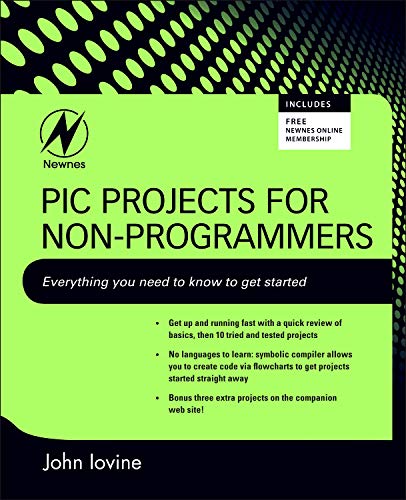
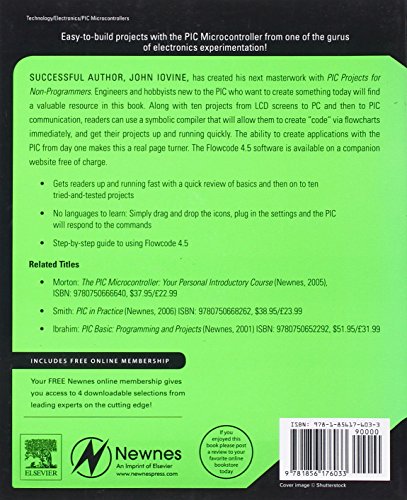
Full description not available
D**O
Flowcode Introduction, MicroPIC software development.
Excellent starter book. Gets you up and running fast! I've been programming PICs in Basic for years, but this Flowcode approach for development is unique and amazingly fast. I'm tempted to abandon conventional programming altogether. Wish there were sequels to this book; particularly focusing-in on some of the Flowcode advanced Component Macros (GPS, CAN, I2C, etc).
H**H
Hardware Programmers
The material in this book that was especially helpful was information on procurement and use of hardware programmers. I likedthe information on the implementing of Pic Microcontrollers for use in real world projects.
M**K
PIC Projects For Non-Programmers - A Good, But Mistitled, Learning Aid
PIC Projects for Non-Programmers is a great technical resource. It's somewhat mistitled. While titled "for non-programmers," the target audience, specifically Engineers, definitely has some programming as part of their job descriptions. Most people who want to undertake PIC projects have some programming background, or at least an interest in it.This book is centered around Flowcode, a functional flow chart program that allows you to logically map out the PIC programs actions without actually having to code it. That allows you to leverage or improve your understanding of how PIC programs should be organized without actually having to program. But I worry that without a focus on the underlying code, Flowcode may demotivate those who might otherwise take their knowledge further. Furthermore, they don't tell you that the version of Flowcode you are allowed to freely access with this book is limited. If you want a version for student or commercial use, you will have to pay premiums to get that functionality. So while the title implies this is a general text to help you learn the concepts behind PIC projects, it sometimes devolves into a "how-to" guide for Flowcode that seems designed to sell the premium licenses of the program.In some sense, this book could be a really good learning aid for a student interested in electronics and engineering. I would go so far as to say that this book could be used for middle school and high school technical programs, as well as rudimentary college courses. Because the projects are covered in a step-by-step fashion in Flowcode diagrams, students can easily get the benefits of understanding how PIC programs work. Even the related topics beyond Flowcode are covered simply enough that they are easy to follow and provide good foundations for further learning.PRACTICAL TOPICSChapter 8 provides a methodical, if not exhaustive, treatment of RS232 serial communications. Since many newer computers lack DB9 and serial ports, they also lightly cover USB to RS232 adapters. There is coverage of Hypterterminal/PuTTY and some of the basic programming needed to establish communications and control the MC.The last two chapters lightly touch upon analog to digital converters and power control from DC to AC. While all three of the final chapters are very light, they do provide enough background to do some basic stuff. Know that you will have to seek out further resources for these last three topics.THE HARDWAREOne of the things that I appreciated about this text is that, rather than following one microcontroller throughout the entire text, they cover a variety of models and components in the examples that are relevant to each chapter. They progress from the 16F84 PIC MC to the 16F88 PIC MC and the ECIO28 between chapters 3 and 4 when they cover binary LED output.And when they cover LCD outputs in chapter 7, they focus on the Hitachi 44780. Since most LCDs are compatible with it the examples are very relevant.This provides a better understanding of the concepts, even if it may not be quite as easy to mimic across different units. Still, many things do transfer over and I found the transitions between the various topics and components to be nearly seamless.CONCLUSIONThe included examples are methodical and logical. At times, the treatment is not as comprehensive as I would like it to be. But this is still a great resource. And the explanations are so simple and easy to follow, that the positives far outweigh the negatives. I recommend it.
B**.
For non-progammers, yes. For true beginners, maybe not.
This book is a good tutorial for newcomers to PIC programming, however, it's focus is on a single method. The author focuses solely on using a program called Flowcode. This basic version of Flowcode is free from its developers, so you can get starting without learning a "programming language". You will, of course, need to buy a PIC along with either a PIC Programmer, or a PIC that integrates the programmer. The PIC programmer is simply a device that loads the code (the output of Flowcode) to your PIC chip so that it can actually be used.The author goes into several options for selecting a PIC and programmer, and I found this to be a pretty good overview of what's available. I do think he could have done a better job in the beginning of the book introducing PICs, the functions of the various components, and maybe some basic electrical theory. He assumes you are new to programming, but does not assume that you are new to electrical circuits, components, etc. In all, you'll probably need to spend somewhere between and additional $40-$100 depending on your component selections to build the projects in this book.In this way, if you are a true beginner inspired by some projects you've seen on the internet, but otherwise have no electrical training, you'll probably need to do further research and reading to truly grasp what's going on here. The author does take everything step-by-step and gives details for the projects he's building, but that won't necessarily be enough for you to make your own projects successfully.I also wish the author had given a broader overview of other options such as the Arduino, which is also appealing to beginners and has similar programming software available for "non-programmers". This book essentially assumes you've already researched those options and ruled them out.All that said, he does well in describing how to use Flowcode and reviewing the various component options available to you. Additionally, his tutorials take you one step at a time from building the most basic projects with simple functions into more complex projects that integrate many different types of components.In summary, while this book lives up to its objective, it is narrowly focused one solution (not that that's necessarily a bad choice) and assumes that while you may be new to PIC programming, you have some basic electrical theory and circuit building skills under your belt.
G**Y
Ideal companion for Flowcode
Clear explanation of projects. Ideal companion for Flowcode. Several projects included, from winking led to LCD and stepper motors.Recommended reading for PIC programming.
R**N
PIC Projects for Non-Programmers useless and out of date
The book refers to flowcode 4.5 which is out of dateIt tells you how to download the flowcode program which dose not work because the book is out of dateThe majority of the book is of on use at allIt should not be on sale or state it refers to an obsolete version of flowcodeThe current version of flowcode is V6A total waste of money
A**M
Perfekte Einführung für Anfänger
Idealer Einstieg, wenn man vorher noch nie mit Microcontrollern gearbeitet hat. Durch die sehr detailierten Erklärungen zusammen mit den Bildern wird alles sehr leicht verständlich.
Trustpilot
Hace 2 semanas
Hace 2 semanas