We remain fully operational. Our teams are working around the clock to ensure your deliveries continue safely.

Descargar la aplicación


Servicios al cliente
Sobre nosotros
Copyright © 2025 Desertcart Holdings Limited
Descargar la aplicación
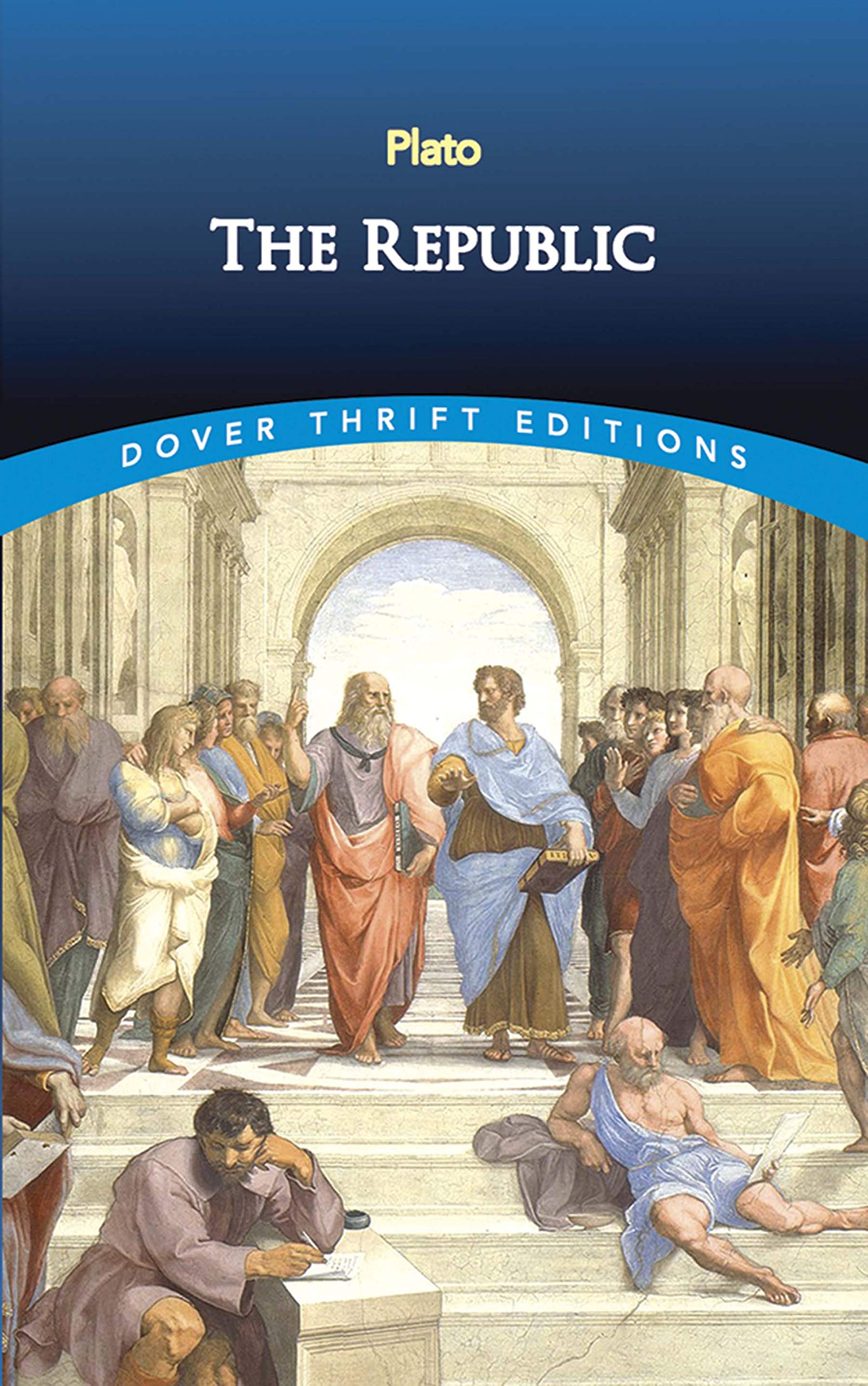
📚 Unlock the secrets of justice and society with Plato’s timeless masterpiece!
The Republic (Dover Thrift Editions) is a paperback edition of Plato’s seminal work exploring justice, ideal society, and philosophy. Featuring a classic cover depicting Plato and Socrates, this edition includes a detailed introduction with modern commentary, making it accessible for both newcomers and seasoned readers. Highly rated and ranked among top political philosophy books, it’s a cornerstone for anyone seeking to understand the roots of Western political thought.








| Best Sellers Rank | #150,076 in Books ( See Top 100 in Books ) #23 in Political Philosophy (Books) #54 in Ancient Greek & Roman Philosophy #67 in History & Theory of Politics |
| Customer Reviews | 4.4 4.4 out of 5 stars (5,398) |
| Dimensions | 5.25 x 0.75 x 8 inches |
| Edition | 1st |
| ISBN-10 | 0486411214 |
| ISBN-13 | 978-0486411217 |
| Item Weight | 2.31 pounds |
| Language | English |
| Print length | 288 pages |
| Publication date | April 18, 2000 |
| Publisher | Dover Publications |
| Reading age | 14 years and up |
C**F
Constantine who was only the Emperor of the East of the Roman Empire and the west had fallen Burn the great library of Alexandri
There are no lables for truth. However, the civilization we live in try to tell us that man's civilization is only 6 thousand yrs old & man 10 thousand. Da, not so! This is why they have gnosticism. Because how if man is only six thousand years old, do they have Solon Hermes, Pythagoras, Socraest, Plato, Aristoles, Hippocratics the physcian, just came out knowing all and more than the Doctors of the eary 20th centry. When it comes to Greek Myyhology shows the mistakes in history. After the Dark age know one knew how to read unless they where Royal bloodlines and yet not even, Constantine who was only the Emperor of the East of the Roman Empire and the west had fallen Burn the great library of Alexandria that was made to collect lost knowledge After the Myology of man & war of the Gods. It was a place that was a city of study we will never have such truth,! When Julis Ceaser burnd it and said how could one man conquer the world by 32 years and in the year 48 BC means that he must have at least been in his 50s which was old then. He said the only way to conquer the world was through igorence. Strip them of their knowledge and the truth of man. The 3rd Century Ad to push ignorence & muder those.Created by PtolemyI Soter who was a Macedonian General under Alexander THE GREAT! most Books were kept inPapyrus scrolls Unknowing how many books were taken out at a time 40,000 to 4000.000, at its height!Being burned down from the bloodlines that still rule the world today but mixed with the once Celts meaning the cent land. Name changed after general Germanius as lands to conquer! This burn threw the world into ignorence except the Romans & Hellenistic, = the Semetic taht went to the Creed of Nicien Council of Nicea 325 almost the same time as the Burning that lost all oneness of man. Constantine odered all priest of all belifes to rewrite the history of man, the book of Enoch was of part of Genesis, it spoke of man being very advanced and the war of man and the Gods. ????? Then they murdered all the advanced people and knowledge like Nikola Tesla had to be past down by word of mouth. I love Greek "Mythology, it should becalled lost facts. Pomei was a myth so was troy, now facts. thank the Greeks for holding this great knowledge, Egyptians are just like the rest even though Thoth who is Hermes tought them
M**K
Philosophy 101 - Justice: its menaing - Plato's Republic + Commentary
Yes, this edition has a long intro, but that intro is an argument by argument exegesis (explanation) of Plato's Republic with extensive quotes and commentary that lay clear its virtues and its flaws as seen from a modern perspective. The Republic is Plato's ideal society, but mustn't an ideal society be based on Justice? So first before we can realize an ideal society, we must achieve justice (or an understanding of it). This is where Plato starts. Socrates, acting as Plato's mouthpiece, asks, "What is Justice." Each guest answers starting with the host who gives the weakest but most obvious answer: Justice is doing good to your friends and evil to your enemies. Socrates examines and dismantels each argument as they are presented. What if the person you think is a friend is not your friend? What if you friend lends you a gun - he then goes crazy and asks for the gun back. The arguments get stronger in succession till Mr. T. proposes that "Might makes right." The tyrant makes justice synonymous with their interests: I am the state and your country right or wrong. On the question of whether justice = happiness: (from the commentary), Let a man do his duty first without asking whether he will be happy or not, happiness will be the inseparable accident which attends him. 'Seek ye first the kingdom of god and and his righteousness, and all thes things shall be added unto you.' Is the just person happy on the rack? Well, maybe not. If you wish to pay for a version with a nice index, feel free, but one of the other reveiws provides the chapter index location numbers. Now I admit I've only read to location 600, but when i've tried to read the Republic on my own it was somewhat perplexing. For those genuses who only need Einsten's equations to feret out the meaning of relativity the intro is superfluous, but to those like me whose intellignece is 'Shockingly limited' I recommend this edition, and the price is right. BTW I paid $$ for a Philosophy 101 course where this book was all we read and professor's lectures were substantially what is in this intro. Mike the K
J**E
Essential Philosophical Reading
Bought the hardcover, it's wrapped in nice pliable leather or faux-leather, the design you see in the product image is stamped into the front. The pages are not cut to length so you get the bumps where the groups of pages are bound. Overall surprisingly nice construction for the price. The translation is fine as long as you're capable of reading older Bible translations or similarly dated texts, I would personally prefer it this way rather than an overly simplified translation that loses the prose of the original. As far as Plato's own writing is concerned, I found his style of argumentation unconvincing, often relying on chains of equivalencies to prove his points, in many cases the end point has little or nothing to do with the beginning. With that said, I did find myself agreeing with a great deal of what he said, just not because of the way he argued the points. The influence of his work is obvious, I found that I was already subconsciously familiar with most of the concepts he presents through my time debating and reading essays written by my peers. To call this work "essential reading" would be a gross understatement, it has as much influence on modern thought as the Gospel or other well known works.
G**K
timeless and fascinating
To think so many supposedly modern “new” conflicts and struggles could be so timeless as to be discussed here is amazing to me. It makes you wonder if, somehow, thousands of years before Plato there was some yet another similar precursor work of art or philosophy or theory of mankind, and before that too, and so on to the very birth of our species.
N**Y
古くて新しい共和国。一読の要あると思うが、かなりの基礎教養ないとわけ分からん。ごめんなさい。
J**.
There’s a reason the Socratic method is used for teaching in American law schools. It fosters rational analysis. Of course, it doesn’t always take. Lol
N**S
The Republic is one of the most influential books of human history. It forms not just the basis of individual rights and responsibilities, but also, through its method of examination, sets out the structure of contemporary governance of states. The premise of the Republic is an examination of whether it is better to be just or unjust, which at the time, and even now, is not a given. Plato uses the state as a vehicle to examine the advantage of one over the other. Many different human constructions have claimed the legitimacy of their cause through their interpretation of the Republic. Hitler and the Nazi's used the examination of the virtuous state to justify their view, whilst most modern leaders also refer to its supporting theirs. It is therefore a devilishly difficult book to truly understand because of the sheer breadth of topics and issues that Plato introduces over the course of the dialogue. Readers must make sense not only of those issues in their own right but they must also understand them in relation to the larger themes and arguments of the work. For me the true value of the Republic is found in Books Five and Eight. In Five we see an analogous treatment of character or what Plato calls the soul. According to Plato the soul has three functions that correspond to the three parts of the soul: to rule oneself, to defend oneself, and to provide for one's bodily needs. Two virtues -- wisdom and courage -- follow directly from the functions of ruling and defending oneself. The other two virtues -- temperance and justice -- are holistic and enable the soul to perform all of its functions well. Plato uses the different functions that we would find in a city or state to demonstrate his point. What appealed to the Nazi's was Plato's focus on what we now call eugenics to make his point. He correctly states that each of us have a particular function, and service to the state. He states that only a very few have the capacity to rule a city or state, but not by birth, but rather through education and self-control. He therefore makes it clear that being born in a particular segment of society does not make a person just or virtuous, but rather their ability to rule themselves (porten sui). In Book Eight Plato examines the natures of different forms of government, and the nature of people that make up those governments (states). His examination of democracy is cutting, with thoughts such as "he grandly does democracy trample all the fine notions of virtue... and promoting to honour any one who professes to be the people's friend (think Trump, populism). Further, "These and other characteristics are proper to democracy, which is a charming form of government, full of variety and disorder, and dispensing a sort of equality to equals and unequals alike." And then he outlines what the individual in a democracy looks like "If any one says to him that some pleasures are the satisfactions of good and noble desires, and others of evil desires, and that he ought to use and honour some and chastise and master the others, whenever this is repeated to him he shakes his head and says that they are all alike, and that one is as good as another." This is what we now term equality, not understanding that things are not equal, but rather that some things are good and some are bad, saying that all things are equal and must be respected. "And above all, see how sensitive the citizens become, they chafe impatiently at the least touch of authority, and at length they cease to care even for the laws, written or unwritten, they will have no one over them". "And so tyranny naturally arises out of democracy, and the most aggravated form of tyranny and slavery out of the most extreme form of liberty." It is uncanny how Plato knew, in 325bc, what our democracies would look like, and what type of leader would arise. What is really frightening though is that he identifies that the next stage after democracy is tyranny. It is a very difficult book to fully understand, or in some cases to agree with, and I don't claim that I do, but there is much for us to learn from the attempt.
C**N
The Republic by Plato is a foundational work in Western philosophy that explores the nature of justice, the ideal society, and the philosopher's role within it. Plato envisions an ideal city-state governed by philosopher-kings, where people are divided into three classes: rulers, warriors, and producers. Each class has a specific role, and justice is achieved when each performs its function without interference. The work also introduces the allegory of the cave, which illustrates the difference between the world of appearances and the world of true knowledge.
G**Z
Great purchase well made and pages of good quality
Trustpilot
Hace 1 mes
Hace 2 días