We remain fully operational. Our teams are working around the clock to ensure your deliveries continue safely.

Descargar la aplicación


Servicios al cliente
Sobre nosotros
Copyright © 2025 Desertcart Holdings Limited
Descargar la aplicación


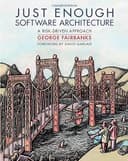

Just Enough Software Architecture: A Risk-Driven Approach [George H. Fairbanks] on desertcart.com. *FREE* shipping on qualifying offers. Just Enough Software Architecture: A Risk-Driven Approach Review: Great Intro to Architecture and Modeling Concepts - I rarely write reviews but really enjoyed this book! I thought it was so useful that we're using it as part of an internal book club at our company. Here's what I found useful for me and why I think it will be more useful if more people have read it (at our company). * It's an introduction to software architecture principles that many people without formal computer science backgrounds don't get without a lot of experience, it doesn't give you all of the answers but it highlights what you don't know and acts as a starting point for further research. WHY should we model and WHAT should we model. * It gives a really comprehensive look at architecture and modeling from a high level. It highlighted for me relevant concepts and terms that I've consistently encountered (and partially understood) in a very accessible way. * It offers an introduction to thinking about WHEN modeling makes sense. It gives you license to think about modeling on a spectrum, when I'd often thought of it as binary ("to model" or "not to model"). * Finally, for our team it further standardizes our vocabulary. It helps get people thinking and speaking on the same page, which is huge when you're frequently getting new hires (especially if they're not from standard comp sci backgrounds). This helps us get closer to understanding HOW modeling can improve our product and company. Review: solid book on risk-driven architecture - I thought overall that the book was pretty good. The author did a good job of laying the groundwork for how to determine when to stop designing your architecture and how to effectively accomplish the design with a special ear towards quality attributes. The author was a bit wordy towards the end, but given that those chapters were meant as a reference, I guess that's ok. You really only need to read the first part of the book to understand the methodology. For a deep dive into the concepts introduced in the first part, the second part is where it's at. It would have been nice if the author had used a single over-arching example throughout the book. The examples he gave, like the Yinzer system (a job-advertising social network), felt incomplete to me. For example, he started the Yinzer example to include the domain and design models, but switched to a new example, an email processing system, for the code model. In any case, after reading the book, I'm finding myself thinking about work projects at a higher level now. I'm definitely recognizing and applying architectural styles more consciously, instead of by accident. So, I would consider that a success in my mind and would recommend it to others!
| Customer Reviews | 4.3 4.3 out of 5 stars (79) |
| Dimensions | 7.75 x 1.25 x 9.5 inches |
| Edition | 1st |
| ISBN-10 | 0984618104 |
| ISBN-13 | 978-0984618101 |
| Item Weight | 2.06 pounds |
| Language | English |
| Print length | 376 pages |
| Publication date | August 30, 2010 |
| Publisher | Marshall & Brainerd |
L**R
Great Intro to Architecture and Modeling Concepts
I rarely write reviews but really enjoyed this book! I thought it was so useful that we're using it as part of an internal book club at our company. Here's what I found useful for me and why I think it will be more useful if more people have read it (at our company). * It's an introduction to software architecture principles that many people without formal computer science backgrounds don't get without a lot of experience, it doesn't give you all of the answers but it highlights what you don't know and acts as a starting point for further research. WHY should we model and WHAT should we model. * It gives a really comprehensive look at architecture and modeling from a high level. It highlighted for me relevant concepts and terms that I've consistently encountered (and partially understood) in a very accessible way. * It offers an introduction to thinking about WHEN modeling makes sense. It gives you license to think about modeling on a spectrum, when I'd often thought of it as binary ("to model" or "not to model"). * Finally, for our team it further standardizes our vocabulary. It helps get people thinking and speaking on the same page, which is huge when you're frequently getting new hires (especially if they're not from standard comp sci backgrounds). This helps us get closer to understanding HOW modeling can improve our product and company.
E**.
solid book on risk-driven architecture
I thought overall that the book was pretty good. The author did a good job of laying the groundwork for how to determine when to stop designing your architecture and how to effectively accomplish the design with a special ear towards quality attributes. The author was a bit wordy towards the end, but given that those chapters were meant as a reference, I guess that's ok. You really only need to read the first part of the book to understand the methodology. For a deep dive into the concepts introduced in the first part, the second part is where it's at. It would have been nice if the author had used a single over-arching example throughout the book. The examples he gave, like the Yinzer system (a job-advertising social network), felt incomplete to me. For example, he started the Yinzer example to include the domain and design models, but switched to a new example, an email processing system, for the code model. In any case, after reading the book, I'm finding myself thinking about work projects at a higher level now. I'm definitely recognizing and applying architectural styles more consciously, instead of by accident. So, I would consider that a success in my mind and would recommend it to others!
J**1
Review of Just enough architecture
So far I have read the first 7 chapters of the book. By what I have seen so far the book contents are interesting and relevant for architecture development. The book contains examples or case studies that makes it easier to understand the topics and see architecture development concepts in practice. The book has hardcover and seems to be a book that will last long if well taken care of. This book will definitely reside on my bookshelf of books of reference.
C**R
Fantastic. Talking sense to anxiety.
Pragmatism, thy name is software. I really appreciate the non-dogmatic approach to architecture. The simple premise that the more danger you are in the more tightly one wants to predict the outcome is simple. To those who build software every day it is a lovely antidote to those who value process over results and a lovely reality check to wave at those who value "organic" over everything else. Thanks
G**K
Just Enough is Plenty
Designing good software architecture is, in my opinion, undervalued. "Just Enough Software Architecture" gives specific and valuable evidence on the need and on the value of having appropriate architecture. Rather than the blind "document it all" attitude, it gives insight into how to decide what to architect and what to ignore. It's a very thoughtful and thought provoking look at the design process.
S**M
Completely different focus on architecture method - Risk based. In today's design risk of failure or security breaches etc are very high. This book helps in identifying them through risk based design methods.
G**B
As a software architecture learner, this book is very good for the purpose.
E**A
Até que ponto discutir a arquitetura de um sistema? Onde começa o "design"? Esse tipo de questão atormenta os profissionais da área. A pressão para se começar o trabalho de execução de um sistema conflita com a necessidade de estudar o problema o suficiente para tomar boas decisões macro que permitam uma execução tranquila. O autor sugere um modelo que basicamente pode ser resumido a: invista em arquitetura nos projetos de maior risco. Os primeiros capítulos, onde o autor define o seu modelo, são bons. A parte onde ele tenta exemplificar com um estudo de caso, nem tanto. É uma boa tentativa para um assunto onde os livros normalmente são muito genéricos. Eu trabalho com isso, tenho um grande conhecimento tácito adquirido, mas acho muito difícil colocar no papel regras que fundamentem o que eu penso. Então entendo a dificuldade dos autores. Mas ainda não achei o livro definitivo sobre o assunto.
H**Y
One of the best books about software architecture. The content is very rich and easy to follow.
ま**う
リスクに応じたJust Enoughなソフトウェアアークテクチャというコンセプトが素敵です。 アーキテクトは普段からこういうことを無意識に意識しているんじゃないかと思うのですが、 これを読みながら今一度 自分の中のアーキテクト的な思考回路を整理できました。 なぜアーキテクト(本書ではもっと広くデベロパーと位置付けていますが)はアーキテクチャを意識するべきなのか。 アーキテクチャがシステム全体の中で果たす役割は何なのか。が明瞭に述べられています。 アジャイル、ウォータフォールといった特定の開発プロセスに依存しないレベルで語られているため 読む人にとっては抽象的過ぎるという印象を持たれるかもしれません。よって経験の少ない初心者向けとは言えません。 また実際のソフトウェア開発の現場で使える即効薬ではありません。ソフトウェア開発プロジェクト全体を通しての リスクとは何なのかをそれぞれの当事者が深く考えるきっかけにする第一歩に過ぎないかもしれません。 しかし、書かれている内容はとても本質的なのでシステム開発に関わる全ての人に読んでほしいと思います。
Trustpilot
Hace 3 semanas
Hace 1 mes